GC Porcelain Manufacturing Process: From Clay to Finished Product
The quality of a porcelain dinner plate is determined long before it reaches the kiln. It is determined by the composition of the clay body, the precision of the forming process, the chemistry of the glaze, and the control of the firing profile. Understanding how porcelain tableware is actually manufactured—not the simplified version, but the specific technical decisions that separate a hotel-grade piece from a budget commercial plate—is directly useful for buyers who need to evaluate supplier capability and quality claims. This is GC Porcelain’s manufacturing process, step by step.
Key Takeaways
- The most important quality variable in porcelain manufacturing is clay body composition: the ratio of kaolin, feldspar, and silica determines whiteness, translucency, strength, and thermal stability before any other process begins.
- Firing temperature for vitrified porcelain ranges from 1,260–1,380°C depending on clay body composition; pieces that do not reach full vitrification (water absorption >0.5%) are not hotel-grade.
- GC Porcelain maintains National First Grade Laboratory status for food safety testing, with in-house capability to verify ISO 6486-1 cadmium and lead leaching compliance.
- The standard defect allowance for hotel-grade tableware is ≤ 1.5% across a production run; premium orders can specify tighter tolerances.
- Decoration timing matters for durability: under-glaze decoration is co-fired at full production temperature and is chemically bonded to the glaze layer; on-glaze decoration fires at lower temperature and sits on top of the glaze—with different durability implications for commercial dishwasher environments.
- From raw clay to shipped order, a standard OEM production run takes 45–75 days depending on decoration complexity and order volume.
Step 1: Clay Body Preparation
Porcelain begins with a clay body formula—a precise blend of three primary materials:
|
Material |
Role |
Typical Proportion |
|---|---|---|
|
Kaolin (高岭土) |
Primary clay; provides plasticity and white color |
40–55% |
|
Feldspar (长石) |
Flux; lowers vitrification temperature; contributes translucency |
25–35% |
|
Silica / Quartz (石英) |
Structural filler; controls thermal expansion |
15–25% |
The specific proportions are factory proprietary and vary by product line. GC Porcelain’s hotel-grade body formulas are developed to achieve a whiteness index (WI) ≥ 85 and water absorption ≤ 0.3% at full firing—specifications that exceed the minimum for commercial tableware and approach state banquet ware standards.
Raw Material Sourcing and Quality Control
Not all kaolin is equivalent. Chinese kaolin from Jingdezhen, Jiangxi Province has a different mineral composition than kaolin from Hebei or Guangdong, producing different whiteness, plasticity, and firing behavior. GC Porcelain sources kaolin from verified suppliers with consistent mineral analysis documentation—whiteness, plasticity index, particle size distribution—because batch-to-batch raw material variation is the most common source of glaze color inconsistency in hotel tableware production.
The raw materials are ball-milled with water to produce a fine slip (suspension), which is then filter-pressed to remove excess water and produce plastic body, or spray-dried to produce granular body for pressing. Slip casting operations use the fluid slip directly.
Step 2: Forming and Shaping
GC Porcelain uses three primary forming methods, matched to the shape requirements of each product:
Jiggering and Jolleying (Wheel-Spinning)
The primary method for round forms—dinner plates, bowls, saucers. A ball of clay is placed on a rotating mold (jiggering for flatware; jolleying for hollowware), and a forming tool profiles the shape while the mold defines the outer surface. This is a high-speed production method suitable for large runs of consistent round shapes.
Pressure Casting
Plastic body is pressed between two porous plaster or polymer molds under hydraulic pressure. Pressure casting produces consistent wall thickness and density, and is used for irregular shapes, rectangular pieces, and forms that require precise dimensional tolerance. Pressure-cast pieces have better consistency than hand-jiggered pieces for complex shapes.
Slip Casting
Fluid slip is poured into porous plaster molds, which absorb water from the slip and form a clay wall of increasing thickness. Excess slip is poured out when the desired wall thickness is reached. Slip casting is used for complex hollow forms, handles, and sculptural elements. It is slower than mechanical forming but enables shapes that cannot be mechanically formed.
Custom Mold Development for OEM Orders
OEM orders requiring new shapes begin with mold development: CAD design review, master model production, and plaster or polymer production mold fabrication. Standard mold development for a new dinner plate shape takes 4–6 weeks and produces a set of production molds with a service life of 150–300 pieces per mold before replacement. This mold cycle cost is the tooling charge on OEM quotes.
Step 3: Drying and Trimming
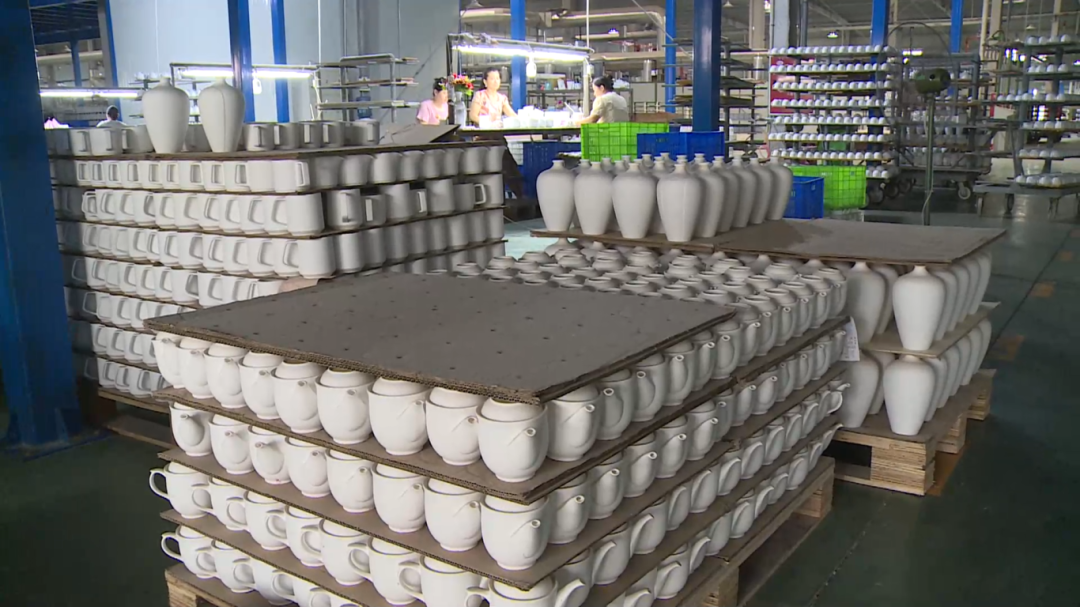
Freshly formed ware contains 18–22% moisture and is mechanically fragile. Pieces are dried in controlled-humidity chambers at 40–60°C for 12–24 hours to reduce moisture to 2–4% before bisque firing. Drying too fast causes cracking; drying too slow extends production cycle time.
After drying to leather-hard stage, pieces are trimmed—excess clay from mold parting lines is removed, foot rings are refined, and surface defects from forming are addressed. This is the last point in the process where clay body defects can be corrected before firing makes them permanent.
Step 4: Bisque Firing
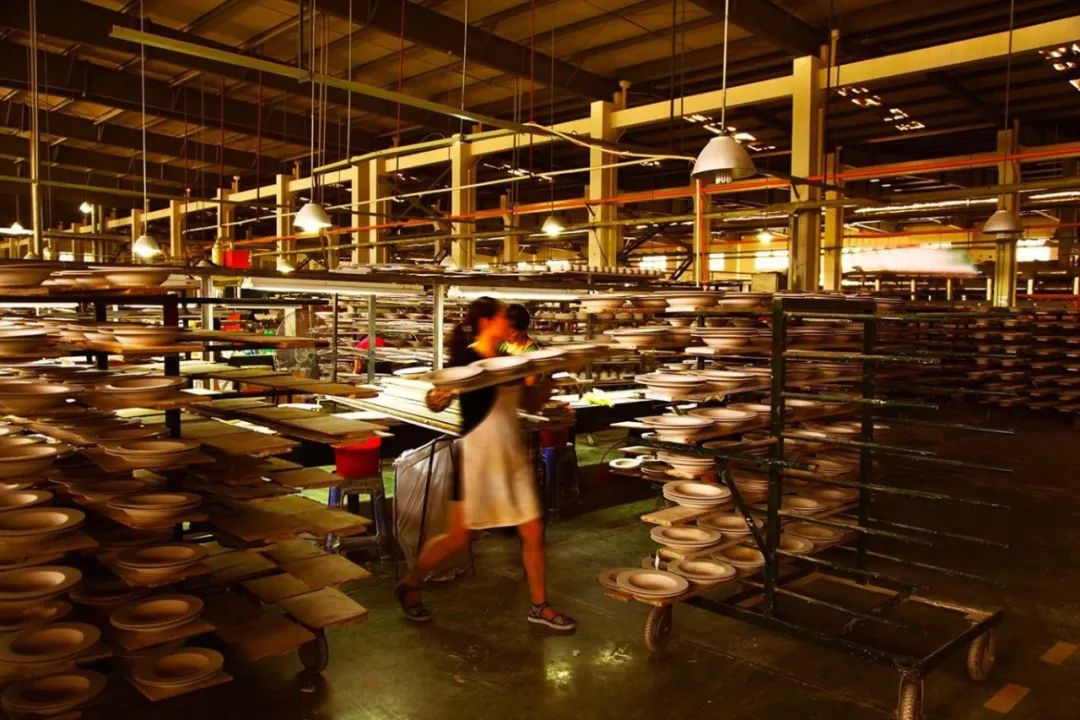
Dried green ware is loaded into tunnel kilns and fired at 900–1,050°C for the bisque (first) firing. This firing burns out organic matter and water from the clay body, producing a porous, hard-but-still-absorbent bisque form.
Bisque firing serves two functions: it strengthens the piece enough for glazing handling, and it creates the absorptive surface that allows glaze to adhere uniformly. Bisque ware has a characteristic chalky white appearance—it is not yet vitrified and will absorb water readily if submerged.
GC Porcelain loads tunnel kilns at precise intervals to maintain consistent thermal history across every piece. Temperature variation within the kiln cross-section of more than ±10°C at bisque stage produces uneven glaze absorption and downstream color inconsistency.
Step 5: Glazing
Glaze is a glass-forming coating applied to bisque ware before the final firing. It provides the smooth, hygienic, aesthetic surface of finished porcelain. GC Porcelain uses three application methods:
Dipping: The piece is submerged in a glaze bath and withdrawn at controlled speed. Used for bowls and irregular shapes where spray coverage is uneven.
Spraying: Glaze is spray-applied in a controlled booth environment. Used for flatware and shapes where consistent coating thickness is critical.
Waterfall glazing: A curtain of glaze flows over the piece on a conveyor. Used for high-volume flatware production with consistent glaze thickness requirements.
Glaze Chemistry and Transparency
GC Porcelain’s standard hotel-grade glaze is a feldspar-silica-calcium formula that fires to a hard, transparent glossy surface at full firing temperature. The glaze is colorless in its fired state, allowing the white clay body color to show through. This is the high-gloss white characteristic of premium vitrified porcelain.
Colored glazes for specialty products use metal oxide colorants: cobalt for blue, copper for celadon green, iron for celadon or amber, manganese for brown or purple. Each colorant has specific firing temperature requirements and interacts differently with kiln atmosphere—color development in colored glaze work requires careful kiln atmosphere control.
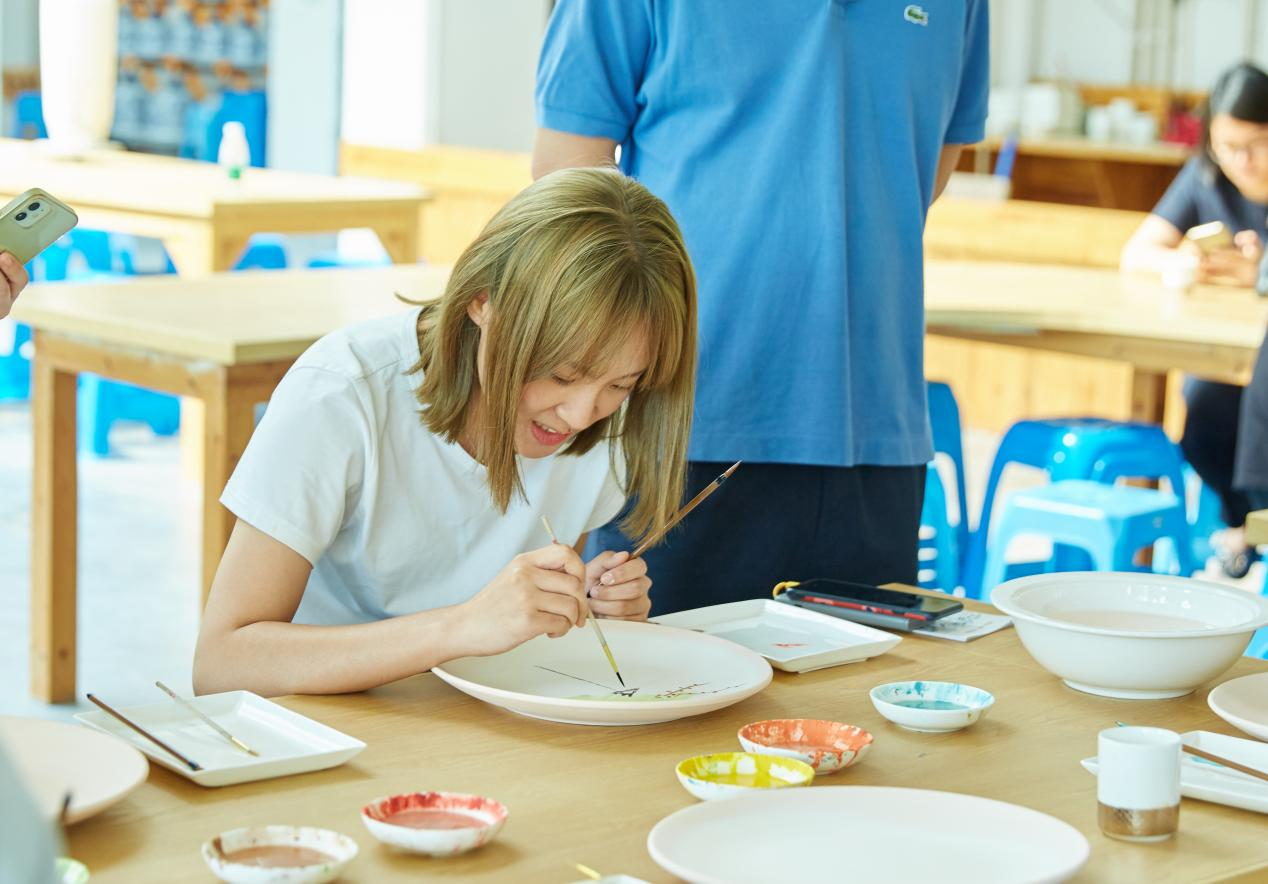
Step 6: Decoration
Decoration is applied either before the final glaze firing (under-glaze) or after (on-glaze). This timing distinction has significant implications for durability.
Under-Glaze Decoration
Decorative pigments are applied to the bisque surface before glazing. The glaze layer is then applied over the decoration, and both are fired together at full production temperature (1,260–1,380°C). The result: the decoration is chemically fused within the glaze layer, not on top of it.
Durability implication: Under-glaze decoration is permanent and dishwasher-stable. Commercial dishwasher detergents, even at high concentrations, cannot affect decoration that is embedded within the glaze matrix. GC Porcelain’s hotel-grade custom logo decoration uses under-glaze application by default.
On-Glaze Decoration (Overglaze Enamel)
Decorative enamels are applied to the fully fired glazed surface and fired at a lower temperature (750–900°C) in a separate decoration firing. The enamel fuses to the glaze surface but is not embedded within it.
Durability implication: On-glaze decoration can show wear over time under aggressive commercial dishwasher conditions—particularly on heavily used surfaces like plate rims where stacking contact occurs. It is appropriate for display pieces, occasional-use service, and fine dining contexts where handling is careful. It is not recommended for high-volume commercial use without explicit testing.
Important specification note: When requesting custom logo decoration on hotel tableware, specify “under-glaze decal printing, co-fired at production temperature” in your RFQ. Without this specification, a factory may quote on-glaze—which costs $0.30–$0.60 less per piece but produces a less durable result.
Step 7: Glost Firing (Final Kiln)
The final kiln firing—called the glost firing—is the most critical step in the manufacturing process. This is when the clay body vitrifies, the glaze melts and fuses, and the piece achieves its final physical properties.
GC Porcelain’s vitrified hotel-grade porcelain fires at 1,280–1,320°C in a 24–36 hour tunnel kiln cycle. The firing profile (temperature ramp rate, peak temperature duration, cooling rate) is computer-controlled and monitored continuously. Deviation of more than ±5°C from the specified profile produces color variation, glaze crawl, or warping defects.
Firing Atmosphere
The kiln atmosphere during firing affects glaze color. Oxidizing atmosphere (excess oxygen) produces clean, bright colors. Reducing atmosphere (oxygen-deficient) creates the blue-green celadon colors characteristic of Song-dynasty aesthetics. GC Porcelain’s hotel-grade production operates in oxidizing atmosphere for consistent white and color-consistent results.
Vitrification: The Critical Quality Threshold
At peak firing temperature, feldspar in the clay body melts partially, filling the spaces between clay particles and creating a dense, glassy matrix. This process—vitrification—produces the key properties of hotel-grade porcelain:
- Water absorption ≤ 0.3% (non-porous; hygienic for food contact)
- Flexural strength ≥ 120 MPa (chip and break resistance)
- Thermal shock resistance: withstands 160°C differential
Pieces that do not reach full vitrification—due to underfiring or body formulation issues—will have water absorption >0.5% and are not suitable for hotel use. They will show staining, odor absorption, and reduced chip resistance under commercial conditions.
Step 8: Quality Control and Sorting
Every piece produced by GC Porcelain passes through a multi-stage quality control process before export.
Visual Inspection
Trained inspectors examine each piece under standardized lighting conditions for: surface defects (pinholes, crawl, blistering), dimensional compliance (rim diameter ±1mm, height ±1.5mm), color consistency (compared against approved reference sample), decoration alignment and completeness, and edge chip damage from kiln loading.
Physical Testing
Batch samples from each production run are tested against specification:
|
Test |
Standard |
GC Porcelain Specification |
|---|---|---|
|
Water absorption |
ISO 10545-3 |
≤ 0.3% |
|
Thermal shock resistance |
ISO 10545-9 |
≥ 160°C differential |
|
Lead leaching |
ISO 6486-1 |
≤ 0.5 mg/L |
|
Cadmium leaching |
ISO 6486-1 |
≤ 0.05 mg/L |
|
Glaze hardness |
Vickers |
≥ 550 HV |
GC Porcelain’s National First Grade Laboratory status means these tests are conducted in-house with equipment calibrated to national standards—not outsourced to third-party labs for routine batch testing.
Sorting and Grading
After inspection, pieces are graded:
- Grade A: Meets all specifications; suitable for hotel export
- Grade B: Minor aesthetic imperfections within specification tolerance; suitable for domestic commercial market
- Reject: Below specification; not shipped
The Grade A rate for GC Porcelain hotel-grade production runs ≥ 97%—meaning a defect and downgrade rate below 3%. This figure is available for customer review during factory audits.
For an understanding of how to evaluate these quality figures across multiple suppliers, see our manufacturer evaluation guide.
How Manufacturing Decisions Affect Procurement
Understanding the manufacturing process answers several questions that arise in B2B tableware procurement:
Why does the same shape cost different prices at different factories? Because clay body formulation, kiln temperature, and firing duration are different. A factory firing at 1,220°C with a lower-kaolin body produces a piece that looks similar to a piece fired at 1,300°C with higher-grade kaolin—until you measure water absorption, test chip resistance, or run it through 500 commercial dishwasher cycles.
Why is under-glaze decoration more expensive? Because it must be applied before glazing and fired at full production temperature. This adds one handling step and requires heat-stable pigments that cost more than on-glaze enamels. The durability difference justifies the cost difference in high-volume hotel contexts.
What does “National First Grade Laboratory” mean? It means in-house testing capability verified by national standards authorities. For a buyer, it means test reports with specific numerical values can be generated from the production facility—not compiled from outsourced testing that may not reflect actual production.
For a full guide to the OEM development process from specification brief to first shipment, see our custom ceramic tableware guide.
FAQ
How long does it take to manufacture a custom porcelain order?
For standard OEM orders with existing shapes and custom decoration: 30–45 days from confirmed purchase order to factory-ready shipment. For orders requiring new mold development: 60–90 days from approved specification (including 4–6 weeks for mold fabrication and 2–3 weeks for production). These lead times assume approved design files are provided without revision cycles. Physical sample review and approval adds 2–3 weeks to the timeline if conducted before bulk production.
What is vitrification and why does it matter?
Vitrification is the process by which feldspar in the clay body melts at high temperature and fills the spaces between clay particles, creating a dense, glassy, non-porous matrix. A fully vitrified porcelain piece has water absorption ≤ 0.5%—it cannot absorb water, bacteria, odors, or staining agents. Hotel-grade tableware requires full vitrification; pieces with water absorption above 0.5% are considered under-fired and unsuitable for commercial food service. When qualifying a supplier, request water absorption test data alongside whiteness index figures.
What is the difference between under-glaze and on-glaze decoration?
Under-glaze decoration is applied before the glaze layer and co-fired at full production temperature (1,260–1,380°C), embedding the decoration chemically within the glaze matrix—it cannot be worn away by dishwashing. On-glaze (overglaze) decoration is applied after the glaze firing and fired at lower temperature (750–900°C), sitting on top of the glaze surface. On-glaze is less durable under commercial dishwasher conditions and is appropriate for fine dining or display contexts rather than high-volume hotel restaurant use.
Can I visit the GC Porcelain factory?
Yes. GC Porcelain offers factory visits for qualified buyers. Video walkthroughs of the production line can be arranged remotely with 48 hours’ notice. Physical factory visits can be scheduled through the sales team. Factory visit access includes the forming area, kiln room, decoration studio, and quality control laboratory. Contact us to arrange a visit or video tour.
Custom Solutions Available
Our technical experts are always ready to assist you in finding the perfect customized solution for your dinnerware needs.