Lead & Cadmium Leaching in Ceramic Tableware: What B2B Buyers Need to Know
When sourcing custom ceramic dinnerware, appearance is only part of the equation. The more important question is whether the product is safe for food contact under real-use conditions. One of the most critical indicators is lead and cadmium leaching, which measures how much soluble Pb²⁺ and Cd²⁺ can migrate from the ceramic surface into acidic food simulants. For importers, wholesalers, hospitality brands, and private-label buyers, this is a direct reflection of product safety, glaze stability, and supplier process control. Source
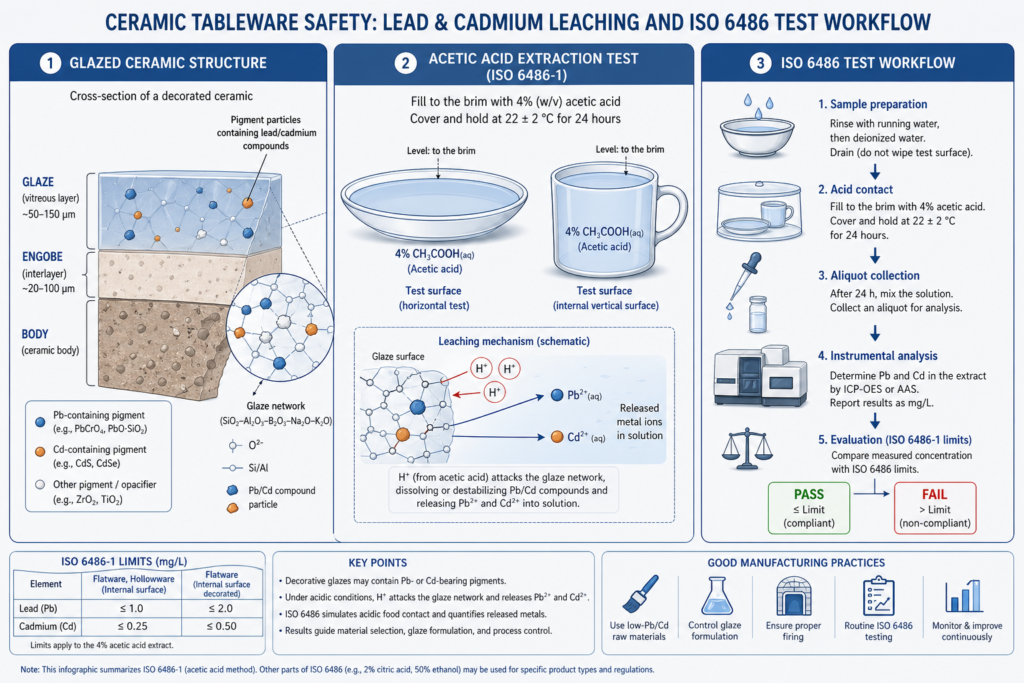
Technical illustration of glaze structure, acid extraction, and laboratory workflow for ceramic tableware safety testing.
What Is Lead & Cadmium Leaching in Ceramic Tableware
Lead & cadmium leaching refers to the release of lead or cadmium from the food-contact surface of ceramic ware when it is exposed to an acidic solution under controlled laboratory conditions. In the ceramic tableware industry, this is not simply a raw material issue. It is a finished-product performance issue influenced by glaze formulation, pigment selection, decoration method, firing maturity, and surface integrity. A product can contain trace amounts of regulated elements and still pass if the glaze matrix is chemically stable. On the other hand, a decorated item can fail if the decal, rim band, or overglaze layer is not durable enough. Source
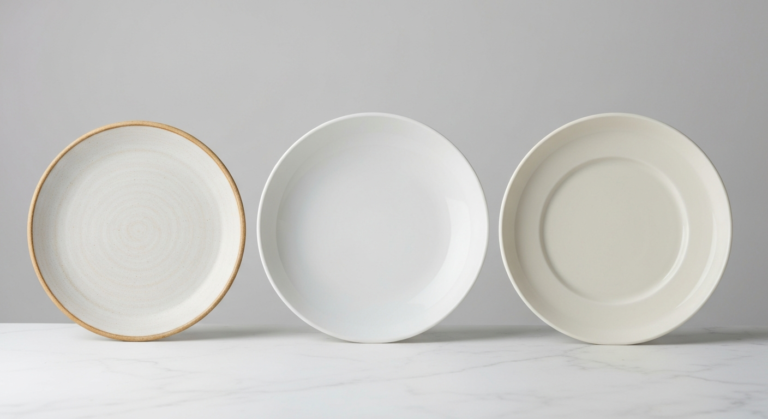
For custom dinnerware projects, this matters even more because every artwork change can affect compliance. A plain white plate may pass easily, while the same shape with a low-fire logo decal, metallic rim, or bright red overglaze may show a completely different migration result. That is why experienced buyers ask for test reports for the final decorated SKU, not just the blank body.
Why This Matters to Importers and Private Label Buyers
From a B2B sourcing perspective, lead and cadmium leaching is one of the clearest ways to assess whether a factory truly understands food-contact ceramics. A supplier that controls this well is usually stronger in raw material management, kiln consistency, decoration validation, and compliance documentation.
Food Safety and Brand Risk
Lead exposure can affect multiple body systems, and the WHO states that there is no level of exposure to lead known to be without harmful effects. WHO also notes that lead exposure was linked to more than 1.5 million deaths globally in 2021, primarily due to cardiovascular effects. Cadmium is also a serious health concern, with toxic effects on the kidneys, skeletal system, and respiratory system, and it is classified by WHO as a human carcinogen. Source Source
For brands, the issue is not only regulatory. It is also commercial. A failed migration test can trigger shipment delays, customs detention, product recalls, retailer penalties, and long-term reputational damage. In competitive tableware markets, buyers increasingly prefer suppliers that can provide compliance evidence early in the sampling phase.
Supplier Capability Indicator
A good supplier will not only say “our products are lead-free” or “we can pass EU and FDA tests.” They should also be able to explain:
- which exact body-glaze-decoration combination was tested,
- which standard was applied,
- whether the test was performed on the final production version,
- and what internal controls are used to keep results stable from batch to batch.
If a factory cannot answer these questions clearly, the risk is usually higher.
How the Acid Extraction Test Works
The standard test method for ceramic food-contact ware uses 4% (v/v) acetic acid as the extraction solution. This acidic medium is designed to simulate contact with acidic foods and beverages such as fruit juice, vinegar-based foods, tomato products, or wine. Under the EU ceramic directive, testing is typically carried out at 22 ± 2°C for 24 ± 0.5 hours. Source
Why Acetic Acid Is Used
Acetic acid provides a reproducible acidic environment that challenges the glaze surface in a controlled way. If the glaze network is weak, unstable, cracked, underfired, or poorly fused with the decoration layer, hydrogen ions can attack the surface and release metal ions into solution.
A simplified dissociation reaction is shown below:
CH3COOH ⇆ CH3COO– + H+
The released hydrogen ions can then attack metal-oxygen bonds in the glaze matrix:
≡Si–O–Pb–O–Si≡ + 2H+ → 2(≡Si–OH) + Pb2+
≡Si–O–Cd–O–Si≡ + 2H+ → 2(≡Si–OH) + Cd2+
These equations show the core mechanism: acid attacks the glaze network, and soluble metal ions migrate into the liquid phase.
Why Light Control Matters in Cadmium Testing
Cadmium pigments, especially cadmium sulfide-based systems, can be sensitive to light during testing. FDA and EU methods note that cadmium extraction should be protected from light because cadmium sulfide (CdS) can oxidize into more soluble forms, which may distort test results. Source Source
A simplified reaction is:
CdS + 2O2 → CdSO4
This is a detail that professional labs and serious suppliers should understand. It also shows why migration testing is not just a paperwork exercise.
How ISO 6486-1:2019 Applies to Ceramic Tableware
ISO 6486-1:2019 specifies the test method for measuring lead and cadmium release from ceramic ware, glass-ceramic ware, and glass dinnerware intended for food contact. It is applicable to products used for the preparation, cooking, serving, and storage of food and beverages, excluding vitreous and porcelain enamel articles covered by another standard. Source
One important point is that repeat-use articles are tested three times with fresh extraction solution, and the third extraction result is used for conformity assessment. This is important because it reflects the stabilized release behavior of reusable ware rather than relying only on a first-contact result. The standard also identifies ICP-MS as the reference analytical method, while methods such as FAAS, GFAAS, and ICP-OES may also be used when accuracy requirements are met. Source
Main International Standards and Regulatory References
Global buyers should understand that lead and cadmium compliance is not governed by one single rule worldwide. Different markets may apply different frameworks.
Council Directive 84/500/EEC
The EU ceramic articles directive defines migration limits for different ceramic categories and sets the testing conditions using 4% acetic acid, 22 ± 2°C, and 24 ± 0.5 hours. It classifies articles into three main groups:
- Category 1: articles that cannot be filled, and fillable articles with internal depth not exceeding 25 mm
- Lead: 0.8 mg/dm²
- Cadmium: 0.07 mg/dm²
- Category 2: all other fillable articles
- Lead: 4.0 mg/L
- Cadmium: 0.3 mg/L
- Category 3: cooking ware, packaging and storage vessels with capacity above 3 liters
- Lead: 1.5 mg/L
- Cadmium: 0.1 mg/L Source
FDA Guidance for Ceramic Foodware
For the U.S. market, FDA maintains category-based action levels for ceramicware. For lead, FDA CPG Sec. 545.450 lists the following action levels:
- Flatware: 3.0 μg/mL
- Small hollowware other than cups and mugs: 2.0 μg/mL
- Cups/mugs: 0.5 μg/mL
- Large hollowware other than pitchers: 1.0 μg/mL
- Pitchers: 0.5 μg/mL Source
FDA also describes extraction conditions and analytical workflows in its Elemental Analysis Manual, including ICP-OES for determining cadmium and lead leached from ceramic foodware. Source
ECHA and Declaration of Compliance
For ceramic products placed on the EU market, a Declaration of Compliance is required at the marketing stages up to and including retail for applicable ceramic articles not yet in contact with food. Manufacturers or importers must also be able to provide supporting test documentation to competent authorities on request. Source
For buyers, this is very important. A compliant supplier should be able to provide both the test report and the supporting compliance documentation, not only a verbal claim.
What Causes High Lead or Cadmium Leaching
Lead and cadmium migration problems are usually caused by poor material selection or weak process control rather than by one isolated issue.
Unstable Glaze or Decoration Chemistry
Some glaze systems, low-fire decorations, metallic trims, and bright overglaze colors may present higher risk if they are not properly formulated or fired. Decorations are often the weakest point in custom dinnerware projects because branding, logo decals, and color bands are frequently added after the base glaze has already been optimized.
Underfiring or Poor Kiln Control
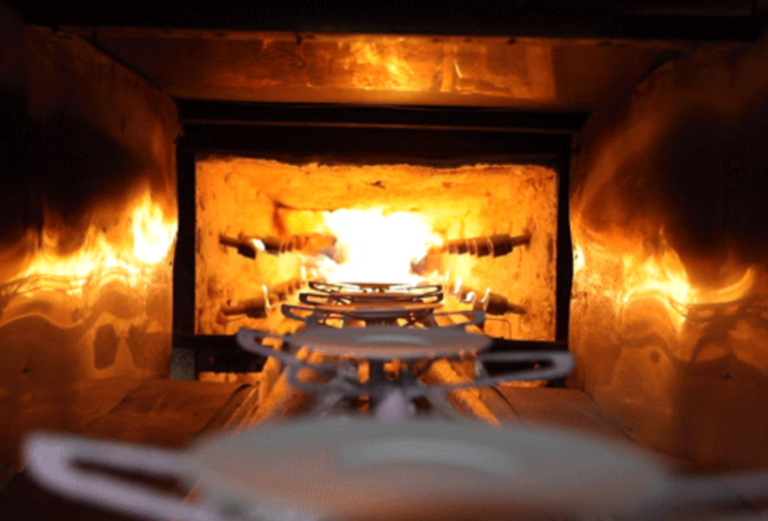
If the glaze is not fully matured, the glass network may remain chemically weak and more vulnerable to acid attack. Uneven kiln temperature, poor soak time, unstable firing cycles, or inconsistent loading can all create variation from batch to batch.
Surface Defects
Surface defects can increase the effective exposure area and create pathways for acidic ingress. Common examples include:
- Pinholes
- Crazing
- Crawling
- Blistering
- Devitrification
- Decal edge attack
Among these, crazing is particularly important because the crack network allows acidic solution to penetrate the glaze more easily, which can increase the migration risk.
How Good Factories Control This Risk
Reliable ceramic manufacturers do not treat migration testing as a final checkpoint only. They control it throughout the development and production process.
Typical Factory Control Measures
A capable supplier will usually implement the following practices:
- approved raw material lists for food-contact glazes and decorations,
- tighter control of high-risk colors such as red, orange, yellow, black, and metallic systems,
- glaze slurry control for density, viscosity, and fineness,
- firing validation for each body-glaze-decoration combination,
- kiln temperature mapping and routine calibration,
- internal acid extraction screening before third-party submission,
- and revalidation after any artwork, material, or process change.
What Buyers Should Ask
When qualifying a ceramic tableware supplier, ask these questions:
- Was the test performed on the final decorated product?
- Which standard was used: ISO, EU, or FDA?
- Was the ware tested as a repeat-use article where applicable?
- Which analytical method was used: ICP-MS, ICP-OES, FAAS, or GFAAS?
- Can the supplier provide the Declaration of Compliance for EU-bound goods?
- What happens if glaze, decal, pigment, or firing conditions change?
A factory that answers these questions clearly is usually much more reliable than one that only sends a generic pass report.
How to Use This Metric to Judge Supplier Quality
For B2B buyers, the most useful question is not simply whether the supplier passed. The better question is how far below the limit they passed.
If a supplier consistently delivers results well below the applicable limits, that usually indicates stronger process control and better safety margin. If results are always close to the threshold, the supplier may be technically compliant today but operationally fragile tomorrow.
Strong Supplier Signals
A strong supplier typically provides:
- test reports for the exact SKU,
- separate validation for decorated versions,
- evidence of internal QA screening,
- traceable raw material approval records,
- documented change-control procedures,
- and market-specific compliance documentation.
Weak Supplier Signals
A high-risk supplier often shows signs such as:
- only testing blank white ware,
- reusing old reports for new artwork,
- vague claims like “lead-free” without technical detail,
- no explanation of test standards,
- or no supporting documentation for EU or U.S. market compliance.
Final Takeaway for B2B Tableware Buyers
In the ceramic dinnerware business, lead and cadmium leaching is more than a lab result. It is a practical indicator of food safety, glaze durability, process consistency, and supplier professionalism. For importers and private-label buyers, understanding this topic helps reduce compliance risk, protect brand reputation, and choose suppliers with real technical depth.
If you are sourcing custom ceramic tableware for retail, hospitality, or promotional programs, always request migration testing based on the finished product, the target market standard, and the final decoration design. That is the only reliable way to evaluate whether a supplier can support long-term, scalable, and compliant business.
Sources
- ISO 6486-1:2019
- ISO 6486-2
- Council Directive 84/500/EEC
- ECHA Ceramic Articles Directive
- FDA Elemental Analysis Manual 4.6
- FDA CPG Sec. 545.450
- FDA CPG Sec. 545.400
- WHO Lead Poisoning and Health
- WHO Cadmium
Custom Solutions Available
Our technical experts are always ready to assist you in finding the perfect customized solution for your dinnerware needs.