Matte Glaze for Custom Tableware: Microcrystal Diffuse Reflection, Process Control, Defects & Buyer Guide
For premium custom tableware, matte glaze is more than a surface style. It is a carefully engineered glaze system that delivers a soft, low-gloss visual effect while still meeting requirements for durability, cleanability, and food-contact safety. In high-quality ceramic production, a true matte glaze is not simply an underfired or rough-looking coating. In most technical cases, it is a fully matured glaze layer whose appearance is created by microcrystal precipitation, controlled surface topography, or both. These microstructural features scatter incoming light and convert mirror-like reflection into diffuse reflection. Source Source
For B2B buyers, this matters because matte glaze directly affects brand aesthetics, tactile feel, stain resistance, cutlery marking, dishwasher performance, and compliance risk. A supplier that can mass-produce stable matte glaze usually has much stronger ceramic engineering capability than one that only offers a beautiful pre-production sample.
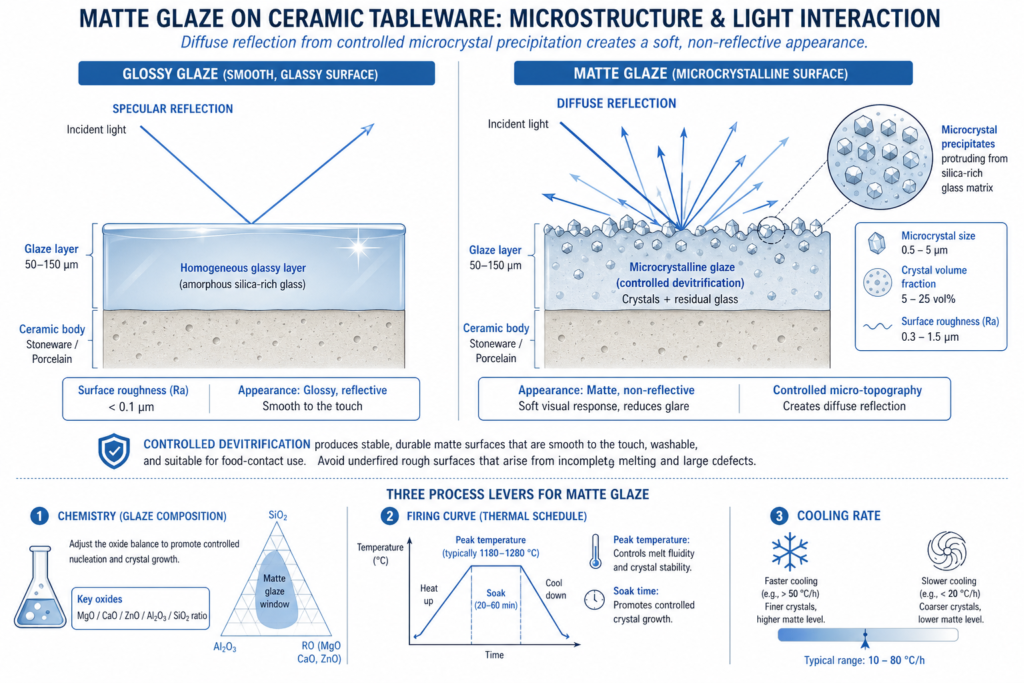
Image: Technical illustration showing how glossy glaze creates specular reflection while matte glaze uses microcrystals and surface micro-topography to generate diffuse reflection. Source
What Is Matte Glaze in Ceramic Tableware?
In ceramic engineering, matte glaze refers to a glaze surface that reflects light in many directions rather than in one mirror-like direction. A glossy glaze appears shiny because its surface is optically smooth. A matte glaze appears soft because its microstructure disrupts that smooth optical behavior. Ceramic Arts Network explains that visible light is roughly in the 390-750 nm wavelength range, and when glaze surface features become large enough relative to that scale, reflected light begins to scatter rather than remain coherent. Source
In the custom dinnerware industry, matte glaze is especially important for:
Premium brand positioning
Matte finishes are widely used in hospitality, upscale retail, and private-label collections because they create a modern, understated, architectural look. They also photograph well under studio lighting because they reduce glare.
Tactile experience
A well-designed matte glaze can feel silky and refined, not abrasive. This is a key selling point for restaurant ware, hotel ware, and giftware.
Product differentiation
In a crowded OEM/ODM market, matte glaze helps buyers build collections that look more exclusive than standard glossy dinnerware.
Functional performance
A supplier that truly understands matte glaze should also control chemical durability, stain resistance, and glaze fit. Without that control, matte ware can quickly develop cutlery marks, crazing, staining, or poor dishwasher durability.
The Science Behind Matte Glaze: Why Microcrystals Create Diffuse Reflection
The core technical principle of matte glaze is light scattering.
Specular reflection vs. diffuse reflection
A glossy glaze reflects incoming light in a controlled, mirror-like direction. A matte glaze reflects the same incoming light in multiple directions because the surface is no longer optically smooth at the microscopic level. This scattering is what creates the soft visual appearance associated with matte ceramics. Source
A simplified gloss relationship can be written as:
GU = 100 × Rs / Rstd
Where:
- GU = gloss units
- Rs = specular reflectance of the sample
- Rstd = specular reflectance of the black glass standard
This is consistent with the measurement principle described in ASTM D523, which evaluates surface gloss using 20°, 60°, and 85° geometries. For low-gloss ceramic surfaces, 60° and 85° readings are especially useful in production quality control. Source
Microcrystal precipitation and devitrification
The most common mechanism behind matte glaze is devitrification. This means that after the glaze has melted, it does not remain fully glassy during cooling. Instead, part of the melt crystallizes into fine phases distributed within or near the glaze surface. Ceramic Arts Network identifies devitrification during cooling as the most common origin of matte glazes, while Digitalfire notes that many matte glazes are essentially glossy glazes whose surfaces have been overtaken by microcrystals. Source Source
Typical matte-related crystalline phases include:
- Wollastonite
- Anorthite
- Diopside
Representative reactions can be expressed as:
CaO + SiO2 → CaSiO3
CaO + Al2O3 + 2SiO2 → CaAl2Si2O8
CaO + MgO + 2SiO2 → CaMgSi2O6
Digitalfire specifically points out that many CaO-Al2O3-SiO2 rich matte systems are associated with anorthite formation, especially in high-calcium matte glazes. Source
Why a matte glaze can still feel smooth
A common misconception is that matte glaze must feel rough. In reality, a high-quality matte glaze can feel extremely smooth because the topography is controlled at the micro-scale and the glaze layer remains dense and mature. Ceramic Arts Network notes that some matte glazes may even feel smoother than glossy surfaces because the reduced real contact area can lower frictional drag at the fingertip interface. Source
A common surface roughness expression is:
Ra = (1 / L) ∫0L |z(x)| dx
Where:
- Ra = arithmetic average roughness
- L = sampling length
- z(x) = surface height deviation from the mean line
For tableware suppliers, gloss value alone is not enough. Roughness, stain pickup, and cutlery marking behavior should also be evaluated.
How Matte Glaze Is Controlled in the Factory
In industrial ceramic production, matte glaze success depends on chemistry, firing, application, and body-glaze fit.
Glaze chemistry design
A functional matte glaze must balance four things:
- enough melt fluidity for full glaze maturity
- enough crystal-driving oxides to create the matte effect
- enough silica and alumina for durability
- a thermal expansion fit compatible with the body
Typical oxide systems used in matte tableware glaze development include combinations rich in:
- CaO
- MgO
- Al2O3
- SiO2
- sometimes controlled ZnO or boron-bearing frits
The engineering objective is not just to create low gloss. It is to create low gloss with stable food-use performance. Digitalfire notes that developing a matte glaze that is also functional is not easy, because many random glaze compositions naturally tend toward glossy behavior instead of controlled matte crystallization. Source
Firing curve control
Cooling rate is often the decisive variable. Ceramic Arts Network explains that some matte glazes appear matte in one kiln but more glossy in another because the glaze depends on the cooling schedule for crystal formation. Source
In practical factory operation, process control usually focuses on:
Peak temperature
The glaze must fully mature. If peak temperature is too low, the surface may look matte but actually be underfired and unstable.
Soak time
A short soak may trap gases or leave incompletely melted materials. A proper soak improves glaze homogeneity.
Controlled cooling through the crystallization window
The glaze must cool slowly enough to allow microcrystal nucleation and growth, but not so slowly that large, harsh, or chemically weak surface crystals develop.
Typical production windows for stoneware or porcelain matte glaze systems may include:
- fired glaze thickness: 120-250 μm
- peak firing temperature: 1180-1280°C
- soak time: 10-25 minutes
- crystallization control zone: 1050-850°C
- cooling rate in that zone: 60-180°C/hour
- target 60° gloss: below 10 GU for full matte, or 10-25 GU for satin matte
These are practical industry ranges, not universal values. Every body-glaze-kiln combination must be validated by testing.
Application control
Even a well-designed matte glaze can fail if slurry control is poor. Stable suppliers should manage:
- specific gravity
- viscosity
- particle size distribution
- application thickness
- drying behavior
- edge coverage
- adhesion to bisque or green body
If the glaze is too thick, it may blister, crawl, or create excessive crystal build-up. If it is too thin, it may become patchy or unexpectedly glossy on rims and raised areas.
Body-glaze fit
A matte glaze must also fit the ceramic body thermally. Otherwise, production may suffer from crazing or shivering.
A simplified thermal stress relationship can be expressed as:
σ ≈ Eg / (1 – νg) × (αb – αg) × ΔT
Where:
- σ = thermal stress in the glaze
- Eg = glaze elastic modulus
- νg = glaze Poisson’s ratio
- αb = body thermal expansion coefficient
- αg = glaze thermal expansion coefficient
- ΔT = cooling interval
If glaze expansion is too high relative to the body, crazing may occur. If it is too low, shivering may appear.
Common Matte Glaze Defects in Tableware Production
Matte glaze is visually attractive, but it is also one of the most defect-sensitive glaze categories.
Pinholes
Pinholes are small surface openings left by gases escaping too late in firing. In matte glaze, they are especially problematic because they trap dirt, reduce hygiene perception, and damage the premium look of the ware.
Crazing
Crazing is a fine crack network caused mainly by thermal expansion mismatch between glaze and body. On matte surfaces, it may be less visible at first, but it can lead to staining and reduced long-term durability.
Crawling
Crawling happens when glaze pulls away during firing, leaving bare patches. This is often linked to poor application, excessive shrinkage, dust contamination, or insufficient wetting.
Dry or chalky surface
This is one of the biggest risks in low-end matte development. A surface can look modern in photos but feel abrasive in use because it is underfired or structurally weak. A true matte glaze should be low-gloss yet still mature and dense. Source Source
Cutlery marking
A matte glaze with excessive micro-roughness or unstable surface crystals can show grey knife marks quickly. This is a major complaint point for restaurants and hotel buyers.
Poor stain resistance
If the glaze surface is too open or chemically weak, coffee, tea, curry, tomato sauce, or detergent exposure may leave visible staining or dull the finish over time.
Why B2B Buyers Should Pay Close Attention to Matte Glaze
For importers, brand owners, wholesalers, and hospitality buyers, matte glaze is a strong indicator of supplier capability.
Matte glaze is a process capability test
Any factory can produce one attractive sample. Fewer factories can keep the same matte surface stable across:
- multiple kiln loads
- repeated body batches
- different shapes such as coupe plates, bowls, and mugs
- mass production under export inspection
Matte glaze affects commercial risk
A matte glaze that is not fully engineered may lead to:
- higher breakage claims due to glaze-body stress
- more customer complaints about knife marks
- reduced repeat order rate
- failed lab tests for migration or dishwasher performance
- inconsistent color and gloss between lots
What buyers should ask suppliers
A serious matte glaze supplier should be able to answer these questions clearly:
What is your target gloss range?
Ask for 60° gloss data and sampling locations.
How do you control the matte effect?
The supplier should explain whether the finish comes mainly from chemistry, controlled cooling, or both.
What is the fired glaze thickness range?
Thickness strongly affects both appearance and defect risk.
How do you test cutlery marking and dishwasher durability?
These are critical for horeca and retail tableware.
Do you have current food-contact test reports?
The reports should match the actual body, glaze, and decoration system being sold.
If a supplier can describe matte glaze only in aesthetic terms and cannot explain the process window, that is a warning sign.
Matte Glaze and International Standards
For export tableware, matte glaze must be supported by compliance documentation, not just appearance approval.
ASTM D523 for gloss measurement
ASTM D523 covers specular gloss measurement of nonmetallic surfaces using 20°, 60°, and 85° geometries. It is highly useful for turning subjective finish descriptions into measurable production standards. Source
ISO 6486-1:2019 for lead and cadmium release testing
ISO 6486-1:2019 specifies the test method for release of lead and cadmium from ceramic ware, glass-ceramic ware, and glass dinnerware intended for food contact. This is a key reference for international tableware compliance. Source
FDA requirements and ceramicware guidance
The U.S. FDA identifies ceramicware as a potential source of lead exposure if poorly controlled and links guidance relevant to ceramic food-contact products, including 21 CFR 109.16 for ornamental and decorative ceramicware. Source
According to FDA CPG Sec. 545.450, action guidance for lead in leaching solution includes:
- flatware: 3.0 μg/mL average of 6 units
- small hollowware: 2.0 μg/mL
- cups/mugs: 0.5 μg/mL
- large hollowware: 1.0 μg/mL
- pitchers: 0.5 μg/mL
These values are highly relevant for U.S.-bound dinnerware programs. Source
EU Directive 84/500/EEC
EU Directive 84/500/EEC applies to ceramic articles intended to come into contact with food and addresses the migration of lead and cadmium from those articles. It is directly relevant to glazed and decorated ceramic tableware exported into Europe. Source
How to Evaluate a Matte Glaze Tableware Supplier
If you are sourcing matte glaze dinnerware, a capable supplier should provide more than a sample photo and a price list.
A stronger supplier can usually provide:
- gloss measurement report
- fired glaze thickness range
- migration test reports
- dishwasher resistance data
- cutlery marking test results
- lot-to-lot consistency standards
- clear explanation of process control
In B2B sourcing, matte glaze is often one of the best ways to distinguish a true manufacturing partner from a trading-only vendor with limited technical control.
Final Thoughts
A good matte glaze is not just about visual softness. It is a controlled glass-ceramic surface system built around microstructure, firing science, body-glaze fit, and compliance management.
For buyers, the takeaway is simple: if a supplier can mass-produce a matte glaze that is consistent, stain-resistant, smooth to the touch, and compliant with destination-market standards, that supplier is likely operating at a much higher technical level than average.
If you are developing a new custom matte glaze tableware collection, it is worth treating glaze finish selection not as a styling step, but as an engineering and sourcing decision.
References
- Ceramic Arts Network, matte glaze optics and devitrification
https://ceramicartsnetwork.org/ceramics-monthly/ceramics-monthly-article/Archive-Article-Techno-File-Matte-Glazes - Ceramic Materials Workshop, true matte glaze vs underfired matte-looking surfaces
https://ceramicmaterialsworkshop.com/matte-vs-crystalline-glazes-busting-the-myth-of-the-matte-glaze/ - Digitalfire, crystallization in matte glazes
https://digitalfire.com/glossary/crystallization - Digitalfire, anorthite in calcium matte systems
https://digitalfire.com/mineral/anorthite - ASTM D523, specular gloss measurement
https://www.astm.org/d0523-14r18.html - ISO 6486-1:2019, lead and cadmium release test method
https://www.iso.org/standard/67561.html - U.S. FDA, lead in food and foodwares
https://www.fda.gov/food/environmental-contaminants-food/lead-food-and-foodwares - FDA CPG Sec. 545.450, lead contamination guidance for ceramicware
https://www.fda.gov/files/inspections%2C%20compliance%2C%20enforcement%2C%20and%20criminal%20investigations/published/CPG-Sec.-545.450-Pottery-%28Ceramics%29–Import-and-Domestic—Lead-Contamination.pdf - EU Directive 84/500/EEC, ceramic articles in contact with food
https://eur-lex.europa.eu/eli/dir/1984/500/oj
Custom Solutions Available
Our technical experts are always ready to assist you in finding the perfect customized solution for your dinnerware needs.