Precious Metal Decoration in Custom Dinnerware: Gold & Platinum Adhesion, Process Control, and Buyer Guide
Introduction
In the custom tableware industry, precious metal decoration usually refers to the application of gold, platinum, or related noble-metal systems onto an already glazed and fired ceramic surface, followed by a lower-temperature refiring step. In commercial terms, this process upgrades dinnerware from standard functional ware into premium, hospitality-grade, ceremonial, or brand-signature products.
For B2B buyers, however, the real issue is not only appearance. A gold rim or platinum band may look luxurious on day one, but if the fired layer has poor adhesion, it can quickly fail in dishwashing, transport, or repeated handling. That is why precious metal decoration is one of the clearest indicators of a ceramic supplier’s process capability, glaze control, and quality consistency. Source
What Is Precious Metal Decoration in Custom Tableware?
A technical definition
In ceramic dinnerware manufacturing, precious metal decoration is an overglaze decoration process in which a metal-bearing liquid, paste, or decal is applied on top of a previously fired glaze and then fired again at a lower temperature. Typical systems include:
- Bright gold
- Bright platinum
- Matt or burnish gold/platinum
- Lusters
Digitalfire describes liquid bright precious-metal colors as micro-thin coatings, mainly based on gold, platinum, and palladium, applied onto already fired glaze surfaces. Source
Why it matters in the custom dinnerware business
For OEM and ODM tableware projects, precious metal decoration has direct commercial value because it influences:
- Perceived luxury level
- Brand identity and logo presentation
- Giftability and hospitality positioning
- Retail margin potential
- Supplier qualification for high-end projects
In short, precious metal decoration is not just a decorative extra. It is a surface-engineering process that affects both brand value and product durability.
How Gold and Platinum Decoration Actually Adhere to Ceramic Glaze
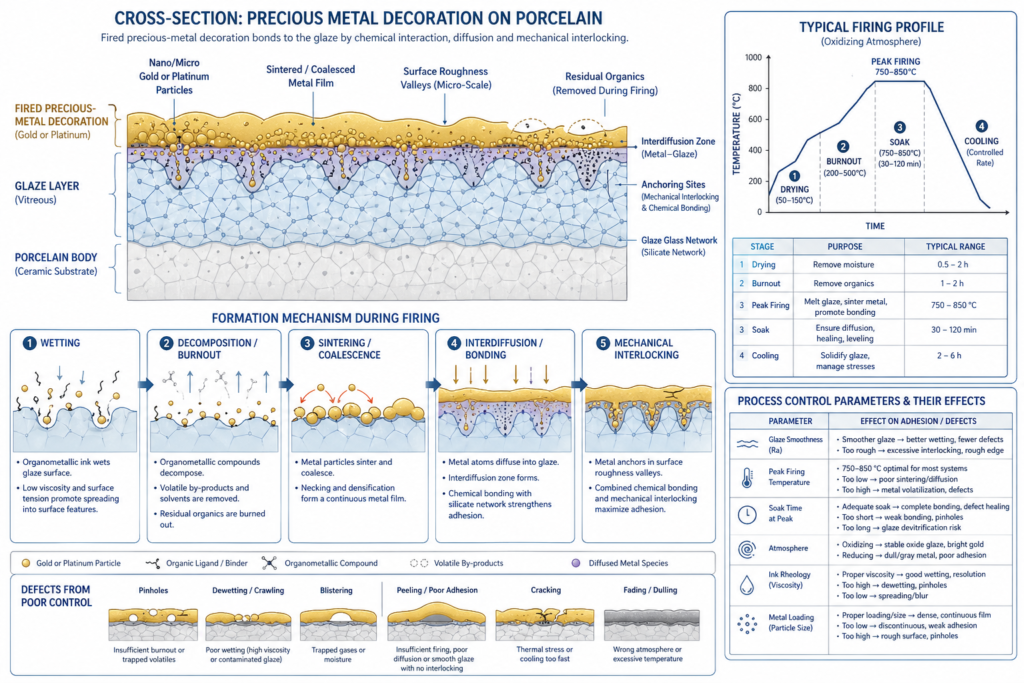
Precious metal decoration is a reactive metallo-organic system
Modern bright gold systems are not simple metallic paints. Heraeus describes bright gold preparations as metal-organic materials based on precious metals dissolved in resin and oil systems. These systems are engineered for different ceramic and glass substrates, and final performance depends on the interaction between the decoration chemistry, the glaze surface, and the firing profile. Source Source
A simplified schematic decomposition during firing can be expressed as:
M–OR / M–SR + O2 → M0 + CO2 + H2O + SOx
where M represents Au or Pt, and the exact commercial precursor chemistry depends on the supplier formulation
This means the final metallic layer is formed during firing, not before it.
The first step is wetting of the glaze surface
Before the decoration can bond well, the liquid must properly spread across the glaze. Poor wetting causes line breakage, uneven thickness, edge beading, and weak adhesion zones.
The wetting relationship can be described by Young’s equation:
γSV = γSL + γLV cos θ
Where:
γ<sub>SV</sub>= solid-vapor interfacial energyγ<sub>SL</sub>= solid-liquid interfacial energyγ<sub>LV</sub>= liquid-vapor surface tensionθ= contact angle
From a factory perspective, a lower contact angle usually means better spreading and a more uniform decoration layer.
The critical adhesion mechanism: burn-off, film formation, and anchoring
The microscopic adhesion of gold or platinum decoration to glaze is not caused by one single bond. It is a hybrid mechanism involving:
- surface wetting
- organic burnout
- metal nucleation and coalescence
- limited interfacial diffusion
- mechanical interlocking within the glaze skin
- stress accommodation during cooling
Heraeus states that during the first heating phase, the organic components burn off and this process is completed at approximately 400°C. They also emphasize that slow temperature increase, enough oxygen, and sufficient ventilation are decisive for decoration quality. Source
A simple diffusion model can be expressed as:
x ≈ √(2Dt)
Where:
x= diffusion depthD= diffusion coefficientt= time
This helps explain why insufficient heatwork leads to weak adhesion, while excessive heatwork may introduce other defects.
Nanoscale evidence behind adhesion
A nanoscale study on ceramic luster layers found that gold-bearing surface layers on glazed ceramics can form a distinct near-surface zone approximately 0.3–0.8 µm thick, with dispersed gold nanoparticles embedded in the glaze. The study explains that metal ions can diffuse into the top glaze during firing and then nucleate and grow into particles near the surface. Although historical lusterware is not identical to modern industrial bright gold tableware decoration, the underlying interfacial principle is highly relevant: strong decorative performance depends on controlled near-surface interaction between metal species and glaze. Source
Process Control in the Factory: What Determines Decoration Quality?
Surface cleanliness and moisture control
One of the most underestimated causes of poor adhesion is contamination. Dust, fingerprints, and invisible condensation can severely disturb firing quality. Heraeus warns that ware transferred from a cold store to a warm decoration room may develop a thin condensation film that later causes pinholes or other firing defects. Source
For this reason, professional suppliers only decorate ware that is:
- clean
- dry
- free from handling residue
- fully temperature-equilibrated
Application thickness and material handling
Heraeus reports a typical material consumption of approximately 0.15–0.30 g per 100 cm² for certain bright gold systems. If the applied layer is too thin, the final decoration may appear weak, reddish, or lacking metallic character. If the layer is too thick, it may crack, blister, or turn matte after firing. Source
Factories also need to control:
- open-pot time
- solvent evaporation
- viscosity drift
- print sharpness
- thinning ratio for spray application
For spraying, Heraeus indicates that about 30% thinner may be required for certain systems. Source
Firing range and thermal profile
For porcelain decoration, Heraeus lists a typical firing range of 780–880°C for certain bright gold systems, while some bone china applications may run from 750–880°C depending on product grade. Source Source
The most critical firing control points include:
1. Controlled ramp through the 200–400°C zone
This is the key burnout stage. If heating is too fast, organics may not burn off cleanly, which can create pinholes, blistering, or poor film formation.
2. Oxidizing atmosphere and ventilation
Heraeus specifically notes that sufficient oxygen and ventilation are necessary for high-quality fired precious metal decoration. Source
3. Stable soak and consistent heatwork
Decoration quality depends not only on peak temperature but also on soak time and total thermal cycle.
Common Defects in Precious Metal Decoration
Pinholes
Pinholes are among the most common precious metal decoration defects. They are usually related to:
- surface moisture
- contamination
- trapped decomposition gases
- unstable burnout conditions
This defect is often an early sign that interfacial continuity has already been compromised. Source
Blistering and bubbling
Blistering usually indicates excessive layer thickness or incomplete burnout of the organic vehicle. If gases cannot escape before the film densifies, localized bubbles form in the decoration.
Weak red-tone or underfired gold appearance
When the layer is too thin or underfired, the result may be a reddish or weak metallic look rather than a rich gold appearance. This is one of the clearest signs that either deposit weight or heatwork is outside the correct process window. Source
Chipping, flaking, or low scratch resistance
If the gold or platinum edge chips off easily, the root cause is often one of the following:
- contaminated glaze surface
- too low firing temperature
- poor thickness control
- mismatch between decoration system and glaze chemistry
Heraeus identifies low firing temperature and incorrect layer thickness as direct causes of low mechanical resistance. Source
Tarnishing
Some precious-metal systems may contain silver. Under unfavorable conditions, silver-bearing decorations can tarnish over time, especially in the presence of humidity, heat, sulfur sources, or problematic packaging materials such as cardboard. Heraeus specifically notes the risk of silver sulphide formation in such systems. Source
A simplified reaction can be written as:
4Ag + O2 + 2H2S → 2Ag2S + 2H2O
Crazing in decorated ware
Crazing is mainly a glaze-body compatibility issue, but third-fire decoration can expose a marginal glaze system. ASTM C554 covers thermal-shock evaluation of crazing resistance in fired glazed ceramic whitewares and explains that inadequate thermal resistance often results in visible craze patterns. Source
Why B2B Buyers Should Pay Close Attention to Precious Metal Decoration
It reveals the supplier’s real process capability
A supplier that can consistently deliver a brilliant, well-adhered, dishwasher-stable gold or platinum rim is usually a supplier with strong control over:
- glaze consistency
- third-fire processing
- kiln atmosphere
- defect prevention
- packaging compatibility
- final inspection standards
In other words, precious metal decoration is one of the best visible indicators of deeper manufacturing competence.
It affects product claims and after-sales risk
If the decoration is unstable, the buyer may face:
- customer complaints
- retail returns
- failed hospitality use
- damage during export packing
- brand image loss
For importers and private-label brands, this is especially important when selling into premium channels.
It influences market positioning
Well-executed gold and platinum decoration supports premium positioning in:
- luxury home dining
- hotel and restaurant projects
- wedding and gifting collections
- ceremonial and festive tableware
- branded corporate giftware
How to Evaluate a Ceramic Supplier for Gold or Platinum Decoration
Questions buyers should ask
Before placing an order, ask the supplier:
- What exact precious metal system is being used?
- Is it bright gold, bright platinum, matt gold, or luster?
- What firing range is validated for this specific body and glaze?
- Is the decoration intended for giftware or repeated-use tableware?
- What dishwasher resistance data is available?
- What are the main defect controls for pinholes, flaking, and tarnish?
- Can the supplier provide food-contact compliance documentation for the finished ware?
What test evidence matters
Dishwasher durability
Heraeus states that under its internal convention, a decoration surviving 500 washing cycles can be considered dishwasher durable, while 1000 cycles may be considered dishwasher resistant. Source
EN 12875-1 is also widely used as a reference method for machine dishwashing resistance of domestic articles, including ceramics. SGS summarizes this standard as a method to assess combined chemical, thermal, and mechanical stress during repeated dishwashing cycles. Source
Adhesion screening
ASTM D3359 is a tape-test method used to assess adhesion of relatively ductile coatings. It was originally developed for coatings on metallic substrates, so it is best used in ceramic decoration as a comparative internal screen rather than as the only acceptance standard. Source
International Standards and Compliance
ISO 6486 for lead and cadmium release
For ceramic ware intended to contact food, ISO 6486-1:2019 specifies a test method for the release of lead and cadmium from ceramic ware, glass ceramic ware, and glass dinnerware. This standard is essential for exporters selling into regulated markets. Source
FDA ceramicware guidance
The U.S. FDA provides ceramicware compliance policy guidance for lead and cadmium contamination. For lead, the FDA lists action levels by product category, such as:
- Flatware: average of 6 units above 3.0 µg/mL
- Small hollowware other than cups/mugs: any 1 of 6 units above 2.0 µg/mL
- Cups/mugs: any 1 of 6 units above 0.5 µg/mL
- Large hollowware other than pitchers: any 1 of 6 units above 1.0 µg/mL
- Pitchers: any 1 of 6 units above 0.5 µg/mL Source
The FDA also maintains separate guidance for cadmium contamination in ceramicware. Source
Conclusion
In the custom dinnerware industry, precious metal decoration is much more than a visual luxury. It is a technically demanding overglaze process in which wetting, burnout, interfacial anchoring, firing control, and durability testing all work together to determine final performance.
For B2B buyers, the quality of gold or platinum decoration is one of the most practical ways to judge whether a ceramic supplier truly understands premium manufacturing. A decoration that remains brilliant, adherent, and stable after dishwashing and handling is not just beautiful—it is proof of process discipline.
If you are sourcing custom porcelain dinnerware with gold or platinum decoration, always evaluate not only the look of the final piece, but also the supplier’s firing data, defect control standards, durability testing, and compliance documentation.
References
- Heraeus Precious Metals – Bright Golds
https://www.heraeus-precious-metals.com/en/products-solutions/category/precious-coatings/bright-golds/ - Heraeus Precious Metals – Lusters
https://www.heraeus-precious-metals.com/en/products-solutions/category/precious-coatings/lusters/ - Digitalfire – Liquid Bright Colors
https://digitalfire.com/glossary/liquid+bright+colors - Heraeus Datasheet – GG NZ-10% H
https://pim.heraeus.com/datasheets/HPM/PC/Heraeus-HPM-PC_GG_NZ-10_H_Datasheet-EN.pdf - Heraeus Datasheet – GG 501/2/11 H
https://pim.heraeus.com/datasheets/HPM/PC/Heraeus-HPM-PC_GG_501_2_11_H_Datasheet-EN.pdf - Heraeus Datasheet – GG 1046-12% H
https://pim.heraeus.com/datasheets/HPM/PC/Heraeus-HPM-PC_GG_1046-12_H_Datasheet-EN.pdf - ISO 6486-1:2019
https://www.iso.org/obp/ui/en/#!iso:std:67561:en - FDA Lead Contamination Guidance for Ceramicware
https://www.fda.gov/files/inspections%2C%20compliance%2C%20enforcement%2C%20and%20criminal%20investigations/published/CPG-Sec.-545.450-Pottery-%28Ceramics%29–Import-and-Domestic—Lead-Contamination.pdf - FDA Cadmium Contamination Guidance for Ceramicware
https://www.fda.gov/regulatory-information/search-fda-guidance-documents/cpg-sec-545400-pottery-ceramics-import-and-domestic-cadmium-contamination - SGS Summary of EN 12875-1
https://www.sgs.com/en-hk/news/2015/12/sgs-new-testing-service-dishwasher-resistance-en-12875-part-1 - ASTM D3359
https://www.astm.org/d3359-23.html - ASTM C554
https://www.astm.org/c0554-93r20.html - Nanoscale Engineering of Gold Particles in Ceramic Luster
https://pmc.ncbi.nlm.nih.gov/articles/PMC9170166/
Custom Solutions Available
Our technical experts are always ready to assist you in finding the perfect customized solution for your dinnerware needs.