Slip Casting in Ceramic Tableware: Why Plaster Mold Water Absorption Matters
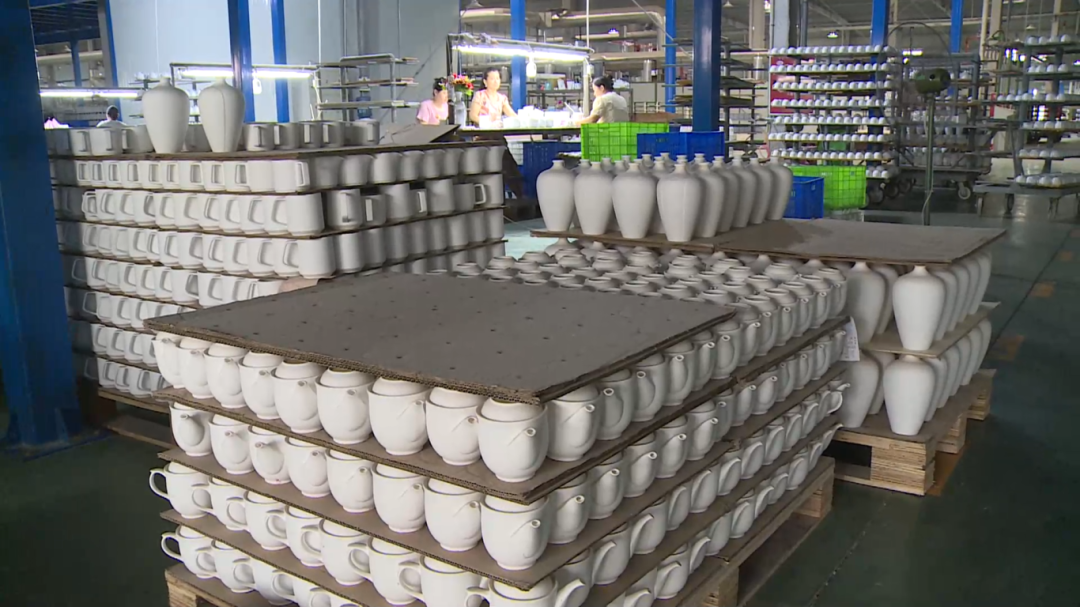
For buyers sourcing custom ceramic tableware, the forming process is not just a factory detail. It affects product consistency, shape precision, glaze performance, lead time, and defect rate. Among all forming methods used in the industry, slip casting remains one of the most important for complex shapes, hollowware, embossed surfaces, and customized designs.
In technical terms, slip casting is a capillary-driven filtration process. A liquid ceramic slurry, known as casting slip, is poured into a porous plaster mold. The mold absorbs water from the slip, leaving ceramic particles behind to build a wall layer against the mold surface. That wall later becomes the green body of a mug, bowl, plate, teapot, or other custom tableware item. Source
For importers, wholesalers, hospitality brands, and private-label buyers, understanding this process helps answer a practical question: Can this supplier deliver stable quality at scale?
Image source: The Open University
What Is Slip Casting in Ceramic Tableware Manufacturing?
Slip casting is a ceramic forming method used when the product shape is too complex for jiggering, pressing, or roller forming. It is widely used for:
- mugs with handles
- bowls with deep profiles
- teapots and pitchers
- sculpted hotelware pieces
- irregular or asymmetric tableware
- embossed or logo-customized dinnerware
In the ceramic tableware manufacturing industry, slip casting is especially valuable because it supports design flexibility without sacrificing surface quality. For OEM and ODM projects, this is critical. Buyers often want customized silhouettes, brand textures, unique rims, or integrated decorative features that cannot be produced economically with simpler forming routes.
In other words, slip casting is not only a forming method. It is a capability marker for a serious custom dinnerware manufacturer.
Why Plaster Mold Water Absorption Is the Core of the Process
The success of slip casting depends on one key function: the plaster mold must absorb water efficiently and consistently.
The mold is usually made from gypsum-based plaster. After setting and drying, it contains a network of interconnected capillaries. When casting slip is poured into the mold, those capillaries pull water out of the slurry. As water leaves, solid particles accumulate at the mold wall and form the ceramic shell. Source
The Chemistry Behind the Plaster Mold
The mold-forming reaction is based on the hydration of calcium sulfate hemihydrate into calcium sulfate dihydrate:
CaSO4·½H2O + &frac32;H2O → CaSO4·2H2O + heat
This crystal transformation creates the rigid porous structure that gives plaster its casting function. If the mold has poor porosity, poor drying recovery, or inconsistent internal structure, the casting rate becomes unstable. That is why advanced factories pay close attention to mold formulation, mold maintenance, and dry-back conditions between cycles. Source
The Physics Behind Water Removal
The water-removal mechanism is driven by capillary pressure. In conventional ceramic slip casting, the pressure differential generated by the porous plaster mold has been reported at roughly 0.1 to 0.2 MPa. Source
The capillary relationship can be described as:
ΔPc = 2γcosθ / r
Where:
- ΔPc = capillary pressure
- γ = liquid surface tension
- θ = contact angle
- r = effective pore radius
This explains why pore structure matters so much. A well-designed plaster mold does not simply “soak up” water. It generates a controlled suction force that drives the entire forming process.
How Slip Casting Builds Wall Thickness
As the mold extracts water, a ceramic layer grows against the mold surface. This growth follows a porous-media filtration mechanism often described by Darcy-type behavior. Industrial studies summarize the casting relationship as:
L2 ∝ (P · t) / η
Where:
- L = cast wall thickness
- P = pressure differential
- t = casting time
- η = slip viscosity
This means that wall thickness increases with casting time, but not in a simple linear way. It also means that lower viscosity and better pressure transfer generally improve casting speed. Source
For tableware factories, this equation has a direct business implication: if mold suction drops or slip rheology drifts, cycle time changes immediately. That affects productivity, consistency, and order delivery.
What Process Parameters Good Factories Control
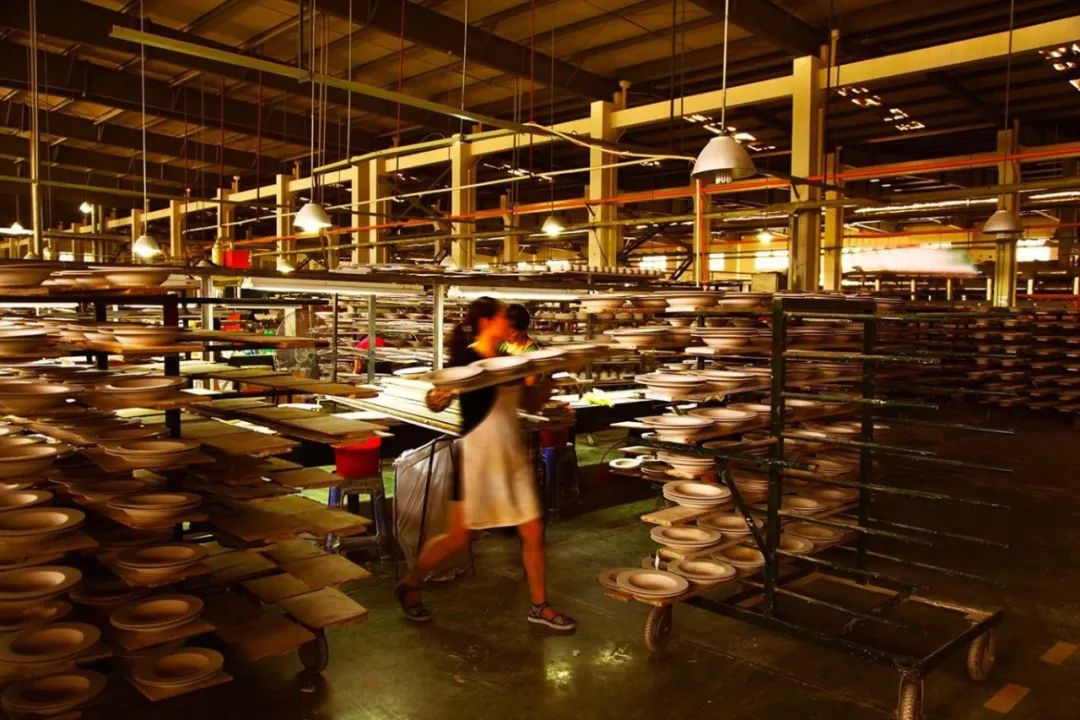
A capable B2B ceramic tableware supplier does not rely on operator experience alone. It controls slip casting with data.
Slip Specific Gravity
Specific gravity is one of the most important indicators in a porcelain slip casting process. Technical process guidance shows that many clay-based casting slips perform well at a specific gravity around 1.75 to 1.80. Source
If specific gravity is too low, the slip contains too much water. That can cause:
- slow casting
- mold waterlogging
- higher drying shrinkage
- powdery cast surfaces
- weaker greenware
If it is too high, the slip may become harder to stabilize and drain properly.
Water Content
A well-deflocculated casting slip is designed to work at relatively low water content. Technical guidance indicates that effective casting can occur at around 30% water, far lower than the level needed in a non-deflocculated slurry. Source
Lower water content generally means:
- faster mold cycle
- lower drying shrinkage
- better green strength
- lower crack risk
Deflocculant Control
Deflocculants such as sodium silicate, soda ash, or polyacrylate dispersants are used to reduce viscosity without adding more water. According to process guidance, modern dispersant systems may operate at approximately 0.3% to 0.5% for some polyacrylate-type agents, while sodium silicate-based systems can be lower depending on body formulation. Source
The buyer does not need to manage this chemistry directly, but should understand its consequence: rheology control separates industrial suppliers from trial-and-error workshops.
Mold Dry-Back Before Reuse
A plaster mold cannot cast consistently if it still contains too much residual moisture from the previous cycle. Patent literature on gypsum molds explicitly notes that absorbed water must be purged from the capillaries before the mold is reused, otherwise the mold cannot draw sufficient moisture from the next ceramic article. Source
This is one of the hidden reasons why two factories using the same body recipe can still produce very different results.
Typical Quality Problems Caused by Poor Slip Casting Control
If plaster mold water absorption is unstable, the problem rarely stays at the forming stage. It spreads into drying, glazing, and firing.
Uneven Wall Thickness
When one area of the mold absorbs faster than another, the cast builds unevenly. In finished tableware, this can lead to:
- poor symmetry
- unstable stacking
- uneven weight
- inconsistent feel in hand
- distortion after firing
This is especially important for premium mugs, bowls, and hospitality programs where dimensional repeatability matters.
Warpage and Shape Deformation
If the green body contains density variation, drying and firing stresses will not be uniform. That often produces:
- rim warpage
- bottom rocking
- handle misalignment
- oval opening dimensions
For export buyers, this directly affects carton yield, inspection pass rate, and customer complaints.
Cracks and Weak Seams
Excess water, poor mold condition, or poor slip rheology can weaken the green body. The result may be:
- rim cracking
- handle joint cracking
- seam tearing
- demolding breakage
In private-label programs, these issues often appear first during pilot runs or just after scale-up.
Pinholes and Surface Defects
Pinholes are usually finalized during glaze firing, but unstable casting can increase the probability. Poorly consolidated bodies, trapped air, and non-uniform moisture release create a more difficult firing environment for smooth glaze results.
Crazing Risk Through Body Inconsistency
Crazing is mainly a glaze-fit issue, but unstable body formation can make it worse. If body maturity and fired absorption vary from batch to batch, glaze behavior also becomes harder to control.
Why B2B Buyers Should Ask About Slip Casting Capability
When evaluating a custom dinnerware manufacturer, many buyers focus on decoration, price, MOQ, and delivery. Those matter, but they do not tell the full story.
A supplier with strong slip-casting control is usually also stronger in:
- dimensional consistency
- defect prevention
- glaze stability
- repeat-order reliability
- new product development
- production planning
Questions Buyers Should Ask Suppliers
If you are sourcing slip casting ceramic tableware, ask these questions:
1. How do you control slip specific gravity and viscosity?
A serious supplier should have routine records, not just verbal explanations.
2. How do you manage mold moisture before reuse?
This reveals whether the factory understands mold absorption as a controlled variable.
3. How do you verify wall thickness consistency?
The answer shows whether the supplier is capable of repeatable mass production.
4. Do you have fired-body water absorption test data?
This helps confirm body maturity and process stability.
5. Can you provide food-contact compliance reports?
For tableware export, this is essential.
The best suppliers answer these questions with data, SOPs, and test reports. The weaker ones answer with general confidence.
What Standards Matter for Ceramic Tableware Buyers
Good slip casting alone is not enough. The finished product must also meet safety and quality requirements.
ISO 6486-1:2019
ISO 6486-1:2019 specifies a test method for the release of lead and cadmium from ceramic ware, glass-ceramic ware, and glass dinnerware intended for food contact. This is one of the most widely recognized international references for ceramic tableware safety. Source
ASTM C738
ASTM C738 covers the determination of lead and cadmium extracted by acetic acid from glazed ceramic surfaces. It is highly relevant for U.S.-market-facing projects. Source
ASTM C373
ASTM C373 covers water absorption, bulk density, apparent porosity, and apparent specific gravity of fired ceramic whiteware products. For buyers, it is useful because fired absorption is an indirect signal of body maturity and process consistency. Source
ASTM C59/C59M
ASTM C59/C59M covers gypsum casting plaster and gypsum molding plaster. This matters because mold material quality affects the stability of the entire slip casting operation. Source
FDA Ceramicware Action Levels
For suppliers exporting to the United States, FDA guidance remains commercially important. Published FDA action-level summaries list category-based thresholds for lead and cadmium migration in ceramicware, including flatware, hollowware, cups, mugs, and pitchers. Source
A Practical Sourcing Insight: Slip Casting Is a Window Into Supplier Quality
For B2B buyers, the biggest takeaway is simple:
Slip casting performance reflects factory management quality.
If a supplier can control:
- plaster mold absorbency
- slip rheology
- casting time and wall build
- mold dry-back
- green-body stability
- fired absorption
- migration compliance
then the supplier is more likely to deliver repeatable quality in large-volume custom programs.
If those controls are weak, the problems usually appear later as:
- higher defect rate
- unstable glaze finish
- inconsistent dimensions
- delayed delivery
- quality disputes after shipment
That is why buyers should treat plaster mold water absorption not as an internal production detail, but as a meaningful indicator of supplier capability.
Final Thoughts
In the global market for custom ceramic tableware, appearance alone is not enough. What matters is whether the product can be manufactured consistently, safely, and efficiently across repeated orders.
That is exactly where slip casting becomes important.
A well-controlled slip-casting process gives buyers more than design freedom. It gives them:
- better consistency
- lower defect risk
- stronger development confidence
- more reliable compliance outcomes
- a clearer way to evaluate supplier professionalism
If you are sourcing mugs, bowls, teapots, or custom hollowware, understanding how a supplier manages plaster mold water absorption can help you avoid quality surprises long before mass production begins.
References
- Slip Casting Lesson – The American Ceramic Society
- Understanding the Deflocculation Process in Slip Casting – Digitalfire
- Investigations on the Applicability of Pressure Slip Casting – NIT Warangal Thesis
- The Role of Water in Slip Casting – NASA Technical Report
- Pottery Plaster Formulations for the Manufacture of Plaster Molds – Google Patents
- ISO 6486-1:2019 Scope
- ASTM C738
- ASTM C373
- ASTM C59/C59M
- FDA Action Levels Summary
Custom Solutions Available
Our technical experts are always ready to assist you in finding the perfect customized solution for your dinnerware needs.