What Is Translucency in Ceramic Tableware? A Technical Guide for Porcelain Dinnerware Buyers
For premium custom tableware, few properties communicate quality as clearly as translucency. When a porcelain plate or cup softly glows at the rim under light, buyers immediately associate it with refinement, purity, and high firing quality. But translucency is not only an aesthetic feature. In industrial ceramics, it is also a technical indicator of microstructural maturity, low porosity, good raw material selection, and stable firing control.
For importers, wholesalers, hospitality brands, and OEM/ODM buyers, understanding translucency helps separate truly capable suppliers from factories that only offer attractive samples. This article explains what translucency means in ceramic tableware, the science behind it, how factories control it, what defects can occur, and how B2B buyers can use this property to evaluate supplier capability.
Why Translucency Matters in Porcelain Tableware
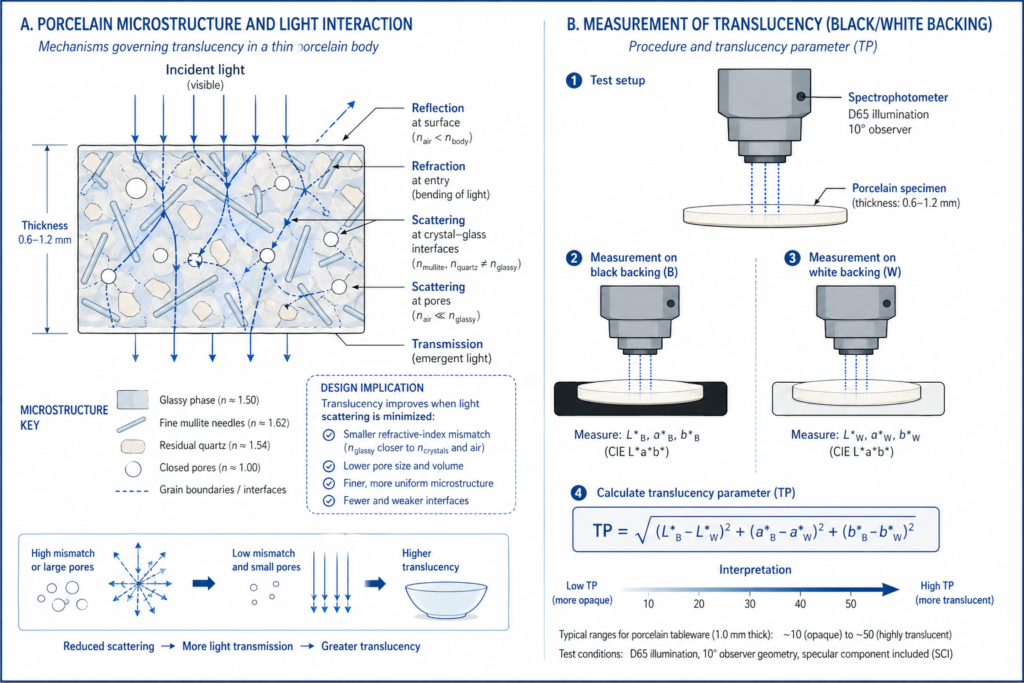
In ceramic tableware, translucency is the ability of the fired body to transmit part of the visible light while diffusing the rest. It is different from transparency. A translucent porcelain plate does not allow a clear image to pass through, but it creates a soft luminous effect, especially in thinner sections such as rims and edges.
For the tableware industry, translucency matters for three reasons.
First, it affects perceived product value. In retail, hospitality, and gifting markets, a translucent body is usually associated with premium porcelain, fine china, and higher-grade finishing.
Second, translucency reflects body densification quality. A well-translucent body is typically low in residual porosity and well vitrified, which often means better process control during milling, forming, glazing, and firing.
Third, translucency helps buyers assess supplier technical level. Factories that can deliver consistent translucency across shapes and batches usually also perform better in whiteness control, thickness consistency, and defect management.
The Science Behind Porcelain Translucency
Light Transmission, Absorption, and Scattering
When light enters a ceramic body, part of it is transmitted, part is absorbed, and part is scattered. In porcelain, the biggest challenge is usually light scattering, not pure absorption.
A simplified light attenuation model can be written as:
I = I0 exp[−(α + σs)L]
Where:
- I0 = incident light intensity
- I = transmitted light intensity
- α = absorption coefficient
- σs = scattering coefficient
- L = optical path length
The lower the scattering coefficient, the higher the translucency.
Why the Glassy Phase Is So Important
A fired porcelain body is not a single material. It is a composite microstructure containing:
- glassy phase
- mullite crystals
- residual quartz
- closed or open pores
Translucency depends heavily on how smoothly light can pass through these phases. The more the refractive index changes from one phase to another, the more light is scattered.
A technical study on fine translucent porcelain reported that translucency improves when the refractive indices of the internal phases are close to each other. In that work, the refractive index of the glassy phase was reported to be around 1.5, quartz around 1.53, and mullite around 1.64, meaning mullite creates stronger scattering than quartz, while pores are even more damaging because the refractive-index difference between ceramic matter and air is very large. Source
A simple refractive-index ratio is:
m = np / nm
Where:
- np = refractive index of the particle or inclusion
- nm = refractive index of the surrounding matrix
The further this ratio is from 1, the stronger the optical scattering.
Why Pores Reduce Translucency So Strongly
Residual pores are one of the biggest enemies of translucency. Even when they are very small, pores create a strong optical discontinuity and cause the body to look milky or chalky instead of luminous.
A useful scattering relationship for very small inclusions is:
σs ∝ N × (r6 / λ4) × [(m2 − 1) / (m2 + 2)]2
Where:
- N = number density of scattering centers
- r = effective radius of the scattering center
- λ = wavelength of light
- m = refractive-index ratio
In industrial porcelain, scattering behavior can be more complex than pure Rayleigh scattering because many microstructural features are similar in size to visible wavelengths. However, the engineering conclusion remains the same: fewer pores, better phase matching, and a more mature vitrified structure lead to better translucency.
Mullite Formation and the Porcelain Reaction Path
Porcelain translucency is also linked to the thermal evolution of clay minerals during firing. Kaolinite-derived clay transforms during heating and eventually contributes to mullite formation. A simplified reaction can be written as:
3Al2Si2O5(OH)4 → 3Al2O3 · 2SiO2 + 4SiO2 + 6H2O
This expresses the high-temperature conversion of kaolinite into mullite, silica, and released water.
At the same time, feldspar-rich raw materials generate a liquid phase that later cools into the glassy matrix. This glassy matrix is essential because it helps eliminate porosity and bind the microstructure together. If the liquid phase is insufficient, the body remains porous. If it is excessive, deformation and bloating may occur.
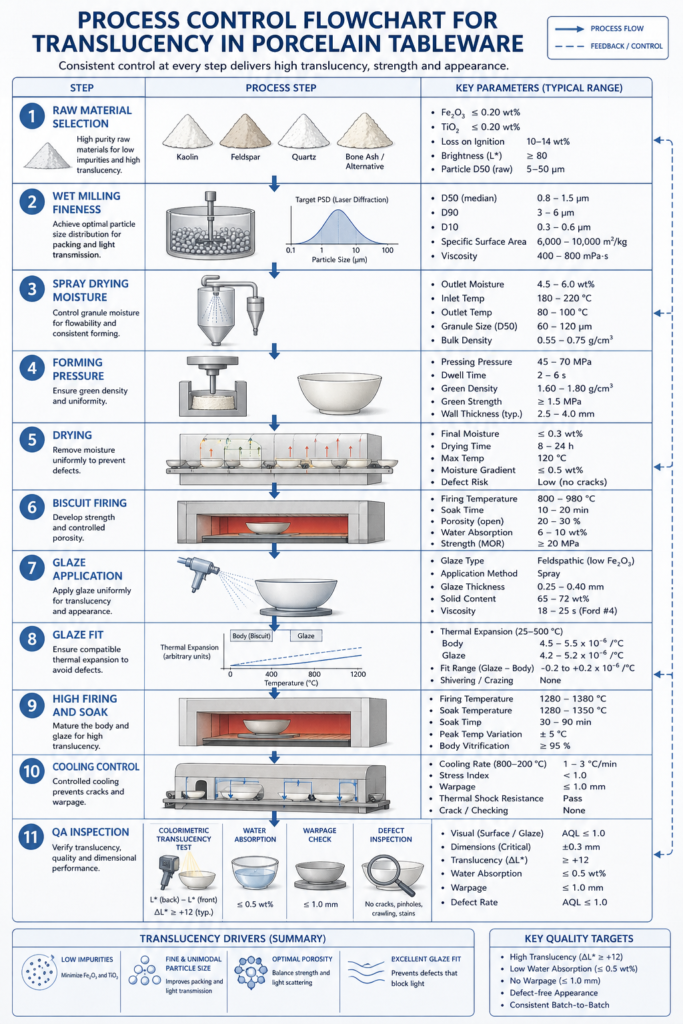
How Factories Control Translucency in Ceramic Tableware Production
Raw Material Purity
High translucency starts with clean raw materials. Premium porcelain tableware bodies usually require low levels of coloring impurities such as Fe₂O₃ and TiO₂, because these oxides reduce whiteness and increase visible light absorption.
Factories that target translucent porcelain should have strong control over:
- clay consistency
- feldspar chemistry
- quartz purity
- recycled scrap ratio
- contamination from milling media, rust, and storage
If raw material control is unstable, translucency will vary from lot to lot even when the kiln curve is unchanged.
Particle Size Distribution
Particle size directly affects packing density, sintering behavior, and pore elimination. Finer particles generally improve densification, but excessive fineness can create forming and shrinkage problems. What matters is not simply “finer,” but well-engineered particle size distribution.
In premium tableware production, factories often monitor:
- slurry median particle size
- coarse particle tail
- residue after screening
- casting slip stability or plastic body consistency
A fine translucent porcelain study reported that using finer particles improved densification and reduced sagging during heat treatment, helping the body reach a more translucent and stable fired structure. Source
Thickness Uniformity
Even a good porcelain body will not look consistently translucent if the thickness varies too much across the piece. Light transmission falls as section thickness increases, so poor forming control can create visible differences from rim to center or from one side of a plate to another.
That is why capable factories focus on:
- stable wall-thickness control
- low density gradients
- effective de-airing
- good drying uniformity
- low lamination risk in formed bodies
For buyers, uneven translucency across the same item is often a sign of weak process capability.
Firing Temperature and Soak Control
Final translucency depends heavily on vitrification. During firing, enough liquid phase must form to eliminate pores, but not so much that the ware warps or bloats.
Depending on the body system, porcelain and fine china tableware may be fired roughly within the following industrial ranges:
- 1220–1280°C for some fine translucent or anorthite-enhanced bodies
- 1320–1400°C for hard porcelain systems
- 900–1000°C for biscuit firing stages where applicable
One documented fine translucent body achieved a very white and translucent structure at 1230°C for 3 hours, showing that body design and firing cycle must be optimized together. Source
Glaze Compatibility
Translucency is often discussed as a body property, but glaze strongly affects the final optical impression. Even if the body is highly matured, a glaze with excessive bubbles, haze, or devitrification can mask the luminous appearance.
Factories need to control:
- glaze melt behavior
- gas release compatibility with the body
- application weight
- thermal expansion fit
- cooling behavior after peak temperature
If glaze control is poor, visual defects may appear even when the porcelain body itself is technically good.
How Translucency Is Tested
Translucency Parameter (TP)
One of the most practical ways to evaluate ceramic translucency is the Translucency Parameter (TP). In this method, the same specimen is measured on white and black backgrounds using spectrophotometric color coordinates in the CIELAB system.
The TP formula is:
TP = √[(L*W − L*B)2 + (a*W − a*B)2 + (b*W − b*B)2]
Where the specimen is measured over white and black backgrounds.
This method has been explicitly used in open-access ceramic translucency studies and is a practical way to compare relative translucency when thickness and test conditions are standardized. Source
Why Thickness Standardization Is Essential
A translucency number has little meaning if the samples are not tested at the same thickness. A 3 mm body and a 4 mm body cannot be compared directly.
Buyers should therefore ask suppliers to report translucency together with:
- body thickness
- whether the sample is glazed or unglazed
- test instrument or geometry
- background type
- illuminant/observer settings
- test batch information
Related Testing Standards Buyers Should Know
For colorimetric calculation, ASTM E308 provides procedures for computing CIE tristimulus values and related color coordinates from spectral data, which supports standardized optical evaluation workflows. ASTM states that such systems are useful for production control, color-difference calculation, and specification work. Source
For density and maturity evaluation, ASTM C373 is highly relevant because it covers water absorption, bulk density, apparent porosity, and apparent specific gravity. ASTM notes that these properties help determine the degree of maturation of a ceramic body. For porcelain tableware, lower absorption and lower apparent porosity usually support better translucency. Source
Common Defects When Translucency Control Is Poor
Milky or Dead-White Appearance
If the body is underfired or retains too much fine porosity, the ware may appear white but not luminous. This is one of the most common signs of insufficient densification.
Pinholes and Blisters
Poor gas release management between body and glaze can lead to pinholes or blisters. These defects damage the surface visually and usually indicate unstable firing or glaze/body interaction.
Warpage and Sagging
If too much liquid phase forms during firing, the body may become overly soft and deform. Warpage not only affects shape tolerance but also changes wall thickness distribution, which harms translucency consistency.
Crazing and Shivering
Even when translucency looks good at first, poor glaze fit can create crazing or shivering later. This is especially risky in export markets where long-term durability and food-contact safety are critical.
Black Specks and Contamination Marks
In translucent whiteware, even minor contamination becomes highly visible. Iron spots, dark inclusions, or kiln debris can seriously downgrade the premium appearance of the product.
Why B2B Buyers Should Pay Attention to Translucency
For importers and sourcing teams, translucency is not only a visual preference. It is a useful technical and commercial screening tool.
A supplier that consistently produces translucent porcelain tableware often also demonstrates stronger capability in:
- raw material qualification
- milling and particle size control
- vitrification management
- forming consistency
- glaze fit
- kiln uniformity
- final inspection discipline
In contrast, a supplier that can only show one attractive sample under backlight may still struggle with batch repeatability, warpage, glaze defects, or inconsistent body maturity.
What Buyers Should Ask Suppliers
A professional RFQ or supplier audit should include questions such as:
- Can you provide translucency test data at a defined thickness?
- What is the water absorption level of the fired body?
- How do you control porosity and body maturity?
- What is your firing temperature range for this body system?
- How do you ensure glaze fit and prevent crazing?
- Can you demonstrate lot-to-lot consistency across multiple shapes?
These questions often reveal far more about supplier capability than price alone.
International Compliance Standards Related to Premium Tableware
ISO 6486-1
ISO 6486-1 specifies a test method for the release of lead and cadmium from ceramic ware, glass-ceramic ware, and glass dinnerware intended for food contact. For export buyers, this standard is important because premium appearance must always be matched by food-contact safety compliance. Source
EU Council Directive 84/500/EEC
For the European market, Council Directive 84/500/EEC regulates the migration of lead and cadmium from ceramic articles intended to come into contact with foodstuffs. It sets extraction conditions and category-based migration limits, making it highly relevant for export tableware programs. Source
FDA Lead Guidance for Ceramic Foodware
For the U.S. market, FDA guidance for ceramic foodware lead contamination remains an important reference. The FDA document includes category-based guideline levels for lead in leaching solution, such as 3.0 μg/mL for flatware, 2.0 μg/mL for small hollowware other than cups and mugs, 0.5 μg/mL for cups/mugs, 1.0 μg/mL for large hollowware other than pitchers, and 0.5 μg/mL for pitchers. Source
Final Takeaway for Importers and Tableware Brands
In ceramic tableware, translucency is one of the clearest visible signs of invisible process quality. It reflects how well a supplier controls microstructure, porosity, phase balance, firing maturity, glaze compatibility, and overall manufacturing discipline.
For B2B buyers, that means translucency should not be treated as a simple visual feature. It should be treated as a technical buying signal.
If a supplier can explain translucency scientifically, measure it consistently, and deliver it at production scale without warpage, pinholes, or glaze problems, that supplier is usually operating at a much higher level than one that only offers beautiful showroom samples.
Sources
- Fine translucent porcelain technical study: https://etheses.whiterose.ac.uk/id/eprint/5983/1/246932.pdf
- ISO 6486-1: https://www.iso.org/obp/ui/en/#!iso:std:67561:en
- ASTM C373: https://www.astm.org/c0373-18.html
- ASTM E308: https://www.astm.org/e0308-22.html
- EU Council Directive 84/500/EEC: https://eur-lex.europa.eu/legal-content/EN/TXT/?uri=CELEX:31984L0500
- FDA lead contamination guidance for ceramic foodware: https://www.fda.gov/files/inspections%2C%20compliance%2C%20enforcement%2C%20and%20criminal%20investigations/published/CPG-Sec.-545.450-Pottery-%28Ceramics%29–Import-and-Domestic—Lead-Contamination.pdf
- TP formula reference: https://pmc.ncbi.nlm.nih.gov/articles/PMC4993593/