Microwave Safe Ceramic Tableware: Why Dielectric Loss Tangent Matters in Custom Dinnerware
When buyers search for microwave safe ceramic tableware, they often expect a simple yes-or-no answer. In reality, microwave safety is an engineering outcome shaped by the ceramic body, glaze system, firing curve, decoration method, and final moisture behavior of the ware. In custom dinnerware projects, even a small change—such as a metallic rim, a darker pigment, a thicker glaze, or a more porous body—can change microwave performance significantly. Source
For importers, wholesalers, hotelware brands, and private-label buyers, microwave safety is not just a consumer convenience feature. It is a useful indicator of how well a supplier controls raw materials, vitrification, glaze fit, and production consistency. A factory that can explain microwave safety scientifically is usually a factory with stronger process discipline overall.
What Does Microwave Safe Mean for Ceramic Tableware?
In practical terms, a ceramic plate, bowl, or mug is considered microwave safe when it can be used for microwave reheating without creating unsafe self-heating, cracking, crazing, arcing, or other damage that affects normal food use. ASTM specifically defines a test method for ceramicware that is “microwave safe for reheating”, and it also makes clear that the scope is consumer microwave reheating rather than full cooking applications. ASTM further notes that ceramic products intended for microwave use should also pass thermal-shock resistance requirements before microwave suitability is evaluated. Source
This distinction matters in B2B sourcing. A dinner plate that survives one informal in-house microwave check is not the same as a product that has been engineered and validated for consistent microwave reheating performance across production lots.
Why Some Ceramic Tableware Heats More Than Others in a Microwave
The core physics behind ceramic microwave behavior is the material’s complex permittivity, especially its dielectric loss factor and dielectric loss tangent.
What Is Dielectric Loss Tangent?
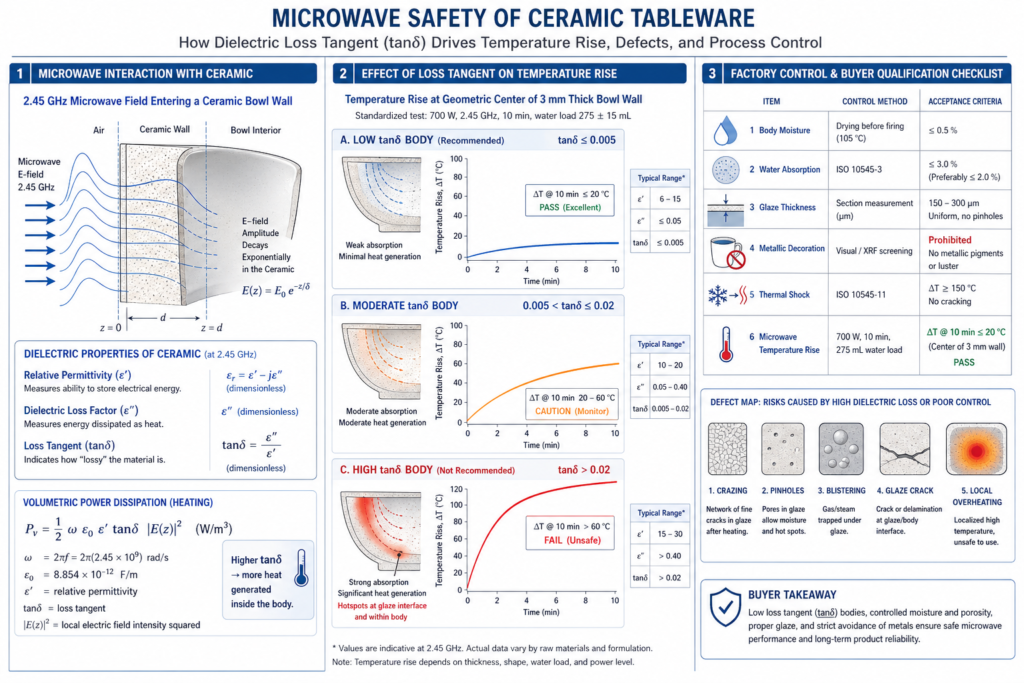
Dielectric loss tangent, often written as tan δ, describes how efficiently a material converts microwave energy into heat.
tan δ = ε″ / ε′
Where:
- ε′ is the dielectric constant, related to energy storage
- ε″ is the dielectric loss factor, related to energy dissipation
A higher tan δ generally means the material will dissipate more electromagnetic energy as heat under microwave exposure. This is why dielectric loss tangent is such an important concept when evaluating whether ceramic tableware will remain relatively cool or become excessively hot in use. Source
How Dielectric Loss Tangent Affects Heating Rate
Microwave dielectric heating can be expressed as volumetric power dissipation:
Pv = 2π f ε0 ε″ E2 = 2π f ε0 ε′ tanδ E2
This equation shows why a higher dielectric loss factor or a higher loss tangent can lead to faster temperature rise in the ceramic body or glaze system. In simple terms, if two ceramic pieces are exposed to the same microwave field, the one with higher effective dielectric loss will usually heat more strongly. Source
Why Moisture and Porosity Matter So Much
Many buyers assume the ceramic recipe alone determines microwave safety. In production reality, porosity and retained moisture are often decisive. A dense vitrified porcelain body is usually a relatively low-loss ceramic, but open porosity allows water to be absorbed into the structure. That absorbed moisture can increase effective microwave heating dramatically, because water is a much stronger microwave absorber than a well-vitrified ceramic matrix.
This is one reason why poorly vitrified tableware, underfired ware, or ware with microcracked glaze surfaces may become hotter in a microwave than expected. What looks like a material problem may actually be a microstructure and process-control problem.
Why Custom Dinnerware Projects Face Higher Microwave Safety Risk
Custom ceramic tableware projects carry more microwave risk than standard stock lines because customization changes the finished dielectric system.
Decoration Can Change Microwave Performance
A plain white vitrified plate may perform well, but the same plate with a metallic band, platinum rim, gold logo, or conductive-effect decal may no longer be suitable for microwave use. ASTM clearly states that dishes with metallic glaze, decoration, or paint should not be used in the microwave unless specifically designed for that purpose and marked accordingly. Source
For sourcing teams, this is a common failure point: the base shape is microwave safe, but the approved decoration is not.
Shape Geometry Also Matters
Microwave field distribution is not always uniform. Handles, foot rings, thick rims, embossed areas, and uneven wall thickness can create local heating differences. This means microwave safety must be evaluated on the final SKU, not just on the body formula in isolation.
How Ceramic Factories Control Microwave Safety
A reliable supplier does not rely on assumptions. Microwave-safe ceramic tableware is usually the result of tight control over the following variables:
1. Low Water Absorption Through Good Vitrification
Factories aiming for microwave-safe porcelain or premium vitrified stoneware usually target very low water absorption to limit moisture-driven heating.
A common absorption formula is:
Water Absorption (%) = (Msat − Mdry) / Mdry × 100%
Lower absorption typically means lower open porosity, better sealing, and more stable microwave performance over time.
2. Stable Glaze Fit
Microwave reheating creates thermal gradients. If the glaze and body do not expand and contract compatibly, repeated thermal cycling can lead to crazing, delayed crazing, or edge stress problems. This is why suppliers often combine microwave validation with thermal-shock or crazing resistance evaluation under standards such as ASTM C554. Source
3. Proper Firing and Maturity
Underfiring can leave excess porosity and unstable glaze structure. Overfiring can create deformation, blistering, or glaze stress. Good factories control:
- body maturity
- glaze melt behavior
- soak time at peak temperature
- cooling curve
- lot-to-lot kiln consistency
These variables directly affect the final dielectric response of the ware.
4. Strict Decoration Approval
A professional supplier will separate approval into at least two stages:
- body and glaze approval
- final decorated SKU approval
This is because decoration can completely change microwave performance, especially when metallic or conductive materials are involved.
Common Ceramic Defects Linked to Poor Microwave Safety Control
When microwave safety is poorly controlled, the result is not always an immediate breakage event. More often, buyers start seeing a defect pattern in the market.
Crazing
Crazing is a network of fine glaze cracks caused by stress mismatch or repeated thermal cycling. In microwave use, local heating differences can accelerate its appearance, especially if the glaze fit is marginal.
Pinholes and Blisters
Pinholes and blisters often indicate incomplete gas release, poor glaze maturity, or contamination. These defects can create weak points, retain moisture more easily, and reduce long-term surface integrity.
Dunting or Body Cracks
If the temperature distribution becomes too uneven, the body may experience thermal shock. Local stress can lead to cracking at the foot, rim, or handle.
Arcing
Arcing is the most obvious high-risk failure. It usually occurs when metallic decoration interacts with microwave energy. This can damage both the dinnerware and the microwave oven itself. ASTM explicitly warns about metallic decoration in microwave applications. Source
Why B2B Buyers Should Audit Microwave Safety Before Ordering
For importers and brand owners, microwave safety is not just a compliance topic. It is a practical sourcing tool.
Microwave Safety Reveals Supplier Capability
A supplier that truly understands microwave-safe ceramic tableware should be able to explain:
- the finished body absorption level
- whether the glaze is fully mature and well-fitted
- whether the final decorated SKU has been validated
- whether the product is intended for reheating only or broader thermal use
- whether any metallic decoration is present
If the supplier cannot answer these questions clearly, there is a high chance that microwave safety is being treated as a sales claim rather than an engineered property.
Ask for the Right Test Evidence
B2B buyers should request evidence related to:
- ASTM C1607 for microwave-safe reheating suitability
- ASTM C554 or equivalent for thermal shock / crazing resistance
- ISO 6486-1 for lead and cadmium release from ceramic ware intended for food contact Source
Microwave safety and food-contact safety are not the same thing, but serious suppliers usually control both together.
What International Standards Matter Most?
There is no single certificate that alone proves a ceramic product is globally approved for every microwave use case. Instead, buyers should look at a combination of standards and guidance.
ASTM C1607
This is one of the most relevant standards for determining whether ceramicware is microwave safe for reheating in consumer microwave ovens. It also highlights that microwave-intended ceramicware should first satisfy thermal-shock resistance expectations. Source
ISO 6486-1
This international standard covers the release of lead and cadmium from ceramic ware, glass-ceramic ware, and glass dinnerware intended for food contact. For private-label tableware projects, it is a key food-contact safety benchmark. Source
FDA Guidance
FDA notes that ceramicware intended for food use must be properly controlled and labeled, and that ceramicware marketed as decorative or ornamental must follow labeling rules if it is not intended for food contact. FDA also warns that poor manufacturing control can lead to lead contamination. Source
FDA CPG Sec. 545.450
This guidance provides public action levels for extractable lead in different ceramicware categories, including cups, mugs, flatware, and hollowware. For buyers sourcing ceramic mugs or dinnerware for the U.S. market, this is an important regulatory reference. Source
Final Takeaway for Importers and Private-Label Buyers
If you are sourcing custom ceramic tableware, microwave safety should never be treated as a default attribute. It should be treated as a performance characteristic that must be engineered, tested, and revalidated whenever the body, glaze, decoration, or shape changes.
The most important technical takeaway is simple:
The higher the effective dielectric loss in the finished ceramic system, the greater the risk of microwave self-heating.
In real production, that effective loss is shaped not only by composition, but also by porosity, moisture absorption, glaze integrity, decoration, and firing quality. That is why microwave safety is such a strong indicator of supplier competence in the ceramic tableware industry.
If a supplier can clearly explain dielectric behavior, moisture control, glaze fit, and testing logic, that supplier is far more likely to deliver stable quality in large-scale B2B production.
References
- ASTM C1607 – Microwave Safe for Reheating for Ceramicware
- ASTM C554 – Crazing Resistance of Fired Glazed Ceramic Whitewares
- ISO 6486-1 – Lead and Cadmium Release from Ceramic Ware
- FDA Guidance on Imported Traditional Pottery
- FDA CPG Sec. 545.450 – Pottery (Ceramics) Lead Contamination
- Keysight – Basics of Measuring the Dielectric Properties of Materials
- COMSOL – Modeling Dielectric Heating: A First Principles Approach
Custom Solutions Available
Our technical experts are always ready to assist you in finding the perfect customized solution for your dinnerware needs.