Mohs Hardness in Custom Tableware: Why Scratch Resistance Matters for B2B Buyers
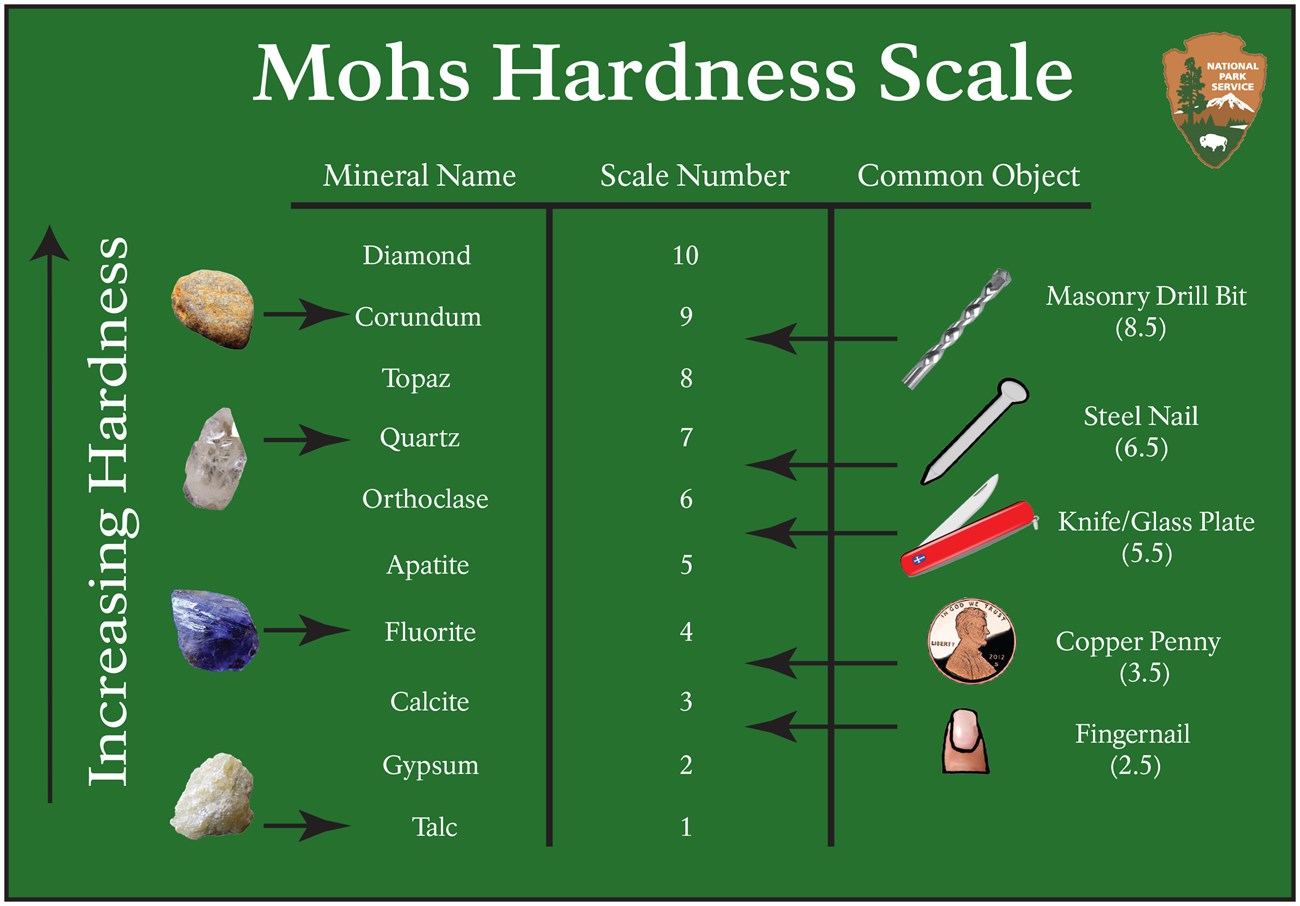
Image source: National Park Service
When international buyers source custom ceramic dinnerware, appearance is only one part of the decision. The more important question is how the product performs after repeated contact with forks, knives, dishwashers, and daily service conditions. This is where Mohs Hardness becomes highly relevant. In practical terms, it is one of the most useful ways to discuss the scratch resistance of a ceramic or glazed tableware surface. Source
For B2B buyers, especially in hospitality, retail, airline catering, and foodservice, poor surface hardness can lead to visible scratches, gray metal marks, faster replacement cycles, and customer complaints. A plate may look perfect in a showroom but fail in real-world use if its glaze is too soft, too rough, or improperly matured during firing. That is why Mohs Hardness should be understood not as a marketing phrase, but as a meaningful durability indicator in tableware development and supplier evaluation. Source Source
What Is Mohs Hardness in Ceramic Tableware?
Mohs Hardness is a relative scale that measures how resistant a material is to scratching. It compares one material against another using reference minerals ranked from 1 to 10, where 1 is talc and 10 is diamond. The key point is that Mohs Hardness is an ordinal scale, not a linear one. A material rated 7 is not “twice as hard” as a material rated 3; it simply resists scratching from a broader range of lower-hardness materials. Source
In ceramic tableware, Mohs Hardness is mainly used to describe the scratch behavior of the glaze surface or other hard finished surfaces. ASTM explains that Mohs scratch hardness can be determined by observing whether a surface is scratched by a pick of known hardness. Although the ASTM method is written for ceramic tile, glass tile, and other hard surfaces rather than tableware specifically, the principle is still highly relevant for assessing scratch resistance in ceramic dinnerware applications. Source
Mohs Hardness vs. Scratch Resistance vs. Metal Marking
These three terms are often confused in the tableware industry, but they are not identical.
- Mohs Hardness refers to relative scratch resistance.
- Scratch resistance refers to whether the glaze itself is damaged by harder contact.
- Metal marking resistance refers to whether metallic utensils leave gray marks or deposits on the glaze surface.
A glaze may be hard enough to avoid deep scratching, yet still show heavy metal marking if the surface is microscopically rough or contains exposed hard particles that abrade stainless steel cutlery. This distinction is especially important in white porcelain and hotelware. Source Source
Why Mohs Hardness Matters in Custom Tableware
In the custom tableware business, buyers are not only purchasing shape, color, and logo decoration. They are also purchasing service life. The surface of a ceramic plate or bowl must remain clean, smooth, and visually stable after repeated use. If the glaze loses its integrity too quickly, the product no longer looks premium, even if the body is structurally intact.
For hospitality buyers, this issue is even more critical. Restaurant, hotel, and catering tableware experiences intense cycles of serving, stacking, washing, and utensil abrasion. Research on porcelain tableware has shown that metal marking and surface degradation directly affect aesthetics, hygiene, and replacement cost, especially in environments with high usage frequency. Source
For private-label brands and importers, Mohs Hardness is also a useful indicator of supplier capability. A factory that truly understands glaze hardness should be able to explain not only whether a product is “scratch resistant,” but also why it performs well, how the glaze is formulated, what firing window is used, and how surface defects are controlled during mass production.
The Science Behind Scratch Resistance in Ceramic Dinnerware
Glaze Chemistry: Why Silica and Alumina Matter
The scratch performance of ceramic dinnerware is controlled largely by the chemistry of the fired glaze. In simplified terms, a glaze is a silicate glass network modified by different oxides.
- SiO2 acts as the primary glass former.
- Al2O3 improves stiffness, chemical durability, and hardness.
- Flux oxides such as Na2O, K2O, CaO, MgO, and B2O3 help lower melting temperature and influence flow behavior.
When a glaze contains insufficient silica or alumina, or when it is over-fluxed, the surface may become too soft or chemically weak. According to Digitalfire, glazes lacking enough SiO2 and Al2O3 are more likely to show cutlery marking, wear, and poor surface durability. Source
Ceramic Phase Development During Firing
The ceramic body beneath the glaze also contributes to total product durability. In porcelain systems, kaolinite transforms during firing into mullite-bearing structures that reinforce the fired body.
Kaolinite dehydroxylation:
Al2Si2O5(OH)4 → Al2Si2O7 + 2H2O↑
Ideal mullite composition:
3Al2O3·2SiO2
Digitalfire notes that mullite has an ideal composition of about 71.8% Al2O3 and 28.2% SiO2, and that mullite formation is an important reason why well-fired porcelain develops strong and durable properties. While Mohs Hardness mainly concerns the surface, a stable vitrified body supports long-term product quality and dimensional reliability. Source
Surface Microstructure: Why Hardness Alone Is Not Enough
A common misconception is that adding hard minerals automatically makes a glaze better. In reality, a glaze can contain hard particles and still perform poorly if the surface is not properly melted and smoothed during firing.
This is why some glazes show gray cutlery marks even though they are not truly soft. Research on porcelain tableware explains that metal marking can result from two combined mechanisms: deposition of metal particles from cutlery, and progressive degradation of the glaze surface under friction and pressure. Roughness, hard crystalline protrusions, and local glaze damage all contribute to this behavior. Source
Digitalfire also points out that unmelted or poorly enveloped particles such as zircon or calcined alumina can create an abrasive micro-surface. In that case, the glaze may not be “scratched” first; instead, it abrades the utensil and traps metal particles in tiny pores or irregularities. Source
How Manufacturers Control Mohs Hardness and Scratch Resistance

Image source: PubMed Central
Raw Materials and Glaze Formulation
Strong scratch resistant tableware starts with disciplined raw material selection. Better factories control not only the recipe but also particle size, purity, and dispersion of glaze materials.
In practice, manufacturers improve surface hardness by:
- maintaining adequate silica and alumina in the glaze system,
- avoiding over-fluxed soft glazes,
- controlling the amount and fineness of zircon opacifier,
- reducing coarse residual particles,
- and matching glaze chemistry to the firing range.
Digitalfire specifically recommends finer particle control, including finer quartz grades where appropriate, because coarse particles can increase abrasive behavior and metal marking risk. Source
Firing Maturity and Cooling Control
Even a well-designed glaze can fail if the firing cycle is not properly controlled. Peak temperature, soak time, and cooling speed all influence whether the glaze becomes smooth, mature, and durable.
According to Digitalfire, glazes fired higher generally have better potential to develop a hard and smooth surface, because higher-temperature systems can better support silica/alumina-rich networks. The same source also notes that in some cases, slightly faster cooling can reduce problematic crystallization that contributes to abrasive surfaces. Source
An industry reference from Holst Porcelain associates 1320°C-fired porcelain with Mohs behavior around the quartz range, while ceramics fired at the same temperature may align closer to the feldspar range. This should not be treated as a universal rule for all tableware, but it does reinforce the importance of firing maturity in ceramic hardness performance. Source
Quality Control Testing in Professional Factories
A technically strong supplier should not rely on visual appearance alone. In mass production, surface durability should be confirmed through multiple quality checks, such as:
- Mohs scratch comparison,
- cutlery or metal-marking tests,
- dishwasher resistance tests,
- crazing resistance tests,
- and microstructural inspection where necessary.
Instrumented scratch testing in broader materials science often evaluates critical load, penetration depth, and frictional force to study failure onset. Although such testing is more common in R&D than in routine tableware QC, it shows that professional scratch evaluation is more sophisticated than a basic “knife rub” claim. Source
What Happens When Surface Hardness Is Poorly Controlled?
Metal Marking
Metal marking is one of the most common complaints in ceramic dinnerware. It appears as gray or dark lines caused by metallic particle deposition from forks, knives, or spoons. It is especially visible on white plates, where even slight surface roughness becomes obvious after use. Research confirms that metal marking is a major performance concern in hospitality tableware because it affects aesthetics, hygiene, and product lifespan. Source
Pinholes, Pitting, and Rough Glaze Surfaces
If the glaze is under-melted or poorly degassed, the fired surface may contain pinholes, pitting, or tiny voids. These defects trap metal particles, dirt, and stains more easily. Even if the product passes visual inspection at shipment, these micro-defects often become more obvious after daily use.
Digitalfire notes that when metal marks cannot be easily removed, they may be trapped in surface pores or irregularities, which is a sign that the glaze is not fully mature or not sufficiently smooth. Source
Crazing and Long-Term Surface Failure
Scratch resistance is not only about hardness. If the glaze and body are poorly matched in thermal expansion, the glaze may develop crazing, which is a network of fine cracks. Once crazing appears, the surface becomes easier to stain, easier to mark, and less hygienic over time.
This is why a supplier should never present hardness alone as proof of premium quality. True performance depends on the balance between hardness, smoothness, glaze fit, and long-term chemical durability.
What B2B Buyers Should Ask Their Tableware Supplier
For importers, distributors, and private-label brands, Mohs Hardness is most useful when it is turned into a supplier qualification question.
Ask These Questions Before Approving a Sample
- What is the glaze type: glossy, matte, reactive, or zircon-opacified?
- How do you test scratch resistance and metal marking resistance?
- Do you have dishwasher resistance test data?
- How do you control glaze particle size and coarse residue?
- What firing range is used for this item?
- How do you prevent crazing, pinholes, and rough glaze surfaces?
A factory that can answer these questions clearly is much more likely to deliver stable production quality than one that only says the item is “high hardness” or “scratch proof.”
What Good Answers Look Like
A professional supplier will explain that scratch resistance depends on glaze chemistry, firing maturity, surface smoothness, and process consistency, not just decorative appearance. They may also distinguish between true scratch damage and metal marking, which is a strong sign that they understand real end-use performance.
By contrast, if a supplier cannot explain the role of silica, alumina, zircon, or firing control, the risk of inconsistency in mass production is significantly higher.
Relevant Standards Buyers Should Know
ASTM C1895: Mohs Scratch Hardness
ASTM C1895 covers the determination of Mohs scratch hardness for ceramic tile, glass tile, and other hard surfaces. While it is not a tableware-specific standard, it provides a recognized framework for discussing scratch resistance on ceramic surfaces. Source
ISO 6486-1:2019: Food Contact Safety
ISO 6486-1 is about the release of lead and cadmium from ceramic ware and glass dinnerware intended for food contact. This is a critical compliance standard, but it addresses food safety, not scratch resistance. Buyers should not confuse heavy-metal compliance with surface durability. Source
BS 8654:2015: Performance Requirements for Ceramic Tableware
BS 8654 covers performance requirements for ceramic tableware intended for domestic and hospitality use. It references related tests for impact resistance, water absorption, dishwashing resistance, and crazing resistance, making it especially relevant for institutional buyers concerned with total lifecycle performance. Source
EN 12875: Mechanical Dishwashing Resistance
EN 12875 evaluates resistance to the combined chemical, thermal, and mechanical stresses of dishwashing. This matters because even a hard glaze can degrade if it is not chemically durable under repeated dishwasher exposure. Source
Final Takeaway
For international buyers of custom tableware, Mohs Hardness is an important way to evaluate surface durability, but it should never be considered in isolation. The best-performing ceramic dinnerware combines:
- a well-designed glaze chemistry,
- enough silica and alumina for durability,
- proper firing maturity,
- a smooth and defect-controlled surface,
- and reliable resistance to metal marking, crazing, and dishwasher wear.
In other words, truly premium scratch resistant tableware is not just hard. It is engineered for long-term use.
If you are sourcing ceramic plates, bowls, mugs, or hotelware, asking the right questions about Mohs Hardness and glaze durability can help you identify stronger suppliers, reduce claims, and build a more reliable tableware program.
References
- National Park Service – Mohs Hardness Scale
https://www.nps.gov/articles/mohs-hardness-scale.htm - ASTM C1895-20 – Standard Test Method for Determination of Mohs Scratch Hardness
https://www.astm.org/c1895-20.html - Digitalfire – Glaze Marks or Scratches
https://digitalfire.com/trouble/glaze+marks+or+scratches - Digitalfire – Mullite
https://digitalfire.com/material/mullite - PubMed Central – Metal Marking Behavior and Testing of Porcelain Tableware
https://pmc.ncbi.nlm.nih.gov/articles/PMC8999791/ - ISO 6486-1:2019 – Ceramic ware in contact with food
https://www.iso.org/standard/67561.html - BS 8654:2015 – Domestic and hospitality use ceramic tableware articles intended for contact with foodstuffs
https://store.accuristech.com/products/preview/1905620 - SGS – EN 12875 Dishwasher Resistance Test
https://www.sgs.com/en-hk/news/2015/12/sgs-new-testing-service-dishwasher-resistance-en-12875-part-1 - ScienceDirect Topics – Scratch Testing
https://www.sciencedirect.com/topics/materials-science/scratch-testing - Holst Porcelain – Hardness
https://holst-porcelain.com/knowledge/characteristics/hardness/
Custom Solutions Available
Our technical experts are always ready to assist you in finding the perfect customized solution for your dinnerware needs.