MOQ Calculation in Customized Dinnerware: Why Minimum Order Quantity Is a Technical Issue, Not Just a Sales Term
In the customized dinnerware business, buyers often treat MOQ as a commercial barrier. In reality, for a professional ceramic tableware supplier, MOQ is a technical and economic threshold that determines whether a custom project can be produced with stable quality, controlled defect risk, and acceptable factory efficiency.
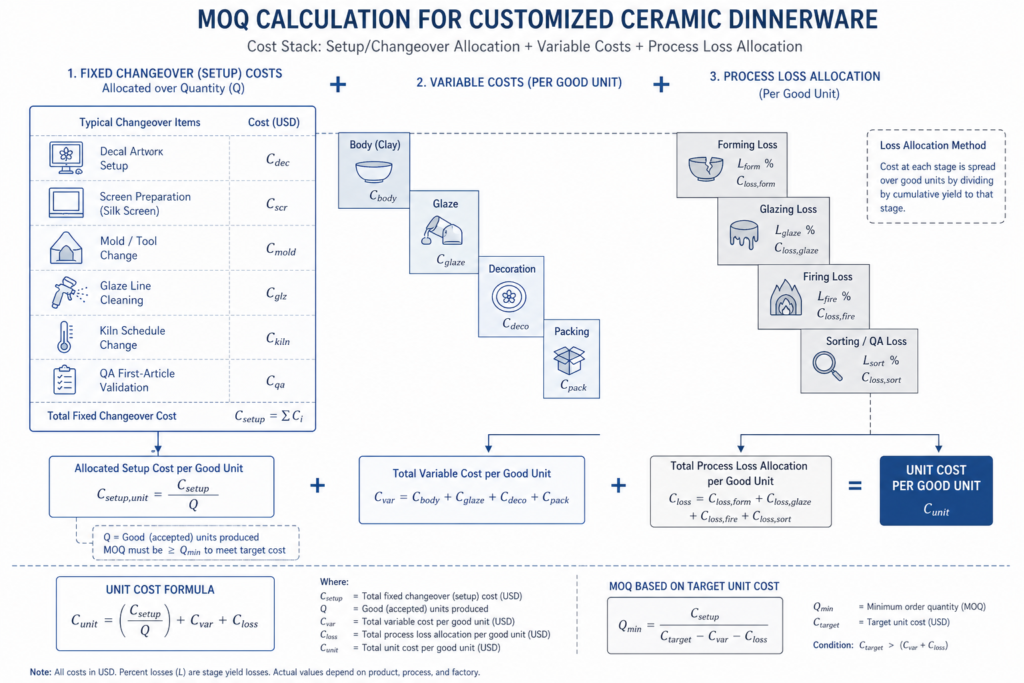
For ceramic factories, MOQ is not only about how many plates, bowls, or mugs a customer wants to order. It is about how many sellable pieces are needed to absorb changeover cost, tooling preparation, decoration setup, kiln scheduling, quality validation, and production loss allocation. That is why MOQ in customized ceramic dinnerware is fundamentally different from MOQ in many low-complexity consumer products.
What Is MOQ Calculation in Customized Dinnerware
MOQ calculation is the factory-side method used to determine the minimum economically viable order quantity for a custom ceramic product. In dinnerware manufacturing, that quantity must be large enough to recover all run-specific costs while still delivering consistent quality.
A proper MOQ calculation usually includes four cost layers:
1. Changeover Cost
This includes all one-time setup activities required to switch the factory from one product or decoration program to another, such as:
- mold or tooling change
- glaze line cleaning
- decal or screen preparation
- color matching
- kiln schedule adjustment
- first article inspection
2. Qualification Cost
Before mass production, the factory often needs to confirm visual quality, dimensions, glaze fit, food-contact safety, and firing stability. This creates additional cost that must be absorbed by the order.
3. Production Loss Allocation
Ceramic production never starts with exactly the number of good pieces that the buyer wants to ship. The factory must account for loss during forming, drying, glazing, firing, and final sorting.
4. Capacity Occupancy
Customized orders interrupt standard production flow. Short runs reduce kiln loading efficiency, increase line fragmentation, and often consume nearly the same engineering attention as larger runs.
For this reason, a realistic MOQ is not arbitrary. It is the minimum quantity at which the supplier can run the project without pushing defect rate, energy waste, or commercial risk too high.
Why MOQ Matters More in Ceramic Dinnerware Than in Other Products
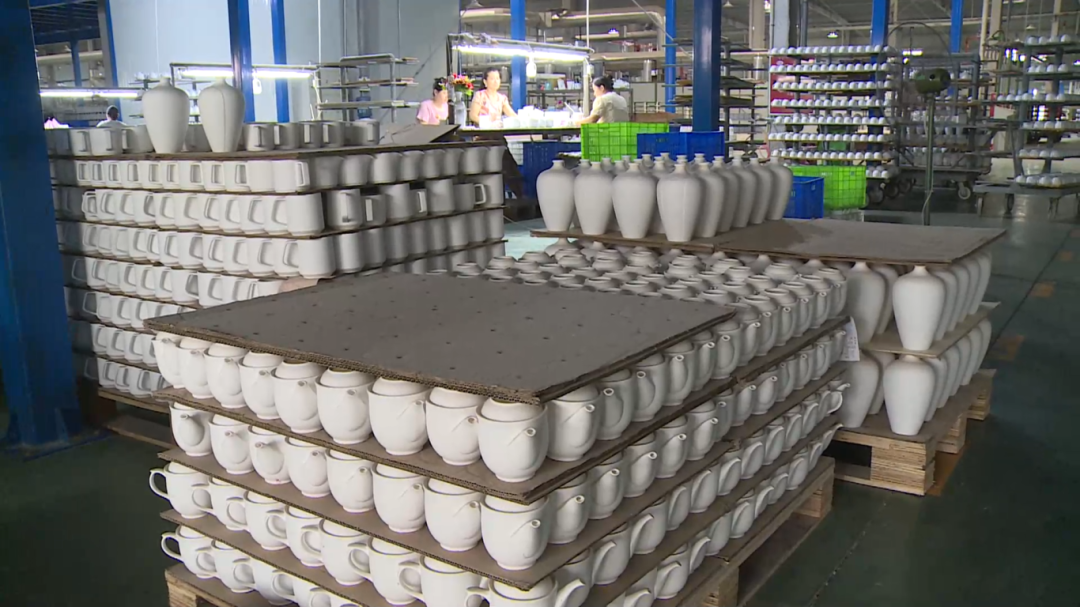
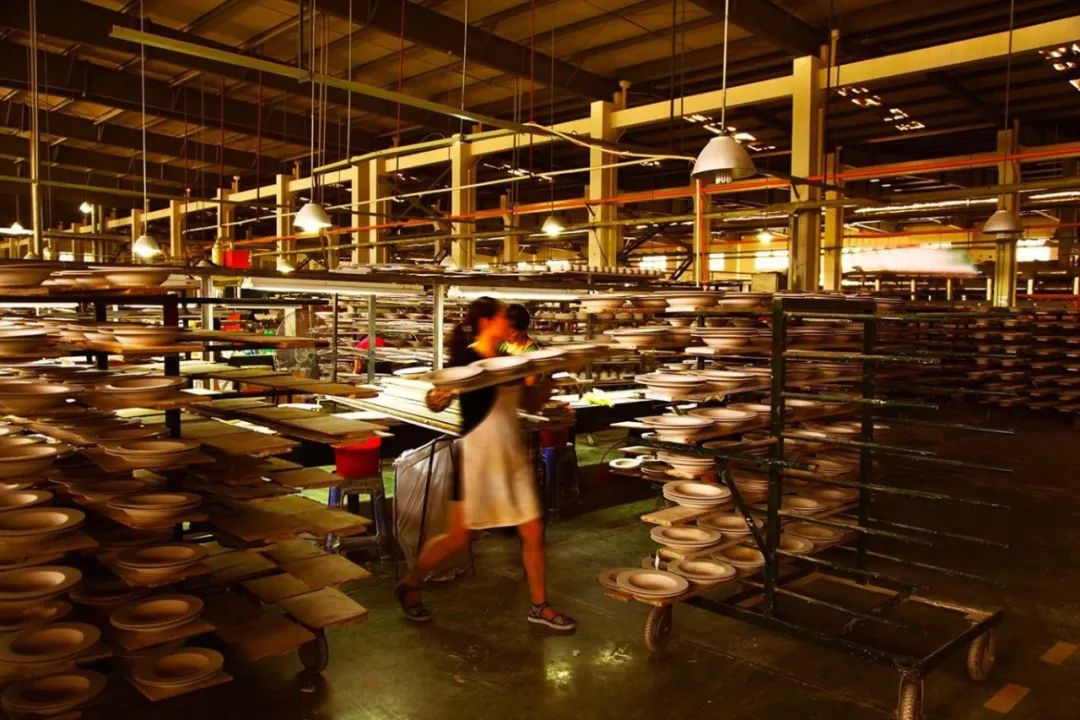
Ceramic dinnerware is a multi-stage thermal process, not a simple assembly business. A custom plate or bowl typically passes through body preparation, forming, drying, glazing, decoration, firing, inspection, and packing. Each stage can generate loss, and much of that loss becomes visible only after firing.
A life-cycle study on ceramic tableware production found that the firing stage accounted for 87% of total energy use per kilogram of goods in an industrial factory scenario, while high discard rates could exceed 15%, which means every rejected piece significantly increases the cost of each accepted unit Source.
That is why minimum order quantity in ceramics is strongly linked to:
- kiln loading density
- firing energy efficiency
- defect exposure
- decoration setup cost
- yield after sorting
A buyer who only asks, “Can you lower MOQ?” may miss the more important question: What process cost is the supplier trying to protect?
The Core Logic Behind MOQ Calculation
A technically sound MOQ model can be expressed in a simple economic form:
MOQ = ceil( ( Setup Cost + Qualification Cost + Allocated Tooling Cost + Scheduling Cost ) / Contribution per Good Piece )
In practical terms, MOQ rises when:
- setup cost is high
- yield is low
- reject rate is unstable
- product complexity increases
- contribution per accepted piece decreases
This is especially common in dinnerware customization projects involving:
- new shapes
- multiple decal colors
- metallic decorations
- reactive or matte glazes
- retailer-specific packaging
- low-volume mixed assortments
Why Accepted Quantity Matters More Than Ordered Quantity
In ceramic manufacturing, factories calculate cost based on good output, not on the order quantity printed on the purchase order.
If total process yield is represented by:
Y = (1 – r1) × (1 – r2) × (1 – r3) × (1 – r4) × (1 – r5)
Then the production start quantity is:
Qstart = Qgood / Y
This means that if a buyer needs 10,000 acceptable pieces, the factory may need to start with far more than 10,000 units, depending on defect history and process stability.
That difference is exactly where production loss allocation becomes critical.
How Changeover Cost Affects MOQ in a Ceramic Factory
Changeover cost is one of the most misunderstood drivers of MOQ in ceramic dinnerware manufacturing.
When a factory receives a new custom order, it may need to:
- stop an existing line
- clean glaze tanks and hoses
- prepare a new artwork file or decal paper
- calibrate decoration colors
- change mold sets or rollers
- run pilot pieces for approval
- isolate firing lots to avoid contamination or color variation
Even if the customer orders only a small quantity, most of these costs still occur. That is why the first order always carries more burden than a repeat order.
First Order MOQ vs Repeat Order MOQ
A professional ceramic tableware supplier should be able to explain the difference between:
First Order MOQ
Higher because it includes:
- artwork setup
- line validation
- color approval
- process qualification
- sample risk
Repeat Order MOQ
Lower because:
- tooling already exists
- decoration files are confirmed
- glaze/body compatibility is validated
- historical process data improves planning accuracy
If a supplier gives exactly the same MOQ for every project regardless of design complexity, that is often a sign that MOQ is being quoted from a sales template rather than from actual manufacturing logic.
Why Production Loss Allocation Is So Important
In dinnerware production, loss is not accidental. It is structurally built into the process because ceramic bodies shrink, densify, release gases, and interact with glaze during firing.
Typical Loss Points in Custom Ceramic Production
Forming Loss
Possible issues:
- uneven wall thickness
- poor green strength
- rim deformation
Drying Loss
Possible issues:
- cracking
- warpage
- edge lifting
Glazing Loss
Possible issues:
- glaze thickness variation
- crawling
- contamination
- color inconsistency
Firing Loss
Possible issues:
- pinholes
- blisters
- black core
- distortion
- underfired glaze
- overfired shape deformation
Sorting Loss
Possible issues:
- color deviation
- foot instability
- minor glaze surface defects
- decal misalignment
Every loss point increases the true cost per accepted unit. Therefore, a factory with poor yield must either raise price or raise MOQ.
The Scientific Reason MOQ Cannot Be Separated from Process Stability
Ceramic dinnerware production is governed by thermochemical transformation. That is why MOQ is not just accounting; it is also materials engineering.
Gas Release and Glaze Defects
During firing, several reactions release gases from the body.
Kaolinite Dehydroxylation
Al2Si2O5(OH)4 → Al2Si2O7 + 2H2O↑
Carbonate Decomposition
CaCO3 → CaO + CO2↑
Carbon Burnout
C + O2 → CO2↑
If the glaze seals too early or the firing cycle is too fast, these gases can escape through the molten glaze and create pinholes. According to Digitalfire, pinholing is commonly associated with gas-producing particles, thick glaze application, fast firing, and glaze chemistries that do not heal surface disruption easily Source.
Thermal Expansion Mismatch and Crazing
Another major defect risk is crazing, which occurs when glaze and body do not contract compatibly during cooling or service use.
A simplified stress relationship can be expressed as:
σ = ( E / (1 – ν) ) × ( αbody – αglaze ) × ΔT
This means glaze stress rises when the thermal expansion difference between body and glaze becomes too large.
According to Digitalfire, the root cause of crazing is the thermal expansion mismatch between body and glaze Source. ASTM also recognizes crazing resistance as a critical service property for glazed ceramic whiteware under thermal shock conditions Source.
For buyers, the takeaway is simple: when MOQ is forced too low, the factory has less room to optimize body-glaze fit, firing schedule, and process stability, which can increase hidden defect risk.
How Strong Factories Control MOQ More Efficiently
A high-level supplier does not simply impose MOQ. Instead, they work to reduce the technical burden behind MOQ.
Better Setup Consolidation
Strong factories bundle projects with the same:
- body family
- glaze system
- shape platform
- firing curve
- packaging standard
This lowers changeover cost and often allows more flexible MOQs.
Higher First-Pass Yield
Factories with good process control reduce loss through:
- cleaner raw materials
- tighter glaze viscosity control
- stable application weight
- well-managed burnout stage
- optimized kiln curves
- disciplined visual sorting criteria
Smarter Decoration Planning
MOQ can often be reduced if different SKUs share:
- the same blank shape
- the same glaze base
- the same decal size
- the same outer carton structure
This is often a better negotiation route than simply asking for a lower MOQ with no process adjustment.
How Buyers Can Use MOQ to Evaluate a Supplier
For B2B buyers, MOQ is an excellent tool for judging supplier capability.
A reliable supplier should be able to explain:
What Type of MOQ Is Being Quoted
Is it based on:
- per piece
- per SKU
- per shape
- per decoration
- per assortment
- per carton configuration
Whether Yield Is Included
Does the supplier calculate based on:
- gross production quantity
- or accepted shipment quantity
Whether Repeat Orders Have Lower MOQ
If not, the supplier may not be separating first-order setup cost from repeat production cost.
What Quality Risks Are Considered
A strong supplier should connect MOQ with:
- glaze defect history
- kiln load efficiency
- decoration setup complexity
- food-contact compliance
- final sorting rejection
In short, MOQ transparency often reflects factory maturity.
Relevant Standards Buyers Should Know
When sourcing custom ceramic plates, bowls, mugs, or full tableware sets, MOQ discussions should not be separated from compliance and technical validation.
Food Contact Safety
- ISO 6486-1:2019 specifies the test method for release of lead and cadmium from ceramic ware intended for food contact Source.
- ISO 6486-2:1999 specifies permissible limits for that release Source.
- Council Directive 84/500/EEC requires ceramic food-contact articles in the EU to comply with lead and cadmium migration limits and be supported by a written declaration of conformity Source.
- FDA guidance also addresses lead and cadmium contamination risks in ceramic foodware Source.
Body Maturity and Durability
- ASTM C373 measures water absorption, porosity, density, and specific gravity, which are key indicators of ceramic body maturity Source.
- ASTM C554 evaluates crazing resistance under thermal shock Source.
- ASTM C424 evaluates crazing resistance by autoclave treatment, especially useful for porous whiteware systems Source.
Final Takeaway: MOQ Is a Technical Signal of Factory Capability
In customized dinnerware, MOQ is not just a number from the sales department. It is the visible result of how a factory manages:
- changeover cost
- yield stability
- defect prevention
- kiln utilization
- quality control
- compliance burden
For buyers, the best question is not only “Can you lower the MOQ?” but also:
“What technical assumptions are built into your MOQ?”
That single question can reveal whether the supplier truly understands ceramic manufacturing, or whether they are simply quoting numbers without process logic.
Custom Solutions Available
Our technical experts are always ready to assist you in finding the perfect customized solution for your dinnerware needs.