In-Glaze Decoration for Custom Tableware: Process, Benefits, Defects, and Buyer Guide
For buyers sourcing custom ceramic tableware, decoration is not just about appearance. It is directly linked to brand durability, dishwasher resistance, food-contact safety, and long-term product value. Among the major decoration methods used in the tableware industry, in-glaze decoration stands out as one of the most technically balanced options for branded dinnerware, hotelware, and promotional ceramicware.
Unlike ordinary surface printing, in-glaze decoration allows the pigment layer to become partially embedded into the glaze during firing. This creates a smoother, more durable surface and gives logos, patterns, and brand marks better resistance to wear during repeated commercial use. For OEM and ODM buyers, this is why in-glaze is often considered a premium decoration route for restaurants, hotels, airlines, and institutional dining programs.
What Is In-Glaze Decoration?
In-glaze decoration is a ceramic decorating method in which pigments or decals are applied onto an already glazed ceramic surface and then fired again at a temperature high enough for the glaze surface to soften, but not so high that the glaze becomes uncontrollably fluid. During this firing stage, the decoration does not simply stay on top of the glaze. Instead, it becomes partially engulfed by the softened glaze layer, creating a finish that is more integrated and more durable than standard on-glaze decoration. Source
In practical terms, in-glaze decoration sits between two better-known methods:
- Underglaze decoration: color lies beneath the final glaze layer
- On-glaze decoration: color remains mainly on top of the glaze
- In-glaze decoration: color becomes locked into the upper region of the glaze itself
For export-oriented tableware factories, this makes in-glaze especially useful for custom logos, premium branding, and commercial-use dinnerware where surface durability matters.
Why In-Glaze Matters in the Custom Tableware Industry
In B2B tableware sourcing, decoration failure is often one of the first reasons for customer complaints. A ceramic plate may remain structurally intact, but if the logo fades, scratches easily, or loses gloss after dishwashing, the product is considered a failure from the buyer’s perspective.
That is why in-glaze ceramic tableware is so valuable in the following segments:
- Hotelware and restaurant ware
- Airline catering tableware
- Branded promotional mugs and plates
- Institutional dining projects
- Premium OEM/ODM ceramic dinnerware collections
For these applications, buyers want decoration that can survive:
- repeated washing
- stack abrasion
- detergent exposure
- long-term brand display
- food-contact safety testing
In-glaze decoration delivers this balance better than many standard low-temperature surface-printing methods.
The Core Principle: Glaze Softening
The real technical heart of in-glaze decoration is glaze softening.
A ceramic glaze is a glassy layer. When reheated, it does not instantly melt like water. Instead, its viscosity decreases gradually as temperature rises. Ceramic glaze research explains that glass passes through different viscosity regions, including the softening point, where viscosity is approximately 10^7.6 Pa·s, and the flow point, where viscosity is approximately 10^5 Pa·s. This is why a glaze can still hold shape while being soft enough to interact with pigment particles during firing. Source
In simple factory language:
- if the glaze is too hard, the pigment stays exposed on the surface
- if the glaze is too fluid, the decoration blurs, bleeds, or sinks too deeply
- if the glaze reaches the right softening window, the pigment becomes embedded in a controlled way
What Happens When the Pigment “Sinks” Into the Glaze?
The phrase “pigment sinking” is widely used in the ceramic industry, but the real process is more precise.
During in-glaze firing, several things happen at the same time:
- The organic carrier in the decal or printing medium burns out
- The glaze surface softens and becomes highly viscous
- The glaze begins to wet the pigment particles
- Surface forces and viscous flow draw the glaze around the pigment
- The pigment becomes partially buried in the glaze layer
- Cooling increases viscosity again and locks the decoration in place
This means the decoration is no longer just sitting on top of the ware. It becomes part of the glaze microstructure.
Why Pigment and Glaze Compatibility Matters
Not every ceramic pigment works equally well in an in-glaze system. The success of the process depends on the relationship between:
- pigment chemistry
- glaze composition
- firing temperature
- firing time
- kiln atmosphere
For high-performance reds, oranges, and yellows, many factories use zircon inclusion pigments. These pigments stabilize sensitive color compounds by encapsulating them inside a zirconium silicate matrix.
According to Digitalfire, some important red pigments are based on Cd(Sx,Se1-x) compounds enclosed in zirconium silicate, and zircon formation occurs through the reaction:
SiO2 + ZrO2 → ZrSiO4 Source
Vibrantz also explains that yellow, orange, and red inclusion pigments use cadmium-sulfoselenide compounds encapsulated in zircon-silicate crystals, which improves chemical and thermal stability. Some of these pigment grades are reported to be stable up to 1250°C or 1350°C, depending on application type. Source
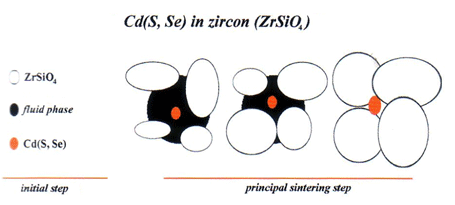
Figure: Process of occluding pigments in zircon. Source: Digitalfire.
Typical Process Parameters in In-Glaze Production
For overseas buyers, one of the most important points is this: a good supplier does not control in-glaze decoration by temperature alone. The true process target is the time-temperature-viscosity window.
Typical industrial control factors include:
Glaze Thickness
A practical glaze thickness window is often around 150–300 μm, depending on body type, glaze formulation, and decoration design. If the glaze is too thin, the pigment may remain exposed. If it is too thick, the logo may lose definition.
Decorative Layer Thickness
The pigment-bearing layer must be controlled carefully. Too little deposit leads to weak color. Too much deposit increases the risk of roughness, blistering, or incomplete burial.
Burnout Control
The organic materials used in decals or inks must burn out cleanly before or during the glaze-softening stage. Poor burnout often causes visible defects such as pinholes and bubbles.
Firing Window
Many industrial in-glaze or third-fire tableware systems operate in a range of roughly 780–900°C, though the actual firing window depends on the glaze formulation, pigment system, and substrate. The objective is to reach the glaze softening zone without causing excessive surface flow. Source
Soak Time and Cooling
Peak hold time must be long enough for proper pigment embedding, but not so long that the decoration diffuses laterally. Controlled cooling is also important to reduce stress and prevent delayed defects.
Common Defects in In-Glaze Decoration
A supplier’s real skill becomes visible when something goes wrong. The following defects are among the most common in poorly controlled in-glaze production.
Pinholes and Pitting
Pinholes and pitting occur when gases from the body, glaze, or decoration escape through the glaze but the surface cannot heal before cooling. Digitalfire explains that common causes include gas-producing raw materials, incomplete burnout, overly viscous glaze melts, poor airflow, rapid firing, and uneven glaze application. Source

Figure: Severe glaze pinholing defect. Source: Digitalfire.
For branded tableware, pinholes are especially damaging because they often appear inside dark logos or solid print areas, where they are easier to see.
How good factories reduce pinholes
- use cleaner body materials
- improve burnout conditions
- optimize kiln ventilation
- make the glaze more healable
- control application thickness
- slow down firing through critical gas-release zones
Color Bleeding and Edge Blur
If the glaze becomes too fluid during firing, the decoration loses sharpness. Fine lines may spread, text may become fuzzy, and high-coverage logos can develop a halo effect. This is a classic sign that the supplier has exceeded the ideal in-glaze firing window.
Rough Decoration Surface
If the glaze does not soften enough, the pigment does not become fully embedded. The result is a decoration that feels slightly rough or raised to the touch. This often leads to weak abrasion resistance and faster wear in commercial dishwashing.
Crazing
Crazing is a network of fine cracks caused by mismatch in thermal expansion between the body and glaze. It can occur if the glaze chemistry is altered to improve decoration fusion without properly balancing thermal expansion and cooling behavior. Even if the decoration looks good at first, crazing can appear later during ware use.
Heavy Metal Release Risk
Food-contact safety is one of the most important reasons buyers should care about decoration technology.
The FDA notes that lead compounds were historically used in some glazes to regulate melting behavior, but if firing is inadequate or contaminated manufacturing practices are used, extractable lead may remain a problem. FDA also warns that some pottery labeled “Lead Free” has still been found to contain extractable lead because of contamination during production. Source
This is why decoration quality must be evaluated together with food-contact compliance.
What B2B Buyers Should Check Before Choosing a Supplier
For importers, wholesalers, distributors, and private-label brands, the best way to judge in-glaze capability is not by catalog photos. It is by the supplier’s ability to provide technical evidence.
Ask for Cross-Section Proof
A serious supplier should be able to show that the decoration is actually embedded into the glaze, not merely fused weakly on the surface.
Ask About Process Stability
The supplier should explain:
- which glaze system is used
- what firing window is applied
- how color consistency is controlled
- how defects are monitored batch to batch
Ask for Durability Testing
Request evidence such as:
- dishwasher resistance results
- abrasion or surface wear checks
- before/after color comparison
- gloss retention data
Ask for Food-Safety Compliance Reports
For export markets, the supplier should understand and provide testing references related to:
- ISO 6486-1:2019 for test methods on lead and cadmium release from ceramic ware Source
- ISO 6486-2 for permissible limits context Source
- EN 1388 for lead and cadmium release from ceramic ware Source
- ASTM C738 for extraction of lead and cadmium from glazed ceramic surfaces Source
- ASTM C927 for lip-and-rim extraction testing in externally decorated drinkware Source
Ask Whether the Factory Understands Pigment Chemistry
If a supplier cannot explain why certain reds or oranges require zircon inclusion pigments, or why some colors are more sensitive to overfiring, its decoration process may still be trial-and-error rather than fully engineered.
Why In-Glaze Decoration Is a Competitive Advantage for Export Tableware Brands
For foreign trade companies and ceramic tableware manufacturers, in-glaze decoration can be positioned as a clear value-added capability.
It helps buyers achieve:
- better logo durability
- smoother decorated surfaces
- improved resistance to commercial washing
- stronger premium positioning
- lower complaint risk in hospitality projects
- better long-term brand presentation
This is especially important in projects where the customer is not just buying plates or mugs, but buying consistent brand visibility on every piece of ceramicware.
Final Thoughts
In the ceramic tableware business, decoration should never be treated as a cosmetic afterthought. With in-glaze decoration, the success of a logo or design depends on a very specific technical balance: the glaze must soften enough to engulf the pigment, but remain stable enough to preserve clarity, gloss, and safety.
For B2B buyers, that means one simple conclusion:
The best in-glaze suppliers are not the ones who only offer more colors. They are the ones who can control glaze chemistry, firing behavior, defect prevention, and compliance at the same time.
If you are sourcing custom ceramic tableware for hotels, restaurants, retail brands, or promotional projects, understanding in-glaze decoration will help you choose a supplier with stronger real manufacturing capability—not just better sales language.
- Ceramic technology. How to characterise ceramic glazes
- Vibrantz Inclusion Pigments Technical Information
- Digitalfire: Glaze and Body Pigments and Stains in the Ceramic Tile Industry
- Digitalfire: Glaze Pinholes, Pitting
- ISO 6486-1:2019
- ISO 6486 overview / related limit context
- Lucideon: Toxic Metal Release of Ceramic Ware
- FDA CPG 545.450 – Lead Contamination
- FDA CPG 545.400 – Cadmium Contamination
- FDA Guidance on Imported Traditional Pottery and “Lead Free” Claims
Custom Solutions Available
Our technical experts are always ready to assist you in finding the perfect customized solution for your dinnerware needs.