Heat Balance in Ceramic Tableware Manufacturing
In ceramic tableware manufacturing, heat balance is one of the most important but often overlooked technical indicators. It directly affects energy consumption, firing consistency, product quality, production cost, and carbon footprint. For importers, wholesalers, hospitality brands, and private label buyers, understanding heat balance can help identify whether a supplier is running a stable and efficient kiln system or simply relying on experience-based firing.
This article explains what heat balance means in the customized dinnerware and tableware industry, how it is calculated, why it matters for quality control and sustainability, and how B2B buyers can use it to assess a supplier’s real manufacturing capability.
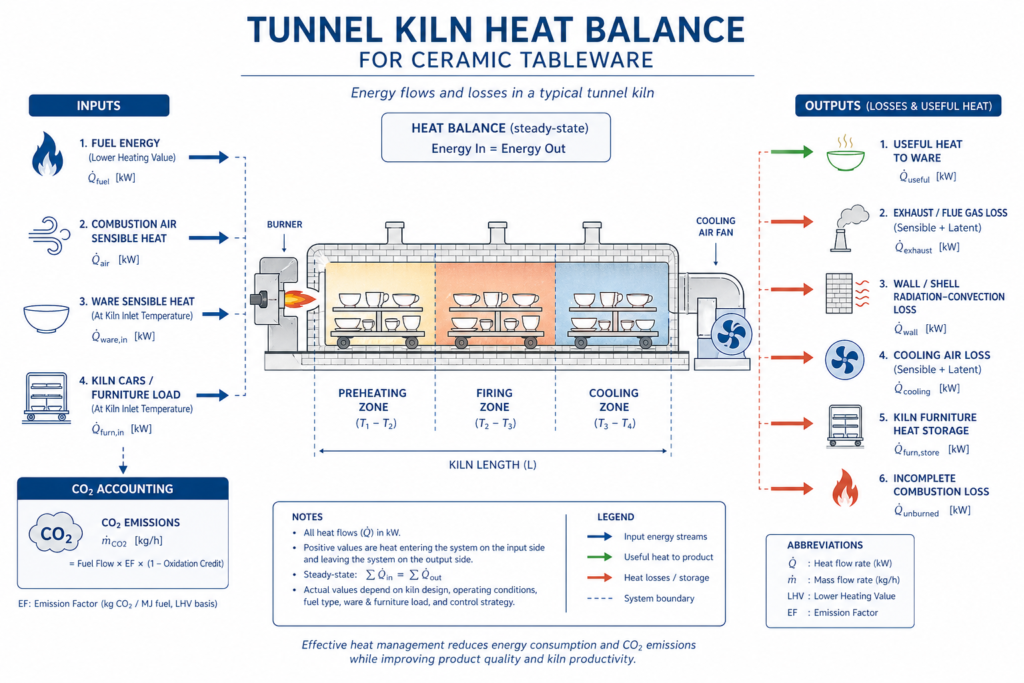
What Is Heat Balance in Ceramic Tableware Manufacturing?
Heat balance refers to the full thermal accounting of a kiln system. It shows how much heat enters the kiln and how that heat is distributed between:
- useful heat absorbed by the ceramic ware
- heat stored in kiln furniture and refractory materials
- heat lost through flue gas
- heat lost from kiln walls and openings
- heat discharged during cooling
- heat wasted through poor combustion or air leakage
In simple terms, heat balance answers one key question:
Where does the energy go during firing?
For a ceramic tableware factory, this matters because the kiln is usually the largest energy-consuming process in production. According to the U.S. National Bureau of Standards, heat balance is one of the best tools for identifying where energy is actually used and where it is lost in furnaces, kilns, and ovens Source.
Why It Matters More in Customized Tableware Production
In standard ceramic production, kiln loading is often repetitive. In customized tableware manufacturing, however, the thermal load changes more frequently because of:
- different plate, bowl, and mug shapes
- varying wall thicknesses
- different glaze systems
- changing order quantities
- logo decals or overglaze decoration
- mixed kiln loading for multiple SKUs
That means the kiln is not only firing ceramic ware. It is also constantly adapting to changing mass, geometry, glaze behavior, and loading density. If the supplier cannot control heat balance well, the result is usually unstable quality, higher reject rates, and unnecessary fuel consumption.
Why Heat Balance Is Critical for Energy Consumption Control
In most ceramic factories, the firing stage dominates the thermal energy bill. Sector data referenced in the EU ceramic BREF review notes that for the ceramics industry, 64% of emissions come from fuel combustion, mainly from drying and firing processes Source.
This is why heat balance is central to both:
- cost control
- carbon footprint reduction
Basic Heat Balance Equation
A kiln heat balance can be expressed as:
Qin = Quseful + Qflue + Qwall + Qopening + Qcooling + Qfurniture + Qunburned + Qaccumulation
Where:
- Qin = total heat input
- Quseful = heat used to fire and mature the ceramic ware
- Qflue = heat carried away by exhaust gas
- Qwall = heat lost through the kiln shell
- Qopening = heat lost through doors, gaps, and air infiltration
- Qcooling = unrecovered heat during the cooling stage
- Qfurniture = heat absorbed by setters, kiln cars, rollers, and refractory supports
- Qunburned = chemical loss caused by incomplete combustion
- Qaccumulation = transient stored heat under unstable operation
A well-run kiln minimizes avoidable losses and maximizes the share of heat that actually contributes to body vitrification and glaze maturation.
How Heat Balance Affects Ceramic Quality
Heat balance is not only about saving gas. It is a direct quality variable.
Ceramic Body Reactions During Firing
As ceramic tableware is heated, the body undergoes multiple physical and chemical transformations.
Dehydroxylation of Kaolinite
A common clay mineral in porcelain and whiteware bodies is kaolinite. During firing, kaolinite loses structural hydroxyl groups:
Al2Si2O5(OH)4 → Al2Si2O7 + 2H2O↑
This transformation is essential for the later development of a mature ceramic structure.
Mullite Formation
At higher temperatures, mullite develops and contributes to strength, durability, and thermal stability:
3Al2Si2O5(OH)4 → 3Al2O3·2SiO2 + 4SiO2 + 6H2O↑
In porcelain tableware, controlled mullite formation is closely related to chip resistance, whiteness, density, and long-term performance.
Carbonate Decomposition
If the ceramic body or glaze contains carbonate-bearing raw materials, decomposition may also occur:
CaCO3 → CaO + CO2↑
This is important for both firing behavior and process-related carbon emissions.
If Heat Balance Is Poor, What Defects Can Appear?
Improper heat distribution, unstable combustion, or poor cooling control can lead to serious defects in ceramic tableware.
Common Defects Caused by Poor Heat Balance
- Pinholes: tiny surface holes caused by incomplete gas release or poor glaze healing
- Crazing: fine cracks caused by glaze-body mismatch and improper cooling history
- Warpage: shape deformation caused by thermal imbalance or overfiring
- Dunting: cracking caused by thermal shock during cooling
- Black core: incomplete burnout inside the body
- Blistering: trapped gas expansion in glaze or body
- High water absorption: underfired body with insufficient vitrification
- Color inconsistency: unstable temperature field or atmosphere variation
For export tableware, these defects do not only affect appearance. They also affect food-contact reliability, stacking accuracy, dishwasher durability, and retail rejection rates.
How Factories Control Heat Balance in Practice
A professional ceramic tableware manufacturer controls heat balance through data, not guesswork.
Key Process Controls Used in Industrial Kilns
A well-managed factory normally uses:
- zone-by-zone temperature monitoring
- fuel flow meters
- flue gas oxygen monitoring
- kiln pressure control
- loading density control
- setter weight management
- cooling curve control
- waste heat recovery systems
- yield-based energy analysis
Typical Control Windows for Tableware Kilns
The exact settings depend on body type, glaze formulation, and kiln design, but common industrial reference ranges include:
Peak Firing Temperature
- 1040-1120°C for earthenware
- 1180-1250°C for vitrified stoneware and hotelware
- 1280-1400°C for hard porcelain
Flue Gas Oxygen in Natural Gas Kilns
- typically around 2-5 vol% under stable firing conditions
Final Firing Uniformity
- preferably within ±5-10°C across the effective loading zone
Cooling Through Quartz Inversion
- controlled cooling around 573°C is especially important to reduce dunting and residual stress
Loading Consistency
- setter mass and stacking pattern should remain as stable as possible between kiln campaigns
These ranges are not universal specifications, but they reflect the type of kiln discipline that buyers should expect from capable suppliers.
How to Calculate Kiln Energy Consumption
For a B2B ceramic tableware supplier, total monthly gas cost is not enough. The more meaningful metric is specific energy consumption per saleable output.
Specific Energy Consumption
SEC = (Efuel + 3.6 × Eelectricity) / msaleable
Where:
- SEC = specific energy consumption in MJ/kg saleable ware
- Efuel = fuel energy input in MJ
- Eelectricity = kiln-related electricity in kWh
- msaleable = mass of accepted finished products in kg
This is far more useful than energy per kiln batch, because it includes the hidden cost of rejects.
Heat Loss Through Flue Gas
One of the most important losses is hot exhaust gas leaving the kiln:
Qflue = ṁgas × cp,gas × (Tstack − Tambient)
NIST notes that stack heat-loss estimation depends on fuel-use measurement, flue-gas analysis, temperature monitoring, and in some cases direct flow measurement Source.
How Heat Balance Connects to Carbon Footprint
For buyers working with sustainability targets, heat balance is also a carbon indicator.
Fuel-Based CO2 Emissions
The GHG Protocol identifies stationary combustion emissions from kilns and furnaces as Scope 1 direct emissions Source.
A simplified kiln-level carbon calculation is:
CO2,fuel = Efuel × EFfuel
For natural gas, a commonly cited default emission factor is approximately:
56.1 kg CO2/GJ
Carbon Footprint Per Saleable Piece
A practical gate-to-gate metric for ceramic tableware sourcing is:
CFpiece = (CO2,fuel + CO2,electricity + CO2,process) / Nsaleable pieces
This allows importers and brands to compare suppliers on a much more realistic basis.
Why Yield Is Also a Carbon Variable
A rejected piece has already consumed:
- raw materials
- forming energy
- drying energy
- kiln space
- fuel
- labor
- inspection time
That means low first-pass yield increases carbon footprint per accepted piece, even if the kiln itself appears efficient.
Why B2B Buyers Should Ask About Heat Balance
For a professional buyer, heat balance is a powerful way to evaluate the real process capability of a ceramic tableware manufacturer.
What Heat Balance Tells You About a Supplier
A supplier with strong heat-balance control usually also has stronger performance in:
- product consistency
- lower defect rates
- better kiln efficiency
- more stable lead times
- clearer carbon reporting
- better support for customized programs
A supplier that only talks about firing temperature, but cannot discuss specific energy consumption, oxygen control, kiln uniformity, or carbon per piece, may not have strong engineering control.
Questions Buyers Should Ask Suppliers
Technical Questions
- What is your kiln energy consumption per kg of saleable ware?
- How do you monitor flue gas oxygen and kiln temperature uniformity?
- How do you control firing when order mix changes?
- How do you reduce kiln heat loss?
Quality Questions
- What defects are most closely monitored after firing?
- How do you control pinholes, crazing, and warpage?
- What is your first-pass yield after glost firing?
Sustainability Questions
- Can you provide kiln-related CO2 data?
- Do you operate under ISO 50001 or similar energy-management practices?
- Can you support product carbon footprint calculation under ISO 14067?
Relevant Standards Buyers Should Know
ISO 50001
ISO 50001 provides a framework for systematic energy management and continuous improvement in energy performance Source.
ISO 14064-1
ISO 14064-1 defines requirements for organization-level greenhouse gas quantification and reporting Source.
ISO 14067
ISO 14067 covers the quantification of the carbon footprint of products and is highly relevant for ceramic tableware carbon reporting Source.
ISO 6486-1
ISO 6486-1 specifies test methods for lead and cadmium release from ceramic ware intended for food contact Source.
ASTM C373
ASTM C373 is used to determine water absorption, apparent porosity, and related properties of fired ceramic products. ASTM specifically notes that these measurements help determine the degree of maturation of a ceramic body Source.
Final Thoughts
In ceramic tableware manufacturing, heat balance is where quality control, energy efficiency, and carbon management come together.
For manufacturers, better heat balance means:
- lower fuel cost
- higher firing stability
- lower reject rates
- more competitive production
For buyers, it means:
- more reliable quality
- better supplier assessment
- lower long-term sourcing risk
- stronger sustainability credentials
If you are sourcing custom ceramic plates, bowls, mugs, or full dinnerware collections, heat balance is not just an internal engineering metric. It is a practical indicator of whether a supplier can deliver consistent quality, controlled energy use, and scalable production performance.
Custom Solutions Available
Our technical experts are always ready to assist you in finding the perfect customized solution for your dinnerware needs.