Bone Ash in Bone China: How Tricalcium Phosphate Shapes Translucency, Quality, and Supplier Performance
For buyers in the customized tableware industry, bone ash is far more than a traditional ceramic raw material. It is one of the defining components that gives bone china its premium identity: elegant translucency, refined whiteness, thin-wall strength, and high-end perceived value. According to ISO 5644:2024, bone china is a type of soft-paste porcelain containing at least 35% by mass of tricalcium orthophosphate in the fired body, with water absorption below 0.5% by the referenced test method. Source
Why Bone Ash Matters in Customized Tableware
In OEM and ODM tableware projects, the material choice directly affects not only product appearance, but also durability, production consistency, and final brand positioning. Bone ash is important because it helps create the characteristic phase composition that distinguishes true bone china from ordinary porcelain. That difference is especially relevant for premium dinnerware, hotelware, giftware, and retail collections where buyers expect thinness, light transmission, and a more refined tactile experience. Source
A supplier may offer white porcelain that looks visually similar in photos, but genuine bone china is compositionally and structurally different. In commercial terms, that means bone ash is tied not only to appearance, but also to how credibly a factory can market its products as bone china in international trade. Source
What Is Bone Ash in Ceramic Engineering?
Bone ash is the calcined inorganic residue of bone. In ceramic chemistry, it is associated with calcium phosphate chemistry, particularly hydroxyapatite and tricalcium phosphate. Digitalfire describes bone ash as tricalcium phosphate in the form of hydroxyapatite and explains that, during bone china firing, it reacts to form anorthite and Ca₃(PO₄)₂-related phases. Source
A simplified thermal transformation can be written as:
2Ca5(PO4)3OH → 3Ca3(PO4)2 + CaO + H2O ↑
Digitalfire gives the corresponding representation as:
2Ca5(OH)(PO4)3 → 3Ca3(PO4)2 + Ca(OH)2
In the fired ceramic body, calcium-bearing species further react with aluminosilicates from kaolin and feldspathic materials, contributing to the formation of anorthite:
CaO + Al2O3 + 2SiO2 → CaAl2Si2O8
This phase evolution is a core reason why bone china behaves differently from conventional porcelain. Source
Bone China Composition: Why Tricalcium Phosphate Is the Key
A classic bone china body is often described as:
- 50% Bone Ash
- 25% Feldspathic Stone
- 25% Kaolin
This typical composition is noted by Digitalfire. Source
However, the most important point for buyers is not the raw batch recipe alone, but the fired phase composition. Research on fired bone china confirms the presence of β-tricalcium phosphate (β-TCP), anorthite, quartz, and an amorphous glassy phase. These phases collectively control translucency, fired strength, and thermal behavior. Source
How Tricalcium Phosphate Affects Bone China Translucency
The relationship between tricalcium phosphate content and translucency is not a simple “more is better” equation. Instead, translucency depends on whether the fired body reaches a microstructure with:
- very low residual porosity
- fine and evenly distributed crystalline phases
- limited agglomeration
- controlled glassy phase formation
- stable densification without excessive deformation
Digitalfire explains that bone china becomes highly translucent when the body achieves excellent density with no pores to scatter light, together with very fine and evenly dispersed crystals. Source
A simple expression for light transmission is:
T = (It / I0) × 100%
where:
- $T$ = transmittance or translucency index
- $I_t$ = transmitted light intensity
- $I_0$ = incident light intensity
For scattering-dominated ceramic systems, the relationship can be described conceptually as:
It = I0e−(α + S)t
where:
- α = absorption coefficient
- S = scattering coefficient
- t = thickness
In practical bone china production, pores, coarse β-TCP clusters, residual quartz, and microstructural inhomogeneity all increase scattering and reduce visible translucency. That is why two suppliers can claim similar bone ash content while delivering very different edge-light effects and body quality. Source Source
The Real Engineering Insight
For manufacturers and buyers alike, the correct goal is not maximum tricalcium phosphate, but optimum tricalcium phosphate within a stable sintering window. Too little calcium phosphate weakens the bone china character. Too much, or poorly dispersed calcium phosphate, can make densification harder, raise scattering, and reduce the final optical quality. That is why high-level factories manage bone ash as a microstructure control variable, not just a label claim. Source Source
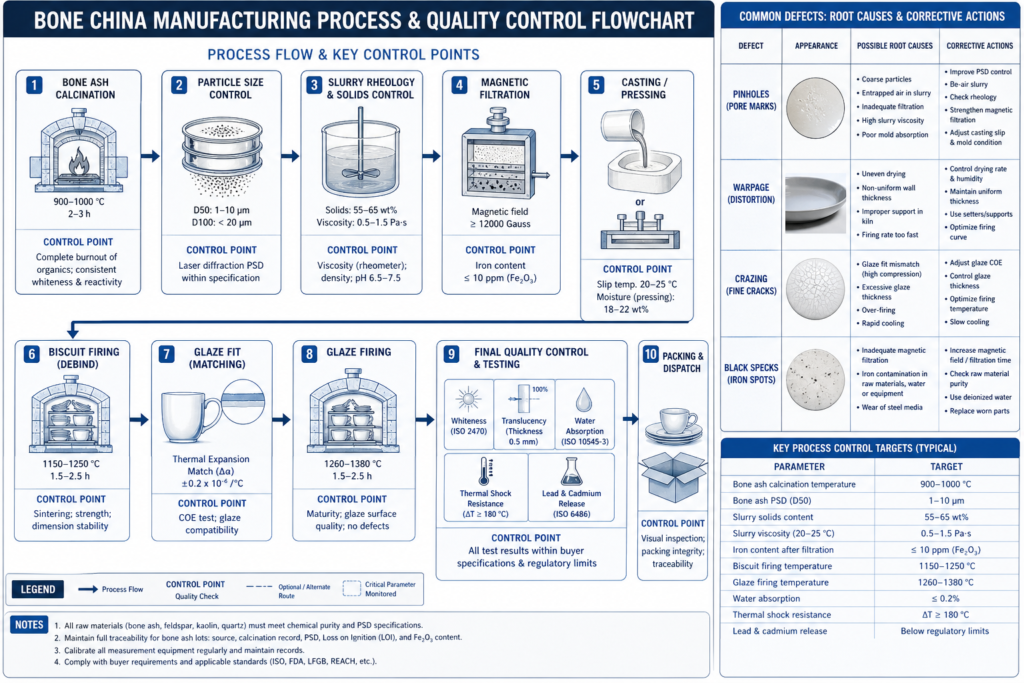
Bone China Manufacturing Process: How Factories Control Bone Ash Performance
Raw Material Preparation
Real bone ash is typically produced by calcining bone at around 1100°C, followed by cooling and milling. This process removes organic matter and stabilizes the material for ceramic use. If calcination is incomplete or contamination is not controlled, problems such as gas release, color defects, and glaze imperfections become more likely. Source
Body Formulation and Dispersion
Because bone china contains relatively low plastic clay content, it has inherently low plasticity. Digitalfire notes that with only around 25% kaolin, bone china bodies have extremely low plasticity, which is one reason industrial casting methods are commonly preferred. Source
In a well-run factory, key control points include:
- bone ash chemistry consistency
- fine and stable particle size distribution
- proper deflocculation of casting slip
- magnetic filtration to remove iron contamination
- controlled solids loading for dense casting
- strict screen residue management
Firing Control
Bone china production is especially sensitive to firing. Unlike some conventional porcelain workflows, bone china is often bisque-fired to high maturity first, then glazed at a lower temperature. Digitalfire highlights that the body becomes very dense after the first firing, which creates a more demanding glazing process and requires careful production tuning. Source
Research also shows that changes in phase evolution can alter the onset of liquid-phase sintering and shift shrinkage behavior. In open-access work on bone china bodies, the fired materials contained β-TCP, anorthite, quartz, and amorphous phase, while increased liquid-phase formation lowered the early sintering temperature and promoted densification. Source
Common Bone China Defects Caused by Poor Bone Ash Control
Pinholes
Pinholes can result from incomplete calcination, trapped gases, contamination, or body-glaze mismatch. Digitalfire notes that excessive bone ash in glaze-related applications can promote pinholing and blistering, especially when firing is too hot or the melt behavior is poorly balanced. Source
Crazing
Crazing usually reflects glaze-body thermal expansion mismatch. In bone china, the phase balance between β-TCP, anorthite, glass phase, and glaze chemistry makes this issue more technically sensitive than in ordinary whiteware. Poor glaze fit may not appear immediately but can emerge after dishwashing, hot-cold cycling, or prolonged storage.
Warpage
Bone china has a narrow firing range and becomes more prone to pyroplastic deformation near maturity. Digitalfire specifically highlights warping risk and the need for carefully tuned firing and custom setters for thin pieces. Source
Black Specks and Gray Tone
These appearance defects are often linked to iron contamination, poor filtration, dirty milling systems, or contaminated recycled scrap. For export-oriented premium tableware, even small visual defects can significantly lower acceptance rates and retail positioning.
How Buyers Can Evaluate Bone China Suppliers
For B2B buyers, the biggest mistake is to assess bone china only by visual inspection of a sample. A good supplier should be able to discuss not only whiteness and translucency, but also composition, porosity, firing maturity, glaze fit, and compliance testing. Source
A serious supplier should be able to provide or explain:
- fired body classification as bone china
- water absorption results
- translucency performance at defined thickness
- porosity or density data
- glaze fit validation
- defect control standards
- food-contact safety compliance records
If a factory can only say “our bone china is very white” but cannot explain process or test data, that is usually a warning sign for long-term OEM reliability.
International Standards Buyers Should Know
ISO 5644:2024
This standard is central because it defines bone china as a soft-paste porcelain containing at least 35% tricalcium orthophosphate in the fired body and refers to test methods for absorption, translucency, thermal shock, dishwasher resistance, and impact resistance. Source
ISO 6486-1:2019 and ISO 6486-2:1999
These standards cover lead and cadmium release for ceramic ware in contact with food. Part 1 specifies the test method, while Part 2 sets permissible limits. They are highly relevant for import compliance and food-contact safety. Source Source
ASTM C373
ASTM C373 is important because it measures water absorption, bulk density, apparent porosity, and apparent specific gravity, which are key indicators of ceramic body maturity and densification. Source
FDA Ceramic Guidance
For U.S.-bound tableware, FDA compliance guidance remains highly relevant. The FDA guidance lists action levels for extractable lead by product category, including 3.0 µg/mL for flatware, 2.0 µg/mL for small hollowware other than cups and mugs, and 0.5 µg/mL for cups and mugs. Source
EU Food Contact Framework for Ceramics
In the EU, ceramic articles intended to contact food are regulated under Directive 84/500/EEC and its later amendments. Secondary regulatory summaries cite limits such as 0.8 mg/dm² lead and 0.07 mg/dm² cadmium for Category 1 flatware-type articles, and 4.0 mg/L lead and 0.3 mg/L cadmium for Category 2 hollowware. Source Source
What Smart Buyers Should Ask Before Placing a Bone China Order
Ask About Material Authenticity
A trustworthy supplier should explain how its body meets the bone china definition and how tricalcium phosphate is introduced and controlled in the fired body. If the factory avoids the topic completely, that is worth investigating further. Source
Ask About Performance at Defined Thickness
For premium tableware, translucency should be evaluated at a specific thickness, not only by visual impression. A technically competent supplier should understand how thickness, phase composition, and residual porosity interact.
Ask About Process Stability
Ask how the factory controls:
- slip rheology
- warpage during firing
- glaze fit
- black specks
- pinholes
- lot-to-lot consistency
Strong suppliers usually answer with process language and measurable quality criteria, not just sales language.
Final Takeaway
In bone china tableware, bone ash is the material system that makes premium translucency possible—but only when tricalcium phosphate is properly balanced with densification, phase development, and porosity control. For importers, wholesalers, and private-label buyers, this means the most reliable supplier is not necessarily the one making the strongest “high bone ash” claim. It is the one that can prove stable body composition, repeatable translucency, low absorption, good glaze fit, and food-contact compliance. Source Source
References
- ISO 5644:2024 — Porcelain Tableware
https://www.iso.org/obp/ui/en/#!iso:std:81502:en - ISO 6486-1:2019 — Release of Lead and Cadmium, Part 1
https://www.iso.org/standard/67561.html - ISO 6486-2:1999 — Release of Lead and Cadmium, Part 2
https://www.iso.org/standard/27281.html - ASTM C373 — Water Absorption and Associated Properties
https://www.astm.org/c0373-18.html - Digitalfire — Bone Ash
https://digitalfire.com/material/bone+ash - Digitalfire — Bone China
https://digitalfire.com/glossary/bone+china - PMC — Effect of Palygorskite on the Sintering Process and Kinetics of Bone China
https://pmc.ncbi.nlm.nih.gov/articles/PMC7178803/ - FDA — Pottery (Ceramics); Lead Contamination
https://www.fda.gov/files/inspections%2C%20compliance%2C%20enforcement%2C%20and%20criminal%20investigations/published/CPG-Sec.-545.450-Pottery-%28Ceramics%29–Import-and-Domestic—Lead-Contamination.pdf - FDA — Pottery (Ceramics); Cadmium Contamination
https://www.fda.gov/regulatory-information/search-fda-guidance-documents/cpg-sec-545400-pottery-ceramics-import-and-domestic-cadmium-contamination - EUR-Lex — Commission Directive 2005/31/EC
https://eur-lex.europa.eu/LexUriServ/LexUriServ.do?uri=OJ:L:2005:110:0036:0039:en:PDF - BfR — Ceramic Crockery: Lower Release of Lead and Cadmium
https://www.bfr.bund.de/cm/349/ceramic-crockery-bfr-recommends-lower-release-of-lead-and-cadmium.pdf
Custom Solutions Available
Our technical experts are always ready to assist you in finding the perfect customized solution for your dinnerware needs.