Dishwasher Resistance in Ceramic Tableware: Why It Matters for B2B Buyers
For importers, wholesalers, hospitality brands, supermarkets, and private-label tableware buyers, dishwasher resistance is far more than a basic product feature. In customized ceramic dinnerware, it is a critical indicator of glaze durability, production consistency, long-term appearance retention, and supplier engineering capability. A plate may look perfect when it leaves the factory, but if the glaze turns dull, rough, or faded after repeated dishwasher cycles, the product has already failed in the market. Source
In technical terms, dishwasher resistance refers to the ability of ceramic tableware to withstand the combined chemical, thermal, and mechanical stress of machine dishwashing without unacceptable change in gloss, color, decoration, surface smoothness, or food-contact safety performance. This is especially important in OEM and ODM projects, where the ceramic surface is not just functional, but also part of the buyer’s brand identity. Source
What Does Dishwasher Resistance Mean in Customized Dinnerware?
In the ceramic tableware industry, a true dishwasher-resistant glaze system should remain stable after repeated wash cycles in terms of:
- Gloss retention
- Color consistency
- Decoration adhesion
- Surface smoothness
- Resistance to haze, roughening, and wear
- Resistance to crazing or edge damage
- Long-term food-contact compliance
This is why professional testing laboratories use standards such as EN 12875-1 to assess domestic articles under repeated dishwashing cycles, and EN 12875-4 for rapid screening of ceramic ware under alkaline detergent exposure. Public summaries of these methods describe evaluations based on visible changes such as gloss loss, color change, and other surface deterioration after wash cycles or accelerated alkaline immersion. Source Source
For B2B buyers, this matters because surface failure often leads directly to:
- customer complaints
- return claims
- negative reviews
- damaged brand reputation
- poor repeat-order performance
A supplier that can deliver reliable dishwasher resistance is usually also strong in glaze formulation, kiln control, thermal-fit engineering, and process repeatability.
Why Strongly Alkaline Dishwasher Conditions Damage Ceramic Glaze
The most important technical issue behind dishwasher resistance is alkaline chemical attack on the glaze surface.
Dishwasher detergents are alkaline by design. During repeated dishwashing, ceramic ware is exposed to hot alkaline cleaning liquor, rinse cycles, and drying stages. The glaze surface is therefore challenged by three forces acting together:
- Chemical attack from alkaline detergent
- Thermal cycling during wash and drying
- Mechanical stress from spray impact, rack contact, and friction
Among these, chemical corrosion of the silicate glaze matrix is often the most critical long-term failure mechanism. A peer-reviewed study on porcelain tableware reports that even low-alkaline detergents can still be corrosive to tableware glaze. The same study explains that repeated alkaline washing attacks the silicate glass matrix while leaving harder crystalline particles relatively unchanged, increasing roughness and changing wear behavior. Source
The Basic Chemistry of Alkaline Glaze Corrosion
Most ceramic tableware glazes are based on a silicate glass network built from bonds such as Si–O–Si and Al–O–Si. Under strong alkaline conditions, hydroxide ions attack the glass network and gradually depolymerize it.
A simplified representation of network cleavage is:
≡Si–O–Si≡ + OH– → ≡Si–OH + ≡Si–O–
A simplified global dissolution reaction can be written as:
SiO2 + 2OH– → SiO32- + H2O
This means that under high-pH conditions, the silica skeleton itself becomes vulnerable. Practical ceramic references on glass and glaze corrosion explain that alkaline solutions attack the silica skeleton, which is why a glaze can lose gloss and become rough after many dishwashing cycles. Source
At the same time, mobile alkali ions such as sodium and potassium can be leached from the near-surface layer. This creates a weakened hydration zone and accelerates surface degradation over time.
Why Glaze Chemistry Matters
A durable glaze normally depends on the right balance between:
- SiO2 for network formation
- Al2O3 for structural stabilization
- controlled Na2O and K2O levels
- properly selected fluxes such as CaO, MgO, and ZnO
Research on ceramic glazes reports that the silica content of commercial glazes typically ranges from 45–80 wt%, while total alkali content is preferably kept below 6 wt% to maintain good chemical durability and control thermal expansion. The same research also notes that higher alumina contributes to better chemical and mechanical durability in fired glaze surfaces. Source
For dinnerware manufacturers, this means one important thing:
good dishwasher resistance starts with glaze chemistry, not with marketing claims.
What Happens When Dishwasher Resistance Is Poor?
When a glaze system is not chemically durable enough, the deterioration is often gradual but very visible in the market.
Common failure results include:
- Gloss loss
- Surface haze or cloudiness
- Rough texture
- Metal marking
- Color shift in decorations
- Logo fading
- Crazing
- Pinholes becoming more visible after use
- Edge flaking in severe cases
A published study on porcelain tableware explains that alkaline attack erodes the vitreous matrix, while harder crystals remain exposed at the surface. These protruding particles then increase roughness and can intensify metal marking, especially when cutlery rubs against the plate during use. Source

Common Ceramic Defects Linked to Weak Dishwasher Resistance
Gloss Loss
This is often the earliest visible sign of alkaline glaze attack. The surface becomes microscopically rougher, which reduces light reflection.
Metal Marking
As the glassy phase is attacked, harder crystalline residues can remain on the surface and act like micro-abrasive points. This increases black or gray cutlery marks on plates. Source
Crazing
If the glaze-body thermal fit is poorly controlled, repeated heating and cooling in dishwasher cycles can help reveal fine cracks in the glaze layer.
Pinholes
Poor glaze maturity, trapped gases, contamination, or incorrect application thickness can leave pinholes that weaken both appearance and chemical durability.
Decoration Fade
For custom dinnerware with decals, logos, or rim decoration, poor resistance to detergent attack can lead to visible decoration wear. Standards such as ASTM C676 and ASTM D3565 are especially relevant where decorative performance under detergent exposure is important. Source Source
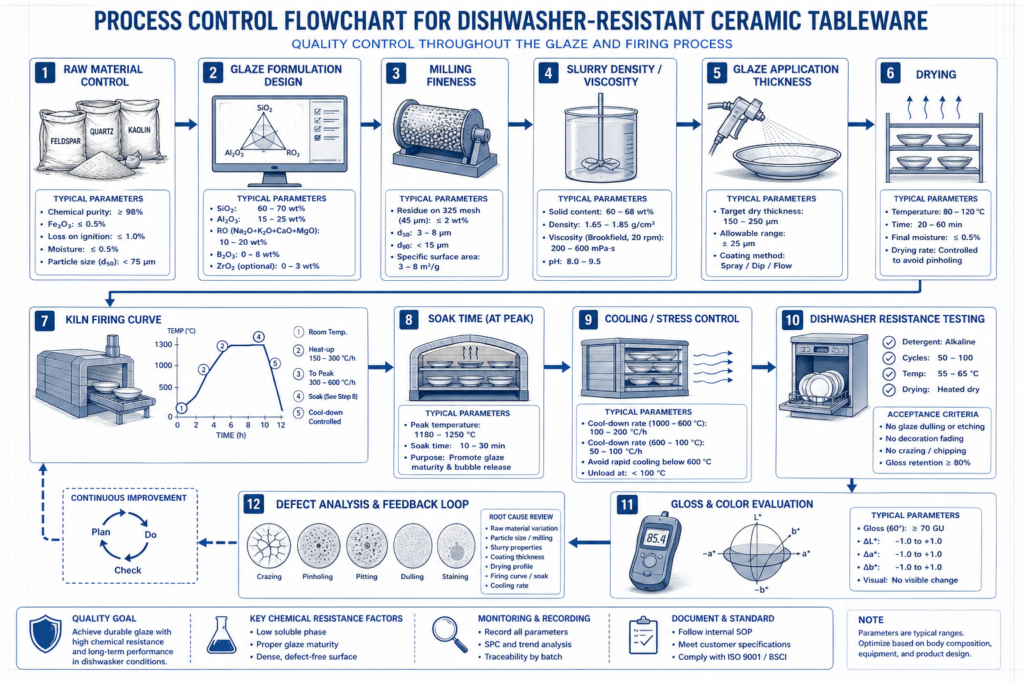
How Ceramic Factories Control Dishwasher Resistance
Professional ceramic manufacturers do not treat dishwasher resistance as a final inspection issue. They control it throughout the production process.
1. Glaze Formulation Control
A durable dinnerware glaze usually requires:
- relatively high silica
- sufficient alumina
- controlled alkali oxides
- balanced flux chemistry
- stable pigment and opacifier compatibility
A practical engineering approach often aims for a glaze with strong network durability and low sensitivity to alkaline attack. Research indicates that keeping alkali content low and alumina content sufficient is beneficial for durability. Source
2. Glaze Slurry and Milling Control
Even a good glaze recipe can fail if the slurry preparation is unstable.
Factories usually monitor:
- particle fineness
- slurry density
- viscosity
- sieve residue
- contamination risk
If dispersion is poor, the fired glaze may show pinholes, orange peel, crawling, blisters, or local weak spots, all of which reduce dishwasher resistance.
3. Glaze Application Thickness
If the glaze is too thin, the surface may lack full protection. If it is too thick, gas release and stress problems may occur during firing.
Uniform glaze thickness is especially important for:
- flat plates
- mug curves
- rim areas
- embossed surfaces
- decal application zones
In customized tableware production, uneven glaze coverage often becomes a hidden cause of future dishwashing complaints.
4. Firing Maturity and Kiln Curve Control
Dishwasher resistance depends heavily on whether the glaze is properly matured.
If the glaze is underfired, the glass network may remain insufficiently developed and more vulnerable to chemical attack.
If it is overfired, the surface may devitrify, distort, or create new mismatch-stress problems.
A capable supplier should therefore control:
- peak firing temperature
- soak time
- cooling rate
- lot traceability
- kiln-to-kiln consistency
This is one of the clearest differences between a true engineering-driven manufacturer and a basic commodity supplier.
5. Body-Glaze Thermal Fit
Dishwasher durability is not only chemical. It is also mechanical.
If the thermal expansion mismatch between body and glaze is not properly controlled, dishwasher thermal cycling can accelerate failure. A simplified way to think about mismatch strain is:
Thermal Mismatch Strain = (αbody − αglaze) × ΔT
Where:
- αbody = thermal expansion of ceramic body
- αglaze = thermal expansion of glaze
- ΔT = temperature change
If the glaze ends up under too much tensile stress, crazing becomes more likely. If compression is excessive, shivering or edge flaking may occur.
Which Standards Matter for Dishwasher-Resistant Ceramic Tableware?
For international buyers, test reports are one of the best ways to judge supplier capability.
EN 12875-1
This standard is widely used to evaluate the resistance of domestic articles to the combined chemical, thermal, and mechanical stresses of machine dishwashing. Public summaries describe repeated standardized dishwasher cycles followed by visual inspection against control samples. Source
EN 12875-4
This is a rapid screening method for ceramics. Public summaries describe alkaline detergent immersion for 16 and 32 hours, making it useful for R&D and quality-control screening of ceramic ware. Source
ASTM C676
This standard covers detergent resistance of ceramic decorations on glass tableware and is highly relevant when decoration durability is important. Source
ASTM D3565
This method is commonly referenced for evaluating the removal of overglaze patterns from tableware by dishwater detergents. It is especially useful for decal or overglaze decoration systems. Source
ISO 6486-1:2019
This standard specifies the test method for lead and cadmium release from ceramic ware, glass ceramic ware, and glass dinnerware intended for food contact. Although it is not a dishwasher-resistance standard, it is highly relevant because buyers need assurance that glaze stability and food-contact safety remain reliable over product life. Source
ISO 4531:2022
This standard applies to vitreous and porcelain enamels and specifies methods of test and limits for release from enamelled articles in contact with food. Source
FDA Lead Guidance for Ceramic Foodware
The U.S. FDA provides action criteria for lead release from ceramic foodware categories such as flatware, hollowware, cups, mugs, and pitchers. This is particularly relevant for exporters to the U.S. market. Source
How B2B Buyers Can Use Dishwasher Resistance to Evaluate Suppliers
For sourcing teams, dishwasher resistance is one of the most practical ways to judge the difference between a basic supplier and a high-level manufacturing partner.
A reliable custom dinnerware supplier should be able to provide:
- EN 12875 test records
- before-and-after comparison photos
- gloss or appearance retention data
- decoration durability results
- food-contact compliance documents
- explanation of glaze chemistry and durability strategy
- evidence of kiln traceability and quality control
If a supplier only says “dishwasher safe” but cannot explain how the glaze was engineered, tested, and controlled, buyers should treat that as a warning sign.
Smart Questions Buyers Should Ask
- Do you have EN 12875-1 test reports for this glaze or collection?
- Have you done rapid alkaline screening for new glaze developments?
- How do you control glaze chemistry for long-term durability?
- How do you prevent crazing, pinholes, and metal marking?
- Can you provide ISO 6486 or relevant food-contact compliance documents?
- How do you control kiln consistency from one production lot to another?
These questions help buyers assess not just the product, but the supplier’s technical maturity.
Final Thoughts: Dishwasher Resistance Is a Quality Signal, Not Just a Product Feature
In the global ceramic dinnerware business, dishwasher resistance is one of the clearest indicators of whether a manufacturer truly understands glaze engineering, quality control, and long-term product performance.
For B2B buyers, this property should never be treated as a simple yes-or-no label. It should be used as a sourcing benchmark to evaluate:
- glaze durability
- process control
- decoration performance
- regulatory readiness
- factory consistency
A strong ceramic tableware supplier does not simply promise that a product is dishwasher safe.
References
- SGS — EN 12875-1 overview
https://www.sgs.com/en-hk/news/2015/12/sgs-new-testing-service-dishwasher-resistance-en-12875-part-1 - Measurlabs — dishwasher resistance testing overview
https://measurlabs.com/products/mechanical-dishwashing-resistance-utensils/ - Peer-reviewed study on porcelain tableware glaze aging and metal marking
https://pmc.ncbi.nlm.nih.gov/articles/PMC8999791/ - Digitalfire — attack on glass and glaze corrosion mechanisms
https://digitalfire.com/article/attack+on+glass%3A+corrosion+attack+mechanisms - Åbo Akademi University doctoral thesis on glaze composition and durability
https://www.doria.fi/bitstream/handle/10024/177898/kronberg_thomas.pdf - ISO 6486-1:2019
https://www.iso.org/standard/67561.html - ISO 4531:2022
https://www.iso.org/standard/81221.html - ASTM C676
https://www.astm.org/c0676-04r19.html - FDA lead contamination guidance for ceramic foodware
https://www.fda.gov/files/inspections%2C%20compliance%2C%20enforcement%2C%20and%20criminal%20investigations/published/CPG-Sec.-545.450-Pottery-%28Ceramics%29–Import-and-Domestic—Lead-Contamination.pdf
Custom Solutions Available
Our technical experts are always ready to assist you in finding the perfect customized solution for your dinnerware needs.