Impact Toughness in Ceramic Tableware: Why Edge-Chip Resistance Matters in Customized Dinnerware
When B2B buyers source customized ceramic plates, bowls, and mugs, they often focus on shape, glaze color, decal quality, and food-safety compliance. However, one of the most commercially important performance indicators is impact toughness—especially at the rim or edge, where real-life damage usually begins. In practical terms, impact toughness determines whether a piece of tableware survives repeated knocks in packing, warewashing, stacking, transport, and hospitality service, or fails through visible edge chipping and breakage. Source
For importers, distributors, hotelware brands, and private-label buyers, this property is not just a lab statistic. It directly affects complaint rate, replacement frequency, brand perception, and total cost of ownership. A dinner plate that chips easily may still pass visual inspection at shipment, but it will quickly become a cost problem in real use. That is why impact toughness should be treated as a strategic quality KPI in customized dinnerware programs. Source

Image: Example of an edge-impact test setup used to evaluate anti-chipping resistance in Joules. Source: Holst Porzellan.
What Is Impact Toughness in Ceramic Tableware?
Impact toughness in ceramic tableware refers to the ability of the fired body-plus-glaze system to absorb sudden mechanical energy without forming a chip, crack, or catastrophic fracture. In ceramic dinnerware, the most sensitive point is usually the edge, because the rim combines geometric stress concentration with frequent contact during daily handling. ASTM C368, the key impact standard for ceramic tableware, specifically recognizes center impact, rim impact, and chipping-related evaluation as important predictors of in-service resistance to breakage. Source
Unlike metals, ceramics do not usually deform plastically before failure. They are brittle materials, which means failure begins when a local flaw—such as a pore, microcrack, quartz-related discontinuity, or glaze-fit stress zone—concentrates enough stress to trigger rapid crack propagation. In dinnerware applications, the question is not simply whether the body is “hard,” but whether it can resist impact at its most vulnerable location under practical service conditions. Source
Why Impact Toughness Is So Important in Customized Dinnerware
For B2B buyers, poor impact toughness creates losses across the entire supply chain:
- higher breakage during packing and inland transportation
- more rim chipping in hotel, restaurant, and catering use
- faster visual degradation in repeated warewashing cycles
- more customer complaints and replenishment orders
- reduced confidence in the supplier’s production consistency
This is especially important in thin-rim, stackable, coupe-shape, and premium matte-glaze collections, where aesthetic design can unintentionally reduce mechanical safety margin. A supplier that cannot control impact toughness consistently will struggle to support demanding foodservice and retail programs. Source
How Edge-Chip Resistance Is Tested in Joules
In commercial tableware discussions, edge-chip resistance is often expressed as a Joule value. This means the edge is tested under controlled impact conditions, and the result is reported as the amount of mechanical energy absorbed before visible damage or fracture occurs. The higher the absorbed energy, the better the anti-chipping performance of the article. Source
The Basic Physics of Impact Energy
The core impact-energy relationship can be expressed as:
Absorbed Impact Energy
E = m g (h1 – h2)
Where:
- E = absorbed energy (J)
- m = pendulum mass (kg)
- g = gravitational acceleration (9.81 m/s2)
- h1 = initial height
- h2 = rebound height
A pendulum-based expression can also be written as:
Pendulum Form
E = m g R (cos β – cos α)
Where:
- R = pendulum radius
- α = release angle
- β = rebound angle
These equations explain why impact resistance in tableware is often reported in Joules. The edge survives if it can consume enough of the incoming energy without initiating a crack or chip. Source
Edge-Chipping Mechanics
Advanced edge-chipping studies also relate the critical force needed to produce a chip to the distance from the edge:
Linear Edge-Chipping Model
F = Te d
A more general form is:
Quadratic Edge-Chipping Model
F = a1d + a2d2
Where:
- F = critical force for chip formation
- d = distance from the edge
- Te = edge toughness coefficient
- a1, a2 = fitted constants
These models show why edge behavior cannot be reduced to body strength alone. Edge performance depends on geometry, flaw population, microstructure, and residual stress state. Source
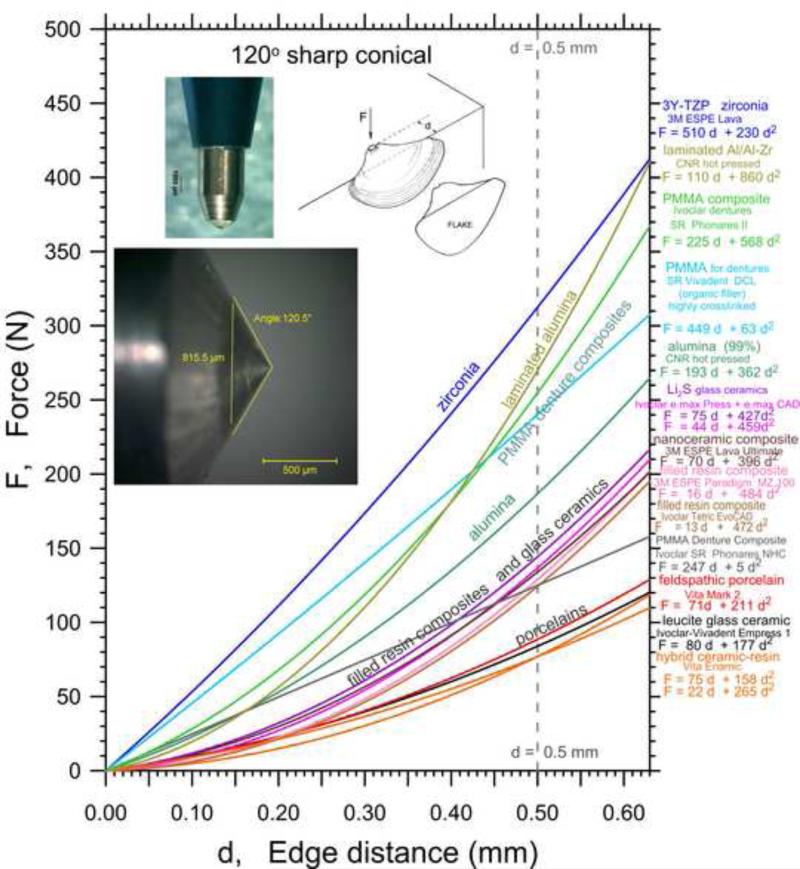
Image: Edge-chipping behavior can be represented through force-versus-distance relationships. Source: PMC / NCBI.
What Controls Impact Toughness in Ceramic Dinnerware?
Impact toughness in ceramic tableware is controlled by a combination of material design, microstructure, glaze fit, rim geometry, and manufacturing discipline. No single variable can explain the full result. Published research on porcelain impact behavior shows that strong performance depends not on one crystalline phase alone, but on the balance among mullite, residual quartz, glassy phase, and defect discontinuities such as pores and cracks around quartz grains. Source
1. Body Microstructure
During firing, kaolinitic raw materials transform and generate a vitrified structure that may include mullite and residual silica phases. A simplified route can be described as follows:
Kaolinite Dehydroxylation
Al2Si2O5(OH)4 → Al2Si2O7 + 2H2O↑
Simplified Mullite-Forming Route
3Al2Si2O7 → 3Al2O3·2SiO2 + 4SiO2
In practical tableware engineering, the goal is not just high crystallinity. The goal is a dense, well-vitrified, low-defect structure with limited harmful residual quartz and minimal pore concentration near the rim. Research indicates that pores and cracks around quartz grains are highly influential in impact failure. Source
2. Glaze Fit
In ceramic tableware, the glaze is not only decorative. It is mechanically active. ASTM C368 explicitly notes that chipping behavior is affected not only by inherent body strength, but also by glaze fit. Source
If the glaze and body expand and contract at incompatible rates during cooling, harmful residual stress can develop. A simplified stress expression is:
Approximate Glaze Stress from Thermal Expansion Mismatch
σg ≈ Eg(αb – αg)ΔT / (1 – νg)
Where:
- σg = residual stress in the glaze
- Eg = elastic modulus of glaze
- αb = thermal expansion coefficient of body
- αg = thermal expansion coefficient of glaze
- ΔT = temperature interval over which mismatch develops
- νg = Poisson’s ratio of glaze
If the glaze is under tensile stress, crazing becomes more likely. If compression is excessive, edge flaking or shivering can occur. Either way, poor glaze fit weakens long-term durability. Source Source

Image: Crazing is a visible symptom of glaze-body thermal expansion mismatch. Source: Digitalfire.
3. Rim Geometry
Rim design has a major effect on performance. A sharp edge increases stress concentration, while a better-designed rim radius helps distribute impact load more safely. ASTM C368 specifically identifies rim contour as a major factor in chipping behavior, with rim thickness and inclination also contributing. Source
For this reason, many durable hotelware programs use subtle edge reinforcement. This does not always mean a visibly heavy product; often, a small geometric optimization can significantly improve impact survival.
Key Factory Parameters That Affect Edge-Chip Resistance
In industrial production, impact toughness is controlled through process discipline rather than one isolated “strong body” claim. The most important factory levers include:
Raw Material and Body Preparation
- ball-milling fineness and particle-size control
- quartz distribution and impurity control
- slip or body consistency
- moisture balance before forming
Coarse particles, segregated silica, and density variation can create weak zones that later become chip origins.
Forming and Drying
- pressing consistency or roller-head stability
- green-edge quality
- residual moisture before firing
- lamination prevention
Poor forming creates internal planes of weakness that may not appear visually until impact occurs.
Firing and Cooling
- peak temperature
- soak time
- pore healing and vitrification level
- controlled cooling through the quartz inversion region near 573°C
Quartz inversion can be expressed as:
Quartz Inversion
α-SiO2 ⇄ β-SiO2 at approximately 573°C
Improper control through this region can contribute to microcracking and residual stress problems. Source
Glaze Application and Maturity
- glaze density and viscosity
- coating thickness
- gas escape during firing
- final glaze healing and surface closure
If the glaze seals too early or the firing curve does not allow gases to escape and heal properly, surface defects can develop.
What Defects Signal Poor Impact Toughness Control?
When a supplier struggles with impact-related process control, several visible defects often appear.
Pinholes and Pitting
Pinholes are small holes in the fired glaze that penetrate toward the body, while pits are smaller surface depressions. These defects are often caused by gas release from the body, insufficient glaze healing, poor oxidation, improper firing curves, or unsuitable glaze viscosity. They are not only cosmetic issues; they indicate deeper process imbalance. Source
Crazing
Crazing is a network of fine cracks in the glaze caused by thermal expansion mismatch between the glaze and the body. In export tableware, crazing is a red flag because it signals unstable glaze fit and weak residual stress management. Source
Edge Flaking or Shivering
When the glaze is too highly compressed relative to the body, it may flake away from edges. This is especially dangerous in thin-rim tableware, because it directly damages the most commercially sensitive area.
Hidden Microcracks and Pore Clusters
These may not be visible before shipment, but they strongly influence breakage under dynamic impact. NIST fractography demonstrates that failure in ceramics often originates from surface flaws, pores, contact damage, and geometric stress concentrators. Source
Why B2B Buyers Should Audit This Property Carefully
From a B2B sourcing perspective, impact toughness is a strong indicator of the supplier’s true technical level. A reliable factory should be able to explain:
- the impact test method used
- whether the result refers to the exact production profile
- what the failure criterion is
- how many samples were tested
- how rim design influences results
- how glaze fit is verified
- how impact data correlates with real customer returns
A supplier that only says “our porcelain is stronger” is offering a sales statement. A supplier that can discuss ASTM C368, glaze-fit control, microstructure, and rim geometry is showing real engineering capability. Source
What Buyers Should Request from Suppliers
For customized dinnerware projects, buyers should ask for:
- impact test data in Joules for the exact item profile
- the test method, ideally with reference to ASTM C368 or a documented internal equivalent
- sample count, average result, and minimum result
- supporting glaze-fit data, such as ASTM C554 or ASTM C424 when relevant
- food-contact safety verification under ISO 6486, ASTM C738, FDA, or EU rules
- failure photos and production-batch traceability
This combination provides a much more complete picture of supplier capability than price alone. Source Source Source
Which Standards Matter Most?
The following standards are especially relevant for export-oriented ceramic tableware projects:
Mechanical and Durability Standards
- ASTM C368 — Impact Resistance of Ceramic Tableware Source
- ASTM C554 — Thermal Shock Crazing Resistance of Fired Glazed Ceramic Whitewares Source
- ASTM C424 — Autoclave Crazing Resistance of Fired Glazed Whitewares Source
- ASTM C372 — Linear Thermal Expansion of Glaze Frits and Fired Ceramic Whitewares Source
Food-Contact and Chemical Safety Standards
- ISO 6486-1 / ISO 6486-2 — Lead and Cadmium Release from Ceramic Ware Source
- ASTM C738 — Lead and Cadmium Extracted from Glazed Ceramic Surfaces Source
- FDA CPG 545.450 — Lead Contamination in Ceramic Ware Source
- FDA CPG 545.400 — Cadmium Contamination in Ceramic Ware Source
- ISO 5644 — Specification and Test Methods for Porcelain Tableware Source
- EU Council Directive 84/500/EEC — Lead and Cadmium Migration from Ceramic Articles Intended for Food Contact Source
Final Takeaway for Importers and Brand Owners
In customized ceramic dinnerware, impact toughness is where material science becomes commercial value. The edge of a plate is not judged by marketing language; it is judged by whether it survives contact. A well-performing item is the result of dense microstructure, balanced glaze fit, controlled rim geometry, low defect population, and stable production discipline. Source
For B2B buyers, the practical conclusion is simple: if a supplier cannot explain its edge-chip resistance in engineering terms, it may not be ready for serious export programs. If it can demonstrate impact performance with data, standards awareness, and consistent process logic, it is far more likely to support durable, scalable, low-complaint customized tableware projects. Source
Custom Solutions Available
Our technical experts are always ready to assist you in finding the perfect customized solution for your dinnerware needs.