Thermal Shock Resistance in Ceramic Dinnerware: Why It Matters for Custom Tableware Buyers
In the custom tableware business, appearance sells the first order, but durability wins the repeat order. One of the most important durability indicators in ceramic dinnerware is thermal shock resistance—the ability of a plate, bowl, or mug to survive sudden temperature changes without cracking, crazing, or breaking in service.
For importers, wholesalers, hospitality brands, and private-label buyers, this is not just a lab term. It directly affects product safety, complaint rates, replacement costs, and brand reputation. A beautifully decorated porcelain plate that cannot handle hot food, dishwashing cycles, or fast temperature changes is not truly commercial-grade.
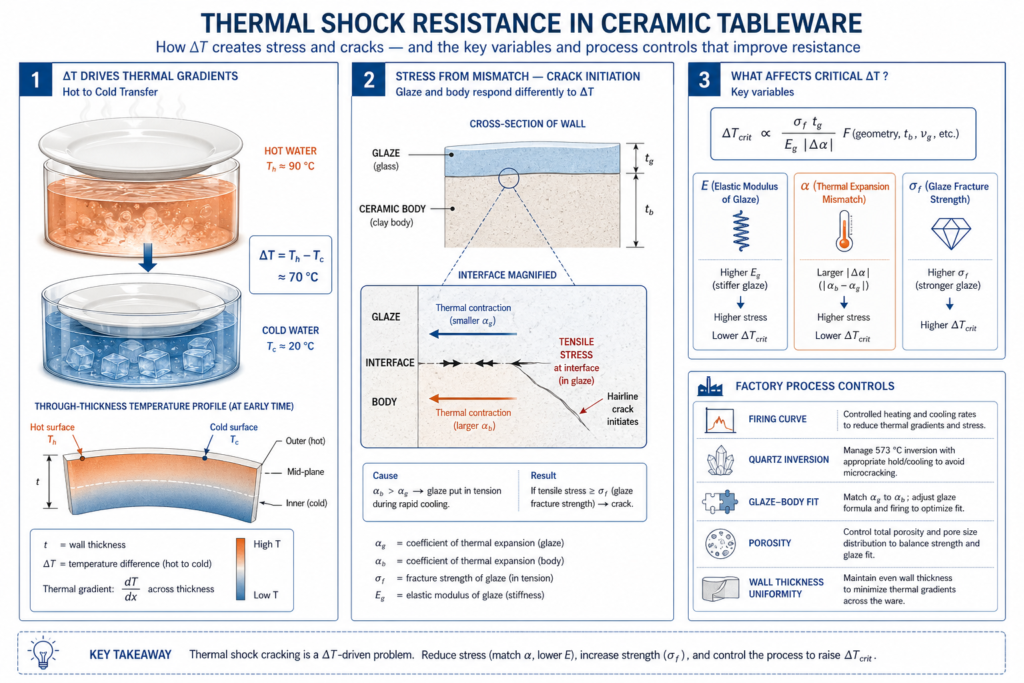
Thermal shock in ceramic dinnerware is driven by temperature gradients, body-glaze mismatch, and process control factors. Source
What Is Thermal Shock Resistance in Ceramic Dinnerware
Thermal shock resistance refers to the ability of a ceramic product to withstand a rapid temperature differential without developing structural damage. In dinnerware applications, this typically happens when a piece moves quickly from hot to cold or from cold to hot conditions. Common examples include hot soup poured into a cool bowl, a mug taken from a dishwasher and placed on a cold surface, or reheated tableware exposed to ambient air too quickly.
From a materials science perspective, ceramic cracking occurs because different parts of the same product do not heat or cool at the same rate. The surface may expand or contract faster than the interior, generating internal stress. Since ceramics are brittle materials, once this stress exceeds the local strength of the body or glaze system, cracks can form. Source
Why Thermal Shock Resistance Matters in Custom Tableware
In standard commodity tableware, geometry and composition are often highly standardized. In custom dinnerware manufacturing, however, every design change can affect thermal performance. A thicker foot, a sharper rim, a heavier glaze layer, an embossed logo, or a new shape profile can change how heat flows through the product.
That is why thermal shock resistance is especially important in custom projects for:
- hospitality and hotelware programs
- restaurant and catering dinnerware
- microwave-safe retail tableware
- premium porcelain giftware
- OEM and private-label ceramic collections
For B2B buyers, a supplier’s ability to control thermal shock resistance is often a strong indicator of real engineering capability—not just decoration skill or molding capacity.
The Science Behind Thermal Shock: How ΔT Causes Cracking
Understanding the Temperature Differential ΔT
In ceramic engineering, ΔT represents the temperature difference imposed on the product during rapid heating or cooling. The greater the ΔT, the greater the thermal stress that may be generated inside the ceramic body.
A simplified thermal stress relationship can be written as:
σth ≈ E · α · ΔT / (1 − ν)
Where:
- σth = thermal stress
- E = Young’s modulus
- α = coefficient of thermal expansion
- ΔT = temperature difference
- ν = Poisson’s ratio
This means thermal shock becomes more severe when the material has:
- a higher elastic modulus
- a higher coefficient of thermal expansion
- a larger sudden temperature change
At the same time, better fracture strength, better thermal conductivity, and better microstructural control can improve resistance to cracking. Source
Critical Anti-Crack Calculation Under ΔT
A simplified critical temperature difference can be estimated as:
ΔTc ≈ σf · (1 − ν) / (E · α)
Where:
- ΔTc = critical temperature difference before cracking
- σf = fracture strength of the ceramic body
This equation explains why ceramic engineers aim to reduce thermal expansion and control flaw population while maintaining sufficient strength. In practical terms, the real-life thermal shock performance of dinnerware is lower than the ideal calculation because geometry, wall thickness variation, glaze mismatch, and hidden microdefects all reduce the safe operating window.
For buyers, the takeaway is simple: thermal shock resistance is not a marketing claim. It is an engineering outcome based on composition, microstructure, design, and manufacturing discipline.
Why Porcelain Can Crack: The Role of Quartz, Mullite, and Glassy Phase
Porcelain dinnerware is not a single-phase material. After firing, it usually contains a combination of:
- glassy phase
- mullite
- residual quartz
This microstructure strongly affects thermal behavior. Quartz is especially important because it expands differently from the surrounding matrix and can generate internal stress during heating and cooling. Research on porcelain has shown that quartz particle size has a major influence on thermal expansion behavior, elastic modulus, and microcrack formation. Coarser quartz particles can promote stress concentration and internal damage, especially when cooling is not well controlled. Source
Key Phase Transformation in Porcelain Firing
A simplified kaolinite-to-mullite transformation route can be expressed as:
Al2Si2O5(OH)4 → Al2Si2O7 + 2H2O↑
3Al2Si2O7 → 3Al2O3·2SiO2 + 4SiO2
The resulting mullite phase improves structural stability, while feldspar-derived glass phase helps densification. But over-vitrification can make the body too rigid and less forgiving under thermal shock. That is why “denser” does not always mean “safer” in real service conditions.
Glaze Fit: A Hidden Factor Buyers Often Overlook
Many buyers assume thermal shock resistance depends only on the ceramic body. In reality, glaze fit is equally important.
If the glaze and the body shrink at different rates during cooling, stress builds at the interface. When glaze thermal expansion is too high relative to the body, the glaze can be pulled into tension and develop crazing—a network of fine surface cracks. Digitalfire describes crazing as a mismatch of thermal expansions between body and glaze, most often when the glaze expansion is higher than the body expansion. Source
A simplified glaze-body mismatch expression is:
σglaze ≈ Eg · (αg − αb) · ΔT / (1 − νg)
Where:
- αg = glaze thermal expansion
- αb = body thermal expansion
This is why two suppliers can use similar-looking porcelain bodies but deliver very different field performance. A strong supplier controls both the body and the glaze as an integrated thermal system.
Common Defects Caused by Poor Thermal Shock Resistance
Glaze Crazing
Glaze crazing appears as a fine crack network on the glazed surface. In dinnerware, it is more than a cosmetic issue. It can lead to staining, hygiene problems, increased return rates, and in some cases safety concerns. Source
Dunting
Dunting is a body crack caused by cooling stress, often during kiln cooling. It is commonly associated with uneven section thickness, poor cooling control, or stress around the quartz inversion range. Hairline cracks or full-body cracks may both result from dunting. Source
Hidden Microcracks and Loss of Ring
Some ceramic pieces do not fail visibly during testing but still lose internal integrity. They may show no obvious crack line, yet the “ring” sound becomes dull after impact or thermal cycling. These hidden defects are especially problematic in hotelware and restaurant use, where repeated service cycles accelerate delayed failure. Source
Catastrophic Breakage
In severe cases, highly vitrified porcelain exposed to a sudden temperature gradient may crack sharply or even shatter. This is one of the reasons why thermal shock testing matters in commercial tableware development.
Thermal shock failure can range from visible cracking to severe fracture. Source
How Manufacturers Control Thermal Shock Resistance
A reliable custom dinnerware manufacturer does not rely on guesswork. Thermal shock resistance must be controlled from raw material selection to final inspection.
Raw Material Control
Key variables include:
- quartz particle size distribution
- feldspar melting behavior
- clay purity and consistency
- batch homogeneity
Quartz control is especially important because coarse residual quartz can promote thermal stress and crack initiation. Source
Body and Shape Engineering
Thermal performance is affected by:
- wall thickness uniformity
- rim and foot design
- handle and joint transitions
- symmetry of the overall shape
Products with uneven cross-sections are more vulnerable because heat does not move through them uniformly.
Firing and Cooling Control
Serious suppliers pay close attention not only to peak firing temperature, but also to the cooling curve. Cooling too quickly through critical temperature zones increases the risk of stress buildup and dunting. This is particularly important near the quartz inversion region around 573°C. Source
Glaze Formulation and Application
A good glaze system should:
- match the body’s thermal behavior
- remain slightly compressive after cooling
- maintain stable thickness
- avoid excessive local stress around decoration areas
This is one reason why reactive glazes, special-effect glazes, or heavy decoration systems require extra technical validation in custom projects.
How Thermal Shock Is Tested in the Ceramic Industry
Thermal shock resistance can be evaluated using standardized or internal methods depending on the market and product type.
EN 1183
EN 1183:1997 covers test methods for thermal shock and thermal shock endurance for brittle materials in food-contact applications, including ceramics, glass, and glass-ceramics. This standard is highly relevant for tableware sold into Europe. Source
ASTM C554
ASTM C554 is a thermal-shock-based method used to assess crazing resistance of fired glazed ceramic whitewares. For buyers sourcing glazed porcelain tableware, this is especially relevant because glaze fit is often the weak point in real use. Source
ASTM C368
ASTM C368 covers impact resistance of ceramic tableware. While it is not a thermal shock test, it is valuable because real service conditions often combine both thermal and mechanical stress. Source
ASTM C1525
ASTM C1525 is designed for advanced ceramics and water-quench thermal shock testing. Although more technical than typical dinnerware qualification, it offers useful engineering reference for retained-strength evaluation after quenching. Source
What B2B Buyers Should Ask a Dinnerware Supplier
If you are sourcing porcelain tableware or hotelware porcelain, do not stop at asking whether the item is “microwave safe” or “dishwasher safe.” Those claims are too broad.
Instead, ask these questions:
What thermal shock test do you use
Request the method name, sample size, and pass/fail logic.
What ΔT can the product withstand
Ask for the tested temperature range and whether the result is based on one-time shock or repeated thermal cycling.
Do you test the decorated product or only the blank body
Decoration layers and glaze effects can change thermal behavior.
How do you control glaze fit
A supplier who understands glaze-body expansion matching is usually more technically mature.
How do you control cooling through critical temperature ranges
This question quickly reveals whether the factory truly understands ceramic process engineering.
How to Judge Supplier Capability Through This One Property
In practice, thermal shock resistance is a shortcut for evaluating broader supplier quality.
A supplier with weak answers usually focuses on:
- appearance only
- price only
- general safety claims without test data
- no discussion of glaze fit or cooling control
A strong supplier is more likely to discuss:
- thermal shock test records
- glaze fit validation
- wall thickness control
- cooling curve discipline
- defect analysis such as crazing and dunting
For importers and brand owners, this matters because poor thermal shock performance often shows up after shipment—not before.
Food Contact Compliance Still Matters
Thermal shock resistance is essential, but it must be considered alongside food-contact compliance.
ISO 6486-1:2019 defines the test method for lead and cadmium release from ceramic ware, glass-ceramic ware, and glass dinnerware in contact with food. ISO 6486-2:1999 specifies permissible limits. These standards do not replace thermal shock testing, but they are both important when evaluating a tableware supplier for export markets. Source Source
Final Takeaway for Importers, Brands, and Wholesale Buyers
If you are buying custom ceramic dinnerware, thermal shock resistance should never be treated as a secondary technical detail. It is one of the clearest indicators of whether a supplier truly understands ceramic engineering.
A high-quality dinnerware supplier should be able to control:
- body composition
- quartz particle behavior
- glaze-body fit
- firing maturity
- cooling schedule
- realistic finished-product testing
In short, thermal shock resistance is not just about whether a plate cracks. It tells you whether the supplier can deliver durable, commercial-grade ceramic tableware that performs in the real world.
References
- Morgan Technical Ceramics — Thermal Shock Resistance: https://www.morgantechnicalceramics.com/en-gb/ceramics-101/thermal-properties-of-ceramics/thermal-shock-resistance/
- ACerS — Thermal Shock Lesson: https://ceramics.org/wp-content/uploads/2014/04/Thermal-Shock-Lesson.pdf
- Digitalfire — Thermal Shock: https://digitalfire.com/glossary/thermal+shock
- Digitalfire — Glaze Crazing: https://digitalfire.com/glossary/glaze+crazing
- Digitalfire — Dunting: https://digitalfire.com/glossary/dunting
- Digitalfire — TSFL Thermal Shock Failure Test: https://digitalfire.com/test/tsfl
- J-STAGE — Effect of Quartz Grain Size on Elastic and Thermal Expansion Properties of Porcelain: https://www.jstage.jst.go.jp/article/jcersj2/131/8/131_23050/_pdf
- EN 1183:1997 overview: https://standards.iteh.ai/catalog/standards/cen/1bc0c320-076f-46d5-8600-0cc210cfbe30/en-1183-1997
- ASTM C368: https://www.astm.org/c0368-88r20.html
- ASTM C1525: https://www.astm.org/c1525-18.html
- ASTM C21.03 listing including ASTM C554: https://www.astm.org/membership-participation/technical-committees/committee-c21/subcommittee-c21/jurisdiction-c2103
- ISO 6486-1:2019: https://www.iso.org/standard/67561.html
- ISO 6486-2:1999: https://www.iso.org/standard/27281.html
If you have any questions or need to custom dinnerware, please contact our Email:info@gcporcelain.com for the most thoughtful support!