Glost Firing in Ceramic Dinnerware: Why It Matters More Than Most Buyers Realize
When buyers evaluate customized ceramic tableware, they often focus on shape, decoration, color matching, MOQ, and lead time. However, one of the most decisive technical steps happens much deeper in the production process: glost firing.
In industrial ceramics, glost firing is the final firing stage in which the glaze melts, levels, bonds to the ceramic body, and develops the final surface properties of the product. It is also the stage where compatible decorations are fused onto the ware. In practical terms, this is the moment when a biscuit-fired ceramic piece becomes a finished food-contact article with its final gloss, smoothness, density, hygiene, and long-term durability. Source
For importers, wholesalers, hospitality brands, and private-label dinnerware buyers, glost firing is not just a factory detail. It is a reliable indicator of whether a supplier truly understands ceramic engineering or is only good at making attractive samples.
What Is Glost Firing in Ceramic Manufacturing
Glost firing refers to the glaze firing cycle after biscuit firing. During this stage, the glaze reaches its mature melt state, flows across the ceramic surface, forms an interface with the body, and then solidifies during cooling into a continuous glassy layer. Source
In double-fired porcelain dinnerware, typical production commonly includes:
- Biscuit firing: about 900–1000°C
- Glost firing: about 1250–1400°C
Comparative research on porcelain and porcelain stoneware also shows that porcelain tableware generally requires a higher optimal firing range than porcelain stoneware, with porcelain bodies often optimized around 1280°C depending on composition. Source
Why Glost Firing Is Critical for Customized Dinnerware
In customized dinnerware, even a small change in glaze recipe, pigment system, edge decoration, matte effect, or body composition can alter firing behavior. That means the glost firing cycle cannot simply be copied from one product to another.
A properly controlled glost firing process helps ensure:
- smooth and defect-free glaze surfaces
- low porosity and good vitrification
- stable body-glaze fit
- resistance to crazing and thermal shock
- better stain resistance and hygiene
- more reliable food-contact compliance
For B2B buyers, this is especially important because custom projects usually require repeatability across multiple SKUs, colorways, and reorder cycles.
How Vitrification Works During Glost Firing
The most important technical concept behind glost firing is vitrification.
Vitrification is the process in which a ceramic body becomes denser through the formation of a glassy phase during firing. As the temperature rises, flux-bearing minerals begin to form a viscous liquid phase. That liquid helps fill pores, improve densification, and strengthen the bond between glaze and body. On cooling, the melt freezes into a glassy matrix. Source
Published research on vitrified ceramic systems reports that the vitreous phase in porcelain stoneware can account for roughly 40–75 wt.%, and in some compositions the non-crystalline matrix reaches 70–74 wt.%. This shows how central glass-phase development is to final ceramic performance. Source Source

Firing temperature strongly influences densification, water absorption, and final ceramic properties. Source
Why Vitrification Matters to Tableware Buyers
From a buyer’s perspective, vitrification is closely related to product quality. A well-vitrified dinnerware body is typically:
- denser
- less absorbent
- more stain resistant
- easier to clean
- more durable in daily use
- more stable under temperature change
If vitrification is incomplete, the product may still look acceptable at first glance, but long-term performance risks increase significantly.
The Eutectic Principle in Ceramics: Why Materials Melt Earlier as a System
One of the most useful ways to understand glost firing is through the eutectic principle.
In ceramics, pure silica (SiO₂) and alumina (Al₂O₃) are highly refractory. On their own, they melt at temperatures far above standard tableware firing ranges. But in real ceramic bodies and glazes, these oxides are mixed with fluxes such as Na₂O, K₂O, CaO, MgO, and sometimes B₂O₃, introduced through feldspar, frits, whiting, dolomite, nepheline syenite, and related raw materials.
When these materials are combined, the multi-component system develops a lower melting region. This is the practical meaning of the eutectic effect: a mixture can begin to melt at a lower temperature than the individual pure components.
Why the Eutectic Principle Matters in Dinnerware Production
For ceramic tableware production, the eutectic principle is what makes industrial glaze firing possible. It allows the body and glaze system to form a useful liquid phase within a realistic kiln range.
Research on porcelain stoneware shows that feldspar-driven vitreous phase formation starts at around 1050°C, well before the system would melt if it depended only on pure silica behavior. This early liquid formation is essential for densification and glaze maturity. Source
Without eutectic melt formation:
- the glaze would not mature properly
- the body would remain too porous
- the surface would not level correctly
- industrial firing would become inefficient or impossible
A Simplified Structural Representation of Flux Action
The role of alkali fluxes can be illustrated schematically as follows:
≡Si–O–Si≡ + Na₂O → 2(≡Si–O⁻ Na⁺)
This simplified representation shows how alkali oxides disrupt the silica network, reduce viscosity, and promote melt formation.
Key Reactions That Influence Glost Firing Quality
Although industrial ceramic firing is a multi-stage transformation rather than a single reaction, several thermal events are especially relevant to glaze firing quality.
Kaolinite Dehydroxylation
Al₂Si₂O₅(OH)₄ → Al₂Si₂O₇ + 2H₂O↑
This reaction releases water vapor as kaolinite transforms into metakaolin. If gas release is not properly managed before the glaze seals the surface, surface defects can result.
Mullite Formation
3Al₂Si₂O₅(OH)₄ → 3Al₂O₃·2SiO₂ + 4SiO₂ + 6H₂O↑
This simplified overall expression represents mullite formation, which is especially important in porcelain bodies. Published studies report mullite levels of up to about 20 wt.% in some porcelain compositions during firing. Source
Calcium Carbonate Decomposition
CaCO₃ → CaO + CO₂↑
This is one of the most important reactions behind glaze defects such as pinholes and blisters. If CO₂ evolves after the glaze has already become too viscous, trapped gas may remain in the finished surface. Source Source
How Factories Control Glost Firing in Mass Production
A capable ceramic supplier does not control glost firing by temperature alone. They control it as a combination of:
- raw material consistency
- glaze chemistry
- glaze thickness
- firing curve
- soak time
- kiln loading
- cooling rate
- body-glaze fit
Typical Process Windows in Dinnerware Production
Below are common industrial ranges used as engineering references. Actual values depend on body type, glaze family, kiln type, and product design.
Biscuit Firing Range
Typically 900–1000°C for porcelain tableware. Source
Glost Firing Range for Porcelain
Typically 1250–1400°C in double-fired tableware systems. Source
Glost Firing Range for Porcelain Stoneware
Often around 1190–1230°C in faster vitrified systems. Source
Soak / Equalization Time
Often controlled within 10–40 minutes, depending on glaze behavior, loading density, and kiln response.
Temperature Uniformity
High-level suppliers usually target narrow kiln variation because even a small temperature gap can lead to visible differences in gloss, color, warpage, or defect rate.
Why Cooling Matters as Much as Peak Temperature
Many buyers assume the most important part of glaze firing is reaching the target peak temperature. In reality, cooling is equally important because this is when the molten glaze becomes glass.
Cooling that is too fast or uneven can intensify stress and raise crazing risk. Cooling that is too slow in the wrong compositional system can encourage unwanted crystallization or gloss inconsistency. Source
The Most Common Glost Firing Defects in Ceramic Dinnerware
When glost firing is poorly controlled, defects appear not as random accidents, but as signs of a mismatch between materials and process.
Pinholes and Pitting
Pinholes are tiny holes in the glaze surface caused by gas escaping through a glaze melt that cannot fully heal. Pitting is related, though sometimes more associated with localized glaze or firing issues.
Main causes include:
- body gases released too late
- carbonate decomposition
- rough biscuit surfaces
- overly stiff glaze melt
- thin or uneven glaze application
- inadequate soak or poor ventilation
- glaze sealing too early Source

Pinholes usually indicate a mismatch between gas release and glaze healing behavior. Source
Crazing
Crazing is a network of fine cracks in the glaze caused primarily by thermal expansion mismatch between glaze and body.
Digitalfire identifies excessive Na₂O and K₂O as frequent contributors to high-expansion glaze behavior. Thickness, cooling stress, and under-vitrified bodies can worsen the issue. Source
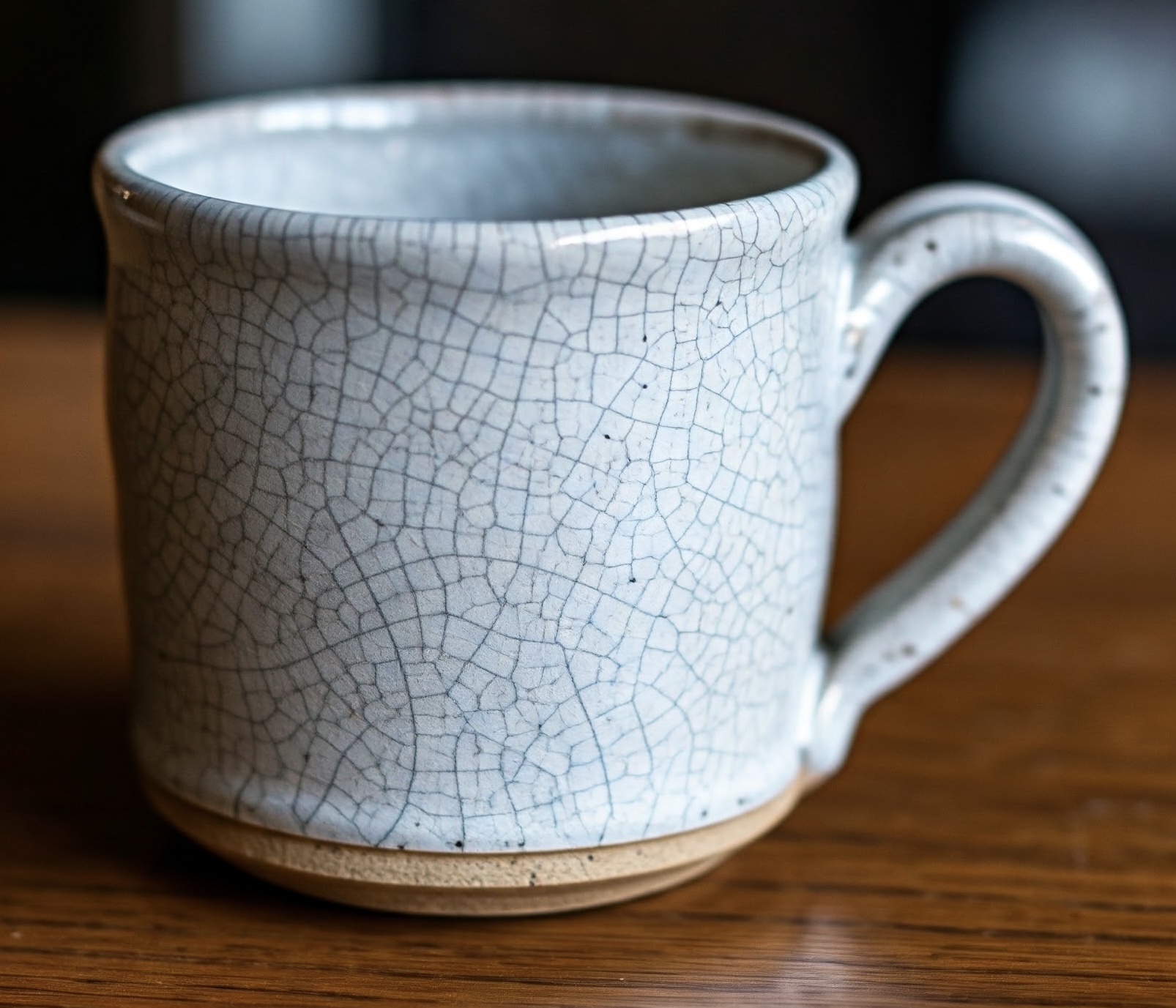
Crazing is usually a body-glaze fit problem, not just a visual issue. Source
Blistering
Blistering occurs when gas bubbles remain larger and more visible in the glaze. It is often linked to overactive gassing, poor healing, overfiring, or an imbalanced firing curve. Source
Crawling
Crawling happens when the glaze pulls away from the surface and leaves bare areas. Common causes include poor adhesion, excessive glaze shrinkage during drying, or contaminated biscuit surfaces.
Devitrification and Surface Dulling
Some glazes lose gloss or change texture due to unwanted crystallization during cooling. This can make approved samples difficult to reproduce in bulk orders.
How Buyers Can Use Glost Firing to Evaluate a Supplier
For overseas buyers, glost firing is one of the best technical checkpoints when qualifying a ceramic tableware supplier.
A factory with strong glost firing control can usually explain:
- why a specific glaze matures at a certain temperature
- how body and glaze are matched for expansion
- how pinholes and crazing are prevented
- how kiln uniformity is monitored
- how food-contact compliance is protected across different decoration families
A weaker supplier, by contrast, often speaks only in terms of appearance and price.
Questions Buyers Should Ask a Ceramic Supplier
1. What is your firing window for this body and glaze combination
A professional supplier should be able to explain the validated glost firing range, not just quote one peak temperature.
2. Do you test water absorption and body maturity
Water absorption is a useful indicator of vitrification and porosity. ASTM C373 is a common reference for measuring water absorption, apparent porosity, and related fired properties. Source
3. How do you verify resistance to crazing
For vitreous ceramic whitewares, ASTM C554 is an important reference standard for crazing resistance under thermal shock conditions. Source
4. How do you control lead and cadmium migration risk
This is especially important when strong colors, decals, metallics, or special-effect glazes are involved.
International Standards Buyers Should Know
Food-contact ceramic ware is not judged only by visual quality. It must also meet safety and performance expectations in target markets.
ISO 6486-1:2019
This standard specifies the test method for release of lead and cadmium from ceramic ware, glass-ceramic ware, and glass dinnerware intended for food contact. It is one of the most important international references for ceramic dinnerware compliance. Source
ASTM C554
This standard covers the crazing resistance of fired glazed ceramic whitewares by a thermal shock method. It is highly relevant for evaluating body-glaze fit in vitrified ware. Source
ASTM C373
This standard is commonly used for measuring water absorption, bulk density, apparent porosity, and apparent specific gravity of fired ceramic materials. Source
FDA Lead and Cadmium Compliance Guidance
For the U.S. market, buyers should also pay attention to FDA policy guidance on ceramicware contamination.
According to the FDA compliance policy for lead contamination in ceramic ware, guideline values include 3.0 μg/mL for flatware, 2.0 μg/mL for small hollowware, 1.0 μg/mL for large hollowware, and 0.5 μg/mL for cups/mugs and pitchers, depending on article category and test criteria. Source
The FDA also maintains separate compliance policy guidance for cadmium contamination in domestic and imported ceramic ware. Source
Final Thoughts: Why Glost Firing Is a Powerful Quality Signal
In ceramic dinnerware manufacturing, glost firing is where chemistry, process control, and final quality come together.
It determines whether the glaze surface becomes smooth and durable, whether the body reaches the right level of vitrification, whether the product resists crazing and pinholes, and whether the finished ware is suitable for long-term food-contact use.
For B2B buyers, understanding glost firing offers a major advantage. It helps separate suppliers who only produce attractive samples from suppliers who can consistently deliver stable quality across full production orders.
If you are sourcing customized ceramic tableware, do not treat glaze firing as a background process. Treat it as one of the clearest technical signals of supplier capability.
References
- Ceramica CH — Glost Firing
https://ceramica-ch.ch/en/glossary/glost-firing/ - Digitalfire — Firing: What Happens to Ceramic Ware in a Firing Kiln
https://digitalfire.com/article/firing%3A+what+happens+to+ceramic+ware+in+a+firing+kiln - Digitalfire — Glaze Pinholes, Pitting
https://digitalfire.com/trouble/glaze+pinholes%2C+pitting - Digitalfire — Glaze Crazing
https://digitalfire.com/trouble/glaze+crazing - MDPI Materials — Porcelain vs Porcelain Stoneware
https://www.mdpi.com/1996-1944/16/1/171 - Elsevier / Journal of Non-Crystalline Solids — The Vitreous Phase of Porcelain Stoneware
https://www.sciencedirect.com/science/article/pii/S0022309311003796 - ISO 6486-1:2019
https://www.iso.org/standard/67561.html - ASTM C554
https://www.astm.org/c0554-93r20.html - ASTM C373
https://www.astm.org/c0373-18.html - FDA Lead Contamination Guidance for Ceramicware
https://www.fda.gov/files/inspections%2C compliance%2C enforcement%2C and criminal investigations/published/CPG-Sec.-545.450-Pottery-(Ceramics)–Import-and-Domestic—Lead-Contamination.pdf - FDA Cadmium Contamination Guidance for Ceramicware
https://www.fda.gov/regulatory-information/search-fda-guidance-documents/cpg-sec-545400-pottery-ceramics-import-and-domestic-cadmium-contamination
Custom Solutions Available
Our technical experts are always ready to assist you in finding the perfect customized solution for your dinnerware needs.