Overglaze Decoration for Custom Tableware: Why Low-Temperature Firing Delivers Richer Ceramic Colors
For brands, wholesalers, importers, and hospitality buyers, overglaze decoration is one of the most important finishing methods in custom ceramic tableware. It offers vivid colors, detailed logo reproduction, metallic effects, and strong design flexibility. That is why overglaze is widely used in promotional mugs, branded hotelware, giftware, seasonal retail collections, and private-label dinnerware. Britannica classifies overglaze colors as low-temperature colours, which explains why the process is closely associated with bright, varied, and visually expressive ceramic decoration. Source
At the same time, overglaze is not just a decorative choice. In food-contact ceramics, it is also a technical and compliance issue. A supplier may be able to make a sample look attractive, but if the overglaze system is poorly engineered, it can lead to fading, pinholes, poor adhesion, dishwasher failure, or even heavy metal release problems. For B2B buyers, understanding overglaze helps separate a visually good sample from a truly reliable production partner. Source
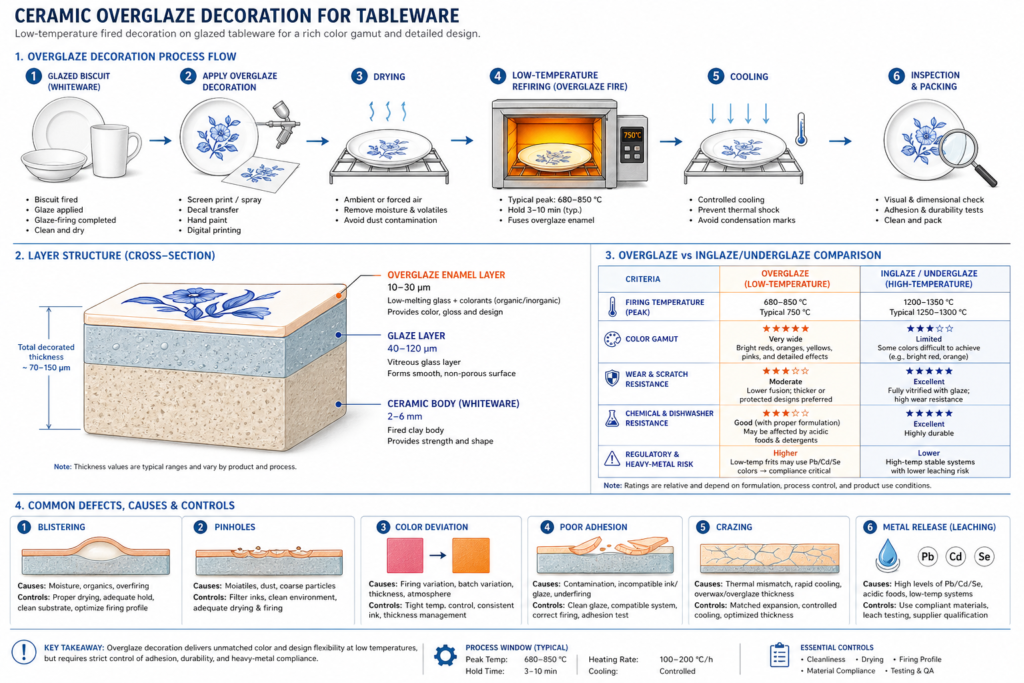
What Is Overglaze Decoration in Ceramic Tableware
Overglaze decoration means the design is applied on top of an already fired glaze surface, followed by a second firing at a lower temperature to bond the decorative layer to the glaze. In practical production, the decoration may be applied by ceramic decals, screen printing, pad printing, hand painting, or digital ceramic printing, depending on the design complexity and order volume. This is different from underglaze decoration, which goes beneath the glaze, and inglaze decoration, which is fired into the glaze layer. Source
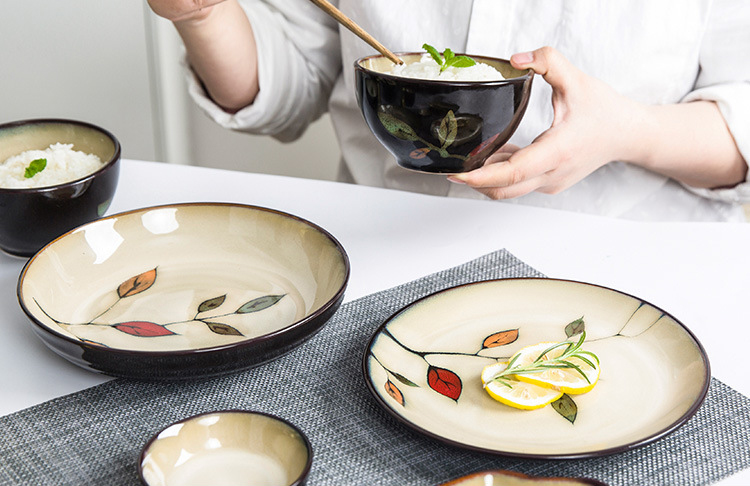
For the custom tableware industry, overglaze is especially valuable because it gives brands more freedom in color, logo sharpness, artwork complexity, and small-batch customization. It is often the preferred choice when buyers want bright reds, oranges, purples, fine-line logos, photo-style decals, or luxury metallic finishes such as gold and platinum. This is why overglaze remains highly relevant in modern ceramic tableware customization. Source
Why Overglaze Matters in Custom Tableware Manufacturing
From a manufacturing and sourcing perspective, overglaze solves a very practical business problem: how to turn a plain ceramic blank into a high-value branded product without changing the main body or glaze recipe. For importers and distributors, this means faster design turnover, lower development costs, and greater flexibility for seasonal or promotional products. For hospitality buyers, it means logo precision and premium appearance. For retailers, it means a broader design vocabulary with stronger shelf appeal.
However, the same reason that makes overglaze attractive also makes it sensitive. Because the decoration sits on the outer glaze surface, it is more exposed to cutlery abrasion, detergents, dishwashing cycles, and food-contact compliance testing. In other words, overglaze gives you more design freedom, but it also demands better process control from the supplier. Source
Why Low-Temperature Firing Creates Richer Ceramic Colors
Low firing protects delicate pigments
The biggest technical advantage of overglaze is that it uses a lower-temperature refire, rather than exposing the color system to the full heat of body vitrification and glaze maturation. This lower thermal load helps preserve pigments and special decorative materials that would otherwise lose strength, dissolve into the glaze, or shift in color at higher firing temperatures. Britannica’s description of overglaze as a low-temperature colour system directly reflects this materials advantage. Source
A wider practical color gamut
In simple terms, low-temperature firing allows the decoration layer to bond without destroying its own visual identity. That is why overglaze can offer a broader practical color range than many higher-temperature decoration routes. Bright warm colors, highly saturated brand tones, pastel effects, gradients, and metallic finishes are all easier to achieve through overglaze than through many underglaze systems. This is one of the core reasons why overglaze dinnerware remains so popular in custom projects.
Better logo detail and sharper graphics
Low-temperature firing also helps maintain fine edges and graphic precision. Because the decoration layer does not become excessively fluid, printed logos and lines are less likely to blur or feather. For buyers in promotional products, hotelware, and retail branding, this matters a lot. A plate or mug may look colorful from a distance, but true supplier capability shows up in how clean the logo edges, line weights, and small text remain after firing and washing.
How the Overglaze Process Works in a Factory
Step 1: Prepare a stable glazed blank
The process starts with an already glazed and glaze-fired ceramic body. The glaze surface should be smooth, clean, and fully matured before decoration. If the glaze is rough, dusty, underfired, or defective, the overglaze layer will not perform consistently.
Step 2: Apply the decoration
The design is then applied by one of several methods:
- Ceramic decal transfer
- Screen printing
- Pad printing
- Hand painting
- Digital ceramic printing
The choice depends on design resolution, quantity, cost target, and visual effect.
Step 3: Dry the decorated ware
Before refiring, the printed or transferred decoration must dry properly. Residual moisture, solvents, or organic binders can create gas-release problems during firing, which later appear as pinholes, blisters, or poor adhesion.
Step 4: Low-temperature refire
The decorated ware is refired at a lower temperature so the enamel or decal layer softens and bonds to the glaze surface. In many industrial overglaze systems, this refire is typically in the range of about 720–860°C, depending on the frit system, pigments, and decoration chemistry. The peak temperature, soak time, and heating rate all influence color maturity, adhesion, gloss, and durability.
Step 5: Inspect and test
After firing, the ware should be inspected for color consistency, surface defects, logo sharpness, adhesion, and durability. For export markets, compliant suppliers should also validate the ware through food-contact and durability testing where required.
Key Process Controls Buyers Should Understand
Firing curve control
A strong supplier does not simply “fire until it looks right.” Overglaze requires a controlled firing curve. If the temperature is too low, the decoration may not bond properly. If it is too high, colors may shift, fine edges may bleed, or metallic finishes may dull.
Surface cleanliness
Dust, grease, glaze powder, or contamination on the glaze surface can interfere with enamel wetting and cause local defects. This is a common reason why some suppliers can produce good first samples but struggle with production consistency.
Decoration thickness
If the decoration deposit is too thin, the color may look weak or washed out. If it is too thick, the layer may blister, crawl, or lose smoothness. Thickness control is especially important for solid logos, dark colors, and metallic bands.
Organic burnout management
Ceramic decals and printing media often contain organic materials that must burn out cleanly during refiring. If heating is too fast or ventilation is poor, trapped gases can create visible surface defects. Digitalfire explains that pinholes and pits are commonly caused by gas release from the body or glaze that fails to heal out during firing. Source
Common Overglaze Defects in Ceramic Tableware
Example of pinholes/pitting on a ceramic glaze surface. Image source: Lakeside Pottery Studio.
Pinholes and pitting
These appear as tiny holes or crater-like marks on the surface. In overglaze production, they are usually related to trapped gases, dirty surfaces, poor burnout of organics, or an enamel layer that seals too early before gases can escape. Pinholes immediately reduce the visual quality of custom dinnerware and may indicate weak process control. Source
Blistering
Blisters are raised bubbles or burst bubbles in the decorative layer. They are often caused by excessive decoration thickness, rapid heating, or incomplete burnout of the decal or printing medium. Blistering is especially damaging on dark grounds, large solid logos, and glossy premium ware.
Color variation
If the firing temperature, soak time, or pigment system is unstable, the result may be visible lot-to-lot color variation. This is a major issue in private-label production because brand colors must remain consistent across repeat orders.
Poor adhesion
If the overglaze does not bond properly, the decoration may scratch off too easily or lose durability after washing. Poor adhesion is a strong warning sign that the supplier has not matched the frit, glaze surface, and firing window correctly.
Edge bleeding
Fine logos and small text may lose sharpness if the enamel becomes too fluid during firing. This defect is common when factories try to push production speed without stabilizing the overglaze chemistry and firing curve.
Crazing and Structural Risk
Example of crazing on a ceramic surface. Image source: Lakeside Pottery.
Although crazing is mainly a glaze-fit issue rather than an overglaze-only issue, buyers should still watch for it in decorated tableware. Digitalfire identifies thermal expansion mismatch between glaze and body as the real cause of crazing and notes that crazing can reduce fired ware strength dramatically. For functional tableware, crazing also raises hygiene concerns if cracks allow moisture and contamination to reach a more porous ceramic matrix below. Source
In practical sourcing terms, if a supplier shows visible crazing on decorated samples, that is not just a cosmetic issue. It may signal deeper problems in glaze fit, firing stability, and long-term product durability.
Food Safety and Heavy Metal Compliance in Overglaze Decoration
This is one of the most important sections for importers and distributors. Overglaze can create excellent visual effects, but historically some bright decorative systems were also associated with lead and cadmium risk. The U.S. FDA notes that lead compounds were historically used in glazes and that when pottery is manufactured improperly or fired under inadequate or uncontrolled conditions, lead may not be fully incorporated into the glaze structure and can leach into food. Source
A peer-reviewed study on overglaze-decorated ceramic dinnerware found that some decorated dishes released high levels of lead and cadmium under acidic extraction conditions. Although that study focused on older ware, it remains an important reminder that visual attractiveness alone does not prove food safety. Buyers should always request compliance evidence for the exact decorated SKU they intend to purchase. Source
Important International Standards for Overglaze Tableware
ISO 6486
ISO 6486-1:2019 specifies the test method for release of lead and cadmium from ceramic ware, while ISO 6486-2:1999 sets permissible limits. These are key reference standards for ceramic food-contact safety in international trade. Source Source
EU Directive 84/500/EEC
For the European market, Council Directive 84/500/EEC sets limits for lead and cadmium release from ceramic articles intended to come into contact with foodstuffs. It also specifies testing conditions using 4% acetic acid at 22 ± 2°C for 24 ± 0.5 hours. Source
FDA lead and cadmium guidance
For the U.S. market, buyers should understand the FDA compliance framework, including CPG 545.450 for lead contamination and CPG 545.400 for cadmium contamination in ceramicware. These documents remain highly relevant when sourcing decorated tableware for food-contact use. Source Source
ASTM C738 and ASTM C556
ASTM C738 covers lead and cadmium extracted from glazed ceramic surfaces, while ASTM C556 evaluates the resistance of overglaze decorations to attack by detergents. Together, these standards help buyers assess both food safety and practical service durability. Source Source
EN 12875 dishwasher resistance
EN 12875 Part 1 evaluates resistance to the combined chemical, thermal, and mechanical stresses of mechanical dishwashing. For overglaze tableware, this is especially important because a product that looks good out of the kiln may still fail after repeated dishwashing cycles. Source
How B2B Buyers Can Evaluate an Overglaze Tableware Supplier
Ask for the exact test reports for the exact decorated SKU
Do not accept a general statement such as “our factory is food safe.” Ask for migration test reports for the actual product category and decoration system being quoted. A plain white plate passing a test does not automatically prove that a red overglaze logo plate also passes.
Check dishwasher and detergent resistance
If the product is intended for hospitality, retail, or repeated household use, ask whether the decoration has been verified for detergent resistance or dishwasher performance. A supplier who understands overglaze should be familiar with this requirement.
Review repeat-order color stability
For branded tableware, one of the biggest hidden risks is reorder inconsistency. Ask how the supplier controls color from batch to batch. Good suppliers should have a master standard, lot traceability, and a defined approval process for color matching.
Look beyond the sample appearance
A bright sample is easy. Stable production is hard. Buyers should look at line sharpness, solid-fill smoothness, metallic uniformity, pinholes, edge cleanliness, and evidence of firing consistency. Overglaze quality is not judged by color alone.
Is Overglaze the Right Choice for Your Custom Tableware Project
Overglaze is usually the right choice when your project requires:
- bright and varied colors
- fine logo detail
- decorative flexibility
- metallic finishes
- short-run customization
- promotional or seasonal artwork
- premium branding on ceramic surfaces
It may be less ideal if the project demands maximum abrasion resistance in the most demanding food-service conditions and the artwork can be achieved by inglaze or underglaze alternatives. The best decoration route always depends on the balance between visual goals, compliance requirements, service conditions, and cost.
Final Thoughts
In the world of custom ceramic tableware, overglaze decoration remains one of the most commercially useful and visually powerful decoration methods. Its biggest strength is also its defining technical advantage: low-temperature firing preserves richer colors and wider design possibilities. That is why overglaze continues to dominate branded mugs, logo plates, hotelware, gift ceramics, and decorative dinnerware programs.
But bright color alone is not enough. For B2B buyers, successful overglaze tableware should also mean stable adhesion, consistent color, dishwasher resistance, and documented compliance with relevant food-contact standards. If a supplier can deliver all of that together, they are not just decorating ceramics — they are operating at a professional manufacturing level.
References
- Britannica: Overglaze colour — https://www.britannica.com/art/overglaze-color
- Britannica: Pottery decorative glazing — https://www.britannica.com/art/pottery/Decorative-glazing
- Digitalfire: Overglaze — https://digitalfire.com/glossary/overglaze
- Digitalfire: Glaze crazing — https://digitalfire.com/trouble/glaze+crazing
- Digitalfire: Glaze pinholes and pitting — https://digitalfire.com/trouble/glaze+pinholes%2C+pitting
- ISO 6486-1:2019 — https://www.iso.org/standard/67561.html
- ISO 6486-2:1999 — https://www.iso.org/obp/ui/en/#!iso:std:iso:6486:-2:ed-2:v1:en
- EU Directive 84/500/EEC — https://eur-lex.europa.eu/legal-content/EN/TXT/?uri=CELEX:31984L0500
- FDA guidance on imported traditional pottery — https://www.fda.gov/regulatory-information/search-fda-guidance-documents/guidance-industry-safety-imported-traditional-pottery-intended-use-food-and-use-term-lead-free
- FDA CPG 545.450 — https://www.fda.gov/media/71764/download
- FDA CPG 545.400 — https://www.fda.gov/regulatory-information/search-fda-guidance-documents/cpg-sec-545400-pottery-ceramics-import-and-domestic-cadmium-contamination
- ASTM C738 — https://www.astm.org/Standards/C738.htm
- ASTM C556 — https://www.astm.org/Standards/C556.htm
- EN 12875 Part 1 summary — https://www.sgs.com/en-hk/news/2015/12/sgs-new-testing-service-dishwasher-resistance-en-12875-part-1
- Research paper on heavy metal extraction from overglaze-decorated dinnerware — https://bearworks.missouristate.edu/articles-cnas/3542/
Custom Solutions Available
Our technical experts are always ready to assist you in finding the perfect customized solution for your dinnerware needs.