Hotel Dinnerware Guide: Materials, Durability & Sourcing for 5-Star Properties
Hotel dinnerware is a category where the wrong choice surfaces itself quickly—chips in the first month of service, glaze crazing under commercial dishwasher cycles, or logo prints that fade within six months of daily use. The right choice performs invisibly: consistent appearance, zero food-safety incidents, low breakage rates, and a brand presentation that holds up across a full hotel F&B lifecycle of 3–5 years. This guide covers the decisions that determine which outcome you get: material selection, durability standards, customization options, how to specify what you need, and how sourcing from a Chinese manufacturer actually works in practice.
This guide is for hotel procurement managers, F&B directors, and hospitality group purchasing officers sourcing tableware for new property launches or replacement cycles.
Key Takeaways
- Bone china is the standard material for five-star hotel fine dining; vitrified porcelain is the commercial standard for all-day dining and banqueting.
- Commercial hotel tableware must withstand 1,000+ machine wash cycles without measurable glaze degradation—ask manufacturers for wash cycle test data, not just general certifications.
- Lead time for custom hotel tableware with brand logo and proprietary shape runs 60–90 days from sample approval; plan a minimum 6-month runway from brief to property opening.
- The optimal hotel tableware replacement cycle is every 3–5 years for full-service restaurants; every 1–2 years for banqueting and casual outlets where breakage rates are higher.
- A five-star hotel opening needing full F&B tableware typically orders 30,000–150,000 pieces—enough volume for direct factory negotiation and significant cost advantage over distribution channels.
Material Guide: Which Ceramic for Which Outlet?
Choosing the wrong material for a specific outlet creates a mismatch between service context and product performance that neither design nor branding can fix.
Bone China
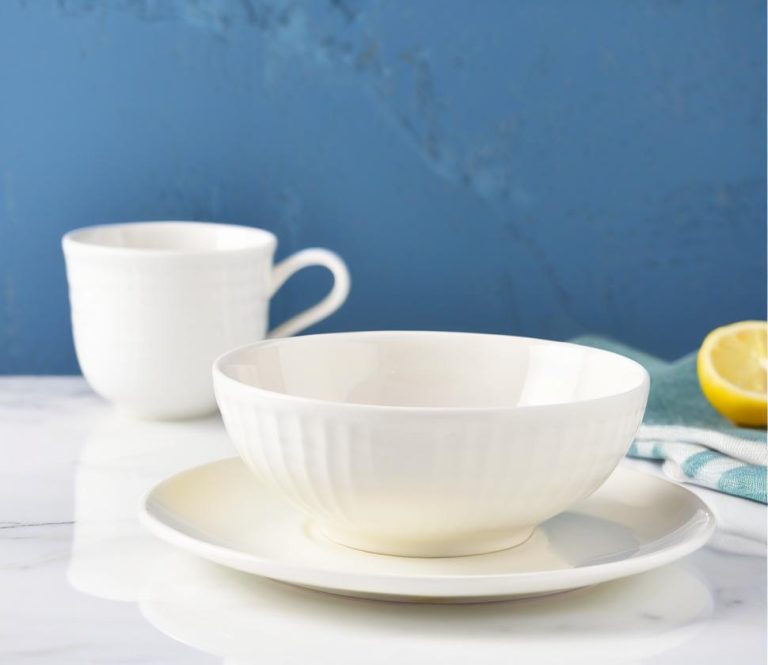
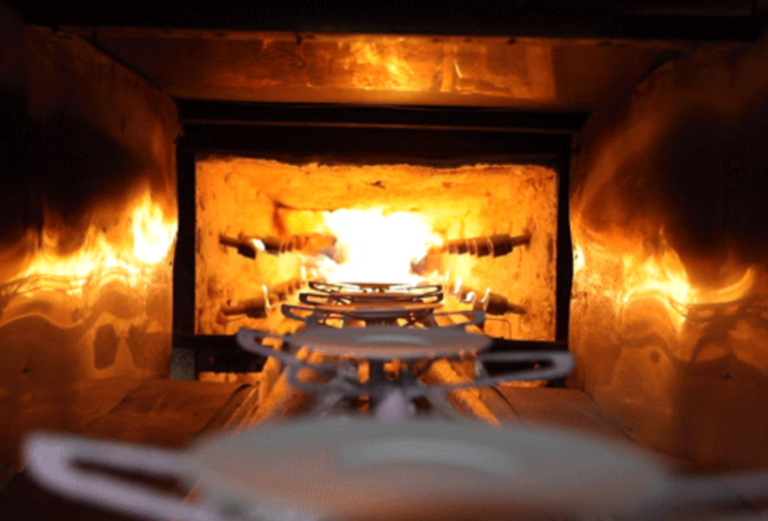
Bone china contains 30–50% bone ash (typically calcined cattle bone), which produces its defining characteristics: ivory-white tone, high translucency when held to light, and an exceptionally thin wall profile at a given strength level. The material fires at approximately 1,260°C and requires tighter kiln control than standard porcelain.
Ideal for: Fine dining restaurants, private dining rooms, executive lounge service, high-end afternoon tea, presidential suite in-room dining.
Trade-off: Higher unit cost (typically 80–150% premium over vitrified porcelain), lower chip resistance than vitrified ceramics. Bone china should not be placed in outlets with high-speed plate clearing, stacked storage over 12 plates high, or bussers with limited tableware handling training.
Vitrification status: True bone china is vitrified—meaning essentially zero water absorption—which makes it food-safe and dishwasher-stable.
Vitrified Porcelain (Hotel-Grade)
Vitrified porcelain is fired at temperatures above 1,250°C until the clay body becomes glass-like (water absorption below 0.5%). This produces a piece that is substantially more chip- and scratch-resistant than standard earthenware or even some bone china grades, while maintaining the bright white appearance expected in hotel service.
Ideal for: All-day dining restaurants, buffet service, banqueting, pool bar and casual outlets, room service.
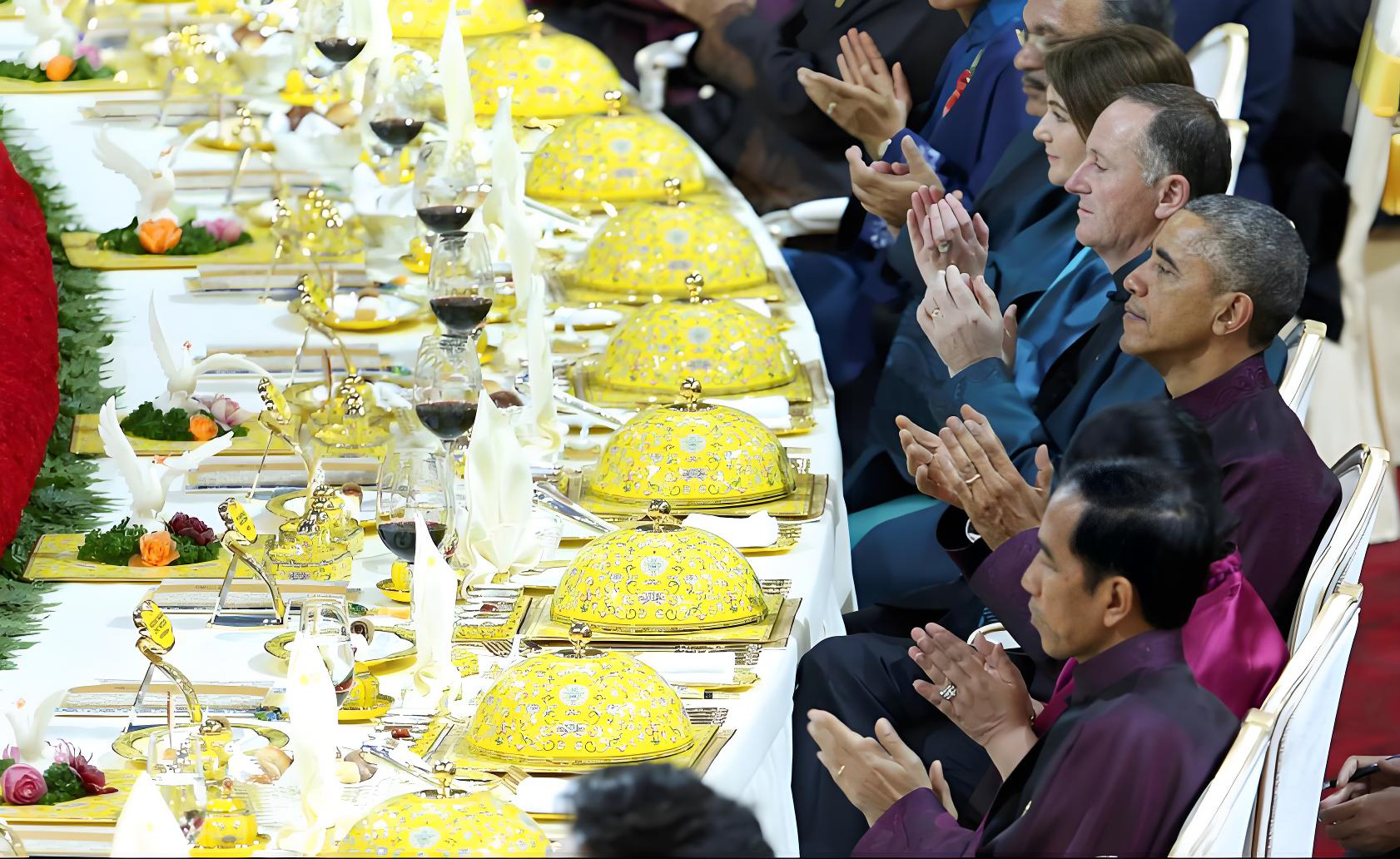
GC Porcelain specification note: Our hotel-grade vitrified porcelain achieves water absorption below 0.1% and passes a 250g steel ball drop test from 40cm height—the internal standard we set based on APEC Summit tableware requirements.
Trade-off: Heavier than bone china at equivalent size; slightly less translucent. Neither trade-off is meaningful in most hotel service contexts.
New Bone China (Bone Ash-Free)
New bone china uses alternative whitening agents (typically dolomite and alumina) to replicate bone china’s appearance without animal-derived raw materials. The result is visually similar to traditional bone china—bright white, thin walls, high translucency—but at a lower production cost.
Ideal for: Hotels with sustainability commitments or vegan/plant-based brand positioning; premium outlets where bone china appearance is required but provenance matters to the guest narrative.
Trade-off: Slightly lower translucency than genuine bone china; sustainability credentials require supplier documentation to validate.
Material Selection Summary
|
Material |
Whiteness |
Translucency |
Chip Resistance |
Cost Index |
Best Outlets |
|---|---|---|---|---|---|
|
Bone china |
Ivory |
High |
Medium |
180–250 |
Fine dining, executive lounge |
|
Vitrified porcelain |
Bright white |
Low |
High |
100 |
ADR, banqueting, casual |
|
New bone china |
Bright white |
Medium |
Medium-High |
130–160 |
Premium casual, sustainable brands |
|
Warm white/grey |
None |
High |
80–100 |
Casual, F&B social spaces |
Cost index: vitrified porcelain = 100
Durability Standards for Commercial Hotel Use
Dishwasher Cycle Performance
Commercial hotel dishwashers operate at 65–85°C wash temperature, with detergents significantly more aggressive than domestic formulations. Hotel tableware must withstand 1,000+ cycles without:
- Glaze crazing (network of fine surface cracks)
- Gold or platinum banding dissolution
- Logo print fading
- Color drift on custom-glazed pieces
Ask any manufacturer for documented dishwasher cycle test data. Acceptable documentation: a third-party test report (SGS, Intertek) showing glaze appearance and gold retention after a specified cycle count. A verbal assurance of “dishwasher safe” is not sufficient for commercial hotel procurement.
Under-glaze decoration (decals fired beneath the glaze layer) survives commercial washing significantly better than on-glaze decoration. For logo-printed tableware in high-turnover hotel outlets, specify under-glaze printing in your brief—it adds 15–20% to decoration cost but reduces logo fade incidents substantially.
Chip and Impact Resistance
The EN 12875-1 standard governs mechanical and thermal shock resistance for ceramic tableware. Request EN 12875-1 test documentation from any supplier submitting a quote for hotel-volume orders. Minimum passing threshold: the piece survives the specified drop-ball test without cracking or chipping.
GC Porcelain hotel-grade vitrified porcelain is tested against an internal standard of 250g steel ball drop from 40cm—equivalent to a plate being knocked off a table edge during service. This exceeds the EN 12875-1 specification.
Thermal Shock Resistance
Room service and buffet applications expose tableware to sudden temperature changes: a plate moved from a 200°C food pass to a cold marble buffet surface, or a cup removed from a commercial dishwasher and immediately filled with boiling water. Thermal shock resistance requires a ceramic body with low thermal expansion and a glaze formulated to match.
Specify thermal shock testing in your procurement requirements: a 150°C delta temperature (piece at 150°C immersed in cold water) without cracking is the standard commercial threshold.
Custom Branding Options
Hotel tableware customization ranges from a single logo print to a fully proprietary shape designed for your property’s F&B concept. The right level depends on your brand strategy and budget.
Logo Printing (Most Common)
A property logo printed on the rim, well, or back-stamp of a standard shape is the most cost-effective customization and the most common choice for hotel tableware. Under-glaze decal printing at 500-piece MOQ is the standard specification.
Brand consistency note: For multi-property hotel groups, standardize on a single manufacturer and shape family across properties. Mixing suppliers produces visible inconsistency in piece thickness, rim profiles, and white tone that guests notice at branded brand touchpoints.
Custom Color Glaze
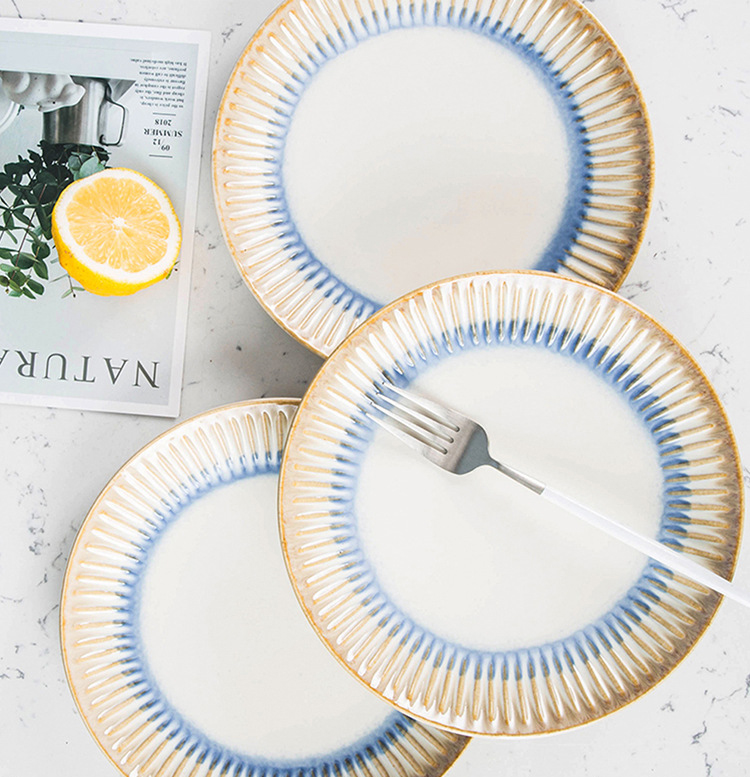
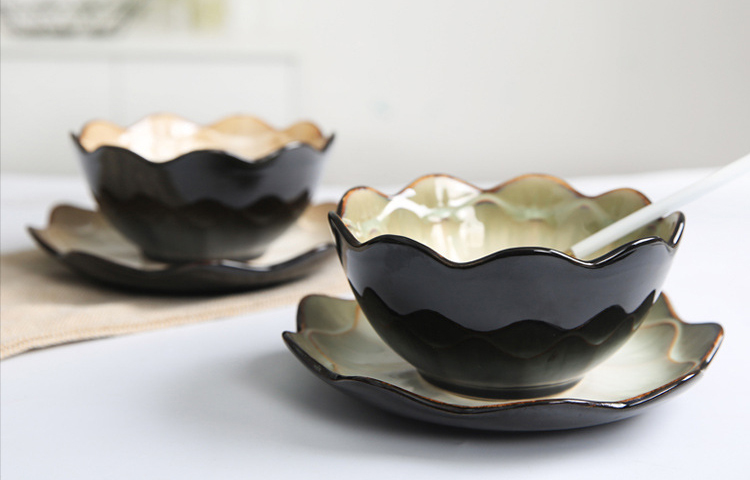
A signature glaze color creates a stronger visual brand identity than logo printing alone. Custom glaze colors require a MOQ of 500–1,000 pieces per color per item and a 30–45 day development cycle for glaze matching. Provide a Pantone reference or physical color swatch—factory color matching is calibrated to this reference, and glaze color in final fired pieces can shift from the wet glaze by 5–10%.
Proprietary Shape Development
For flagship properties, all-suite residences, or hotel brands making tableware a core guest experience differentiator, commissioning a proprietary shape adds lasting brand distinctiveness that no competitor can replicate by switching suppliers.
Proprietary shape development for a hotel requires:
- 3D CAD files or detailed hand sketches with dimensional annotations
- A design brief covering handle ergonomics (for cups and pitchers), stacking requirements, dishwasher rack compatibility, and service style (American service, French service, etc.)
- A budget allocation for mold tooling ($300–$2,000 per shape)
- A 6–8 week development cycle for first samples
The investment pays back when the shape becomes associated with the brand—as visible in the guest photograph as the room or lobby.
Embossed/Relief Patterns
Surface embossing—a repeating pattern pressed into the clay body rather than printed on the glaze—creates texture and visual interest that is fully durable (it cannot wear off). Common applications: rim patterns, back-stamp text, subtle geometric motifs. Embossing requires custom tooling and a 1,000-piece MOQ.
Specifying Your Hotel Tableware Order
A complete specification document submitted to manufacturers prevents the back-and-forth that extends lead times. Structure your brief around these sections:
1. Outlet Context
- Outlet type and service style (fine dining / ADR / banqueting / room service / bar)
- Cover count and daily covers
- Service style (plated / buffet / family-style)
- Existing tableware brand context or inspiration references
2. Product List
For each item: category (plate / bowl / cup / serving piece), size in centimeters, purpose (starter / main / dessert / side), and anticipated quantity per cover.
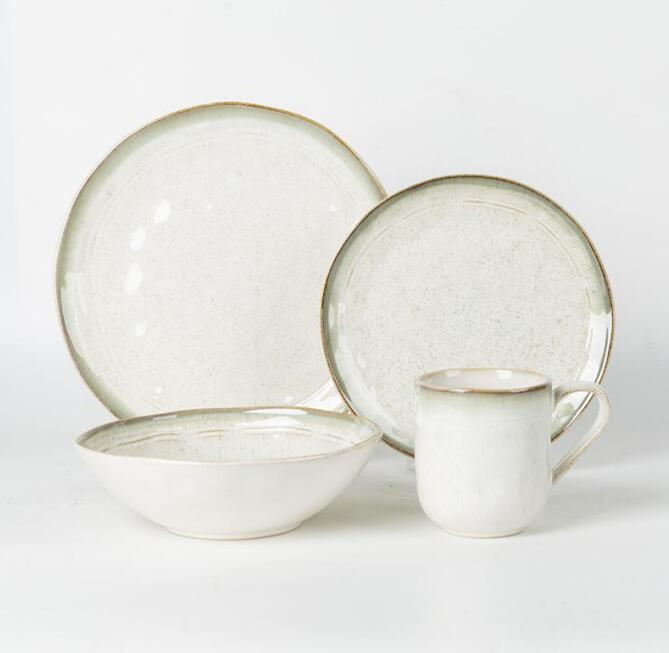
A standard hotel F&B tableware set requires approximately:
- 3–4 plates per guest cover (starter, main, bread, side)
- 2–3 bowls (soup, dessert, mise en place)
- 2 cups (coffee, tea)
- Serving and supplementary pieces at 10–15% of cover count
For a 150-cover restaurant, a typical opening order is 600–750 plates, 300–450 bowls, and 300 cups plus serving pieces—totaling 1,500–2,500 pieces for that outlet.
3. Material and Durability Requirements
Specify: clay body, dishwasher cycle test threshold, thermal shock requirement, EN 12875-1 compliance.
4. Branding Specification
Logo file (vector AI or PDF), placement (rim, well, or back-stamp), Pantone color references, and decoration technique (under-glaze / on-glaze / embossed).
5. Commercial Terms
Required certifications (FDA / LFGB), delivery port, packaging requirements, and delivery date.
MOQ, Lead Time & Pricing for Hotels
MOQ Reality for Hotel Orders
Hotel opening orders almost always exceed minimum order quantities. A 150-cover restaurant opening requires 1,500–2,500 pieces for that outlet alone; a full-service hotel with multiple F&B venues typically orders 30,000–150,000 pieces across all outlets and categories.
At this volume, buyers have real negotiating leverage: tooling fee waivers, extended payment terms, dedicated production scheduling, and pricing well below catalog rates are all achievable.
Lead Time Planning for Hotel Openings
|
Phase |
Duration |
Notes | |||
|---|---|---|---|---|---|
|
Design and brief finalization |
2–4 weeks |
Often the longest phase due to internal sign-off | |||
|
Sample development |
4–6 weeks |
New shape: 6–8 weeks | |||
|
Sample approval |
1–3 weeks |
Best case: 1 week with pre-authorized approval matrix | |||
|
Bulk production |
4–8 weeks |
Depends on total volume | |||
|
QC and export packing |
1–2 weeks |
Third-party inspection recommended | |||
|
Ocean freight |
3–5 weeks |
US/EU destination | |||
|
Total (logo print on existing shape) |
15–24 weeks | ||||
|
Total (custom shape) |
20–30 weeks |
For a hotel opening, work backward from the soft-opening date and add 4 weeks buffer. A property opening in Q4 should have tableware specifications finalized by Q2.
Pricing Benchmark
|
Category |
Vitrified Porcelain |
Bone China |
New Bone China | ||
|---|---|---|---|---|---|
|
Dinner plate (28cm) |
$4–9 |
$8–18 |
$6–13 | ||
|
Soup bowl (350ml) |
$3–7 |
$7–15 |
$5–11 | ||
|
Coffee cup + saucer |
$5–11 |
$10–22 |
$7–16 | ||
|
Serving platter (40cm) |
$8–18 |
$16–35 |
$12–25 |
Prices reflect FOB Nanjing/Chaozhou, custom logo print included, 5,000-piece order. Lower end of range = standard decoration; upper end = premium decoration + custom packaging.
Sourcing from China: What Hotel Procurement Managers Need to Know
Direct Factory vs Distributor
For hotel-volume orders (5,000+ pieces), direct factory purchasing is almost always preferable to buying through a local distributor or importer. The margin a distribution channel adds (typically 30–50% above factory price) is real cost that could fund better tableware, custom development, or larger opening inventory.
The practical challenge for hotel procurement is supplier qualification—verifying that a factory meets your standards without visiting China. This is where certification documentation, video factory tours, and reference checks from other hotel groups become your qualification process.
What to Verify Before Placing a Hotel Tableware Order
For hotel-volume orders, verify these five items as a minimum:
- Business License and export registration — confirmed via China’s gsxt.gov.cn database
- FDA and/or LFGB test report — original document with verifiable report number, less than 2 years old
- EN 12875-1 compliance documentation — or equivalent chip/thermal shock test data
- Wash cycle durability data — test report showing glaze and decoration performance after 1,000+ commercial dishwasher cycles
- Reference contact at a comparable hotel property — a previous hotel client at a similar tier willing to speak about their experience
GC Porcelain has supplied tableware for hospitality properties across 100+ countries and can provide reference contacts at comparable hotel tiers upon request. Visit our custom dinnerware page to begin a conversation about your property’s requirements.

FAQ
What is the best material for five-star hotel tableware?
For fine dining restaurants in a five-star property, bone china is the standard material—it delivers the ivory tone, thinness, and translucency that communicates luxury service. For all-day dining, banqueting, and high-turnover outlets within the same property, vitrified porcelain is more practical: it has higher chip resistance and lower replacement cost while maintaining the bright white appearance expected at five-star standard. Most five-star hotels use both: bone china for signature restaurants, vitrified porcelain for other outlets.
How much does custom hotel tableware cost?
Custom hotel tableware pricing depends heavily on material, quantity, and customization level. As a benchmark: vitrified porcelain dinner plates with custom logo printing at 5,000-piece volume are typically $4–9 per plate FOB China. Bone china at equivalent specification runs $8–18. For a 150-cover restaurant, a full tableware opening order (plates, bowls, cups, serving pieces) typically costs $15,000–60,000 depending on material choices and quantity buffer. These prices are for direct factory procurement; distribution channel prices will be significantly higher.
How long does it take to source custom tableware for a hotel opening?
Plan a minimum 6-month runway from brief to delivery on property. For custom logo printing on existing shapes, the minimum realistic timeline is 15–24 weeks including sample development, approval, production, and ocean freight. For properties requiring custom shape development, allow 20–30 weeks minimum. The most common mistake is beginning the tableware specification process 3–4 months before opening—this forces either rushed decisions or compressed sample approval cycles that produce quality issues.
What certifications should hotel tableware suppliers hold?
For tableware used in hotels serving international guests, the supplier should hold: FDA 21 CFR (US market leaching limits), LFGB (EU/German food safety standard), and ISO 9001 (quality management). ISO 6486-1 (international ceramic tableware safety standard) provides additional documentation of systematic compliance testing rather than one-time certification. For hotel groups with CSR or audit requirements, BSCI or SA8000 social compliance certifications may also be required.
How many pieces of tableware does a hotel restaurant need?
The standard formula for a hotel restaurant is 3–4 times the cover count for plates, 2–3 times for bowls and cups. A 150-cover restaurant needs approximately 450–600 dinner plates, 300–450 bowls, and 300 cups to run service with adequate backup for dishwasher cycle time and breakage. For opening orders, add a 20–30% buffer for breakage and attrition in the first year of operation. Banqueting facilities typically hold additional tableware equivalent to the largest function capacity multiplied by 1.5.
Custom Solutions Available
Our technical experts are always ready to assist you in finding the perfect customized solution for your dinnerware needs.